
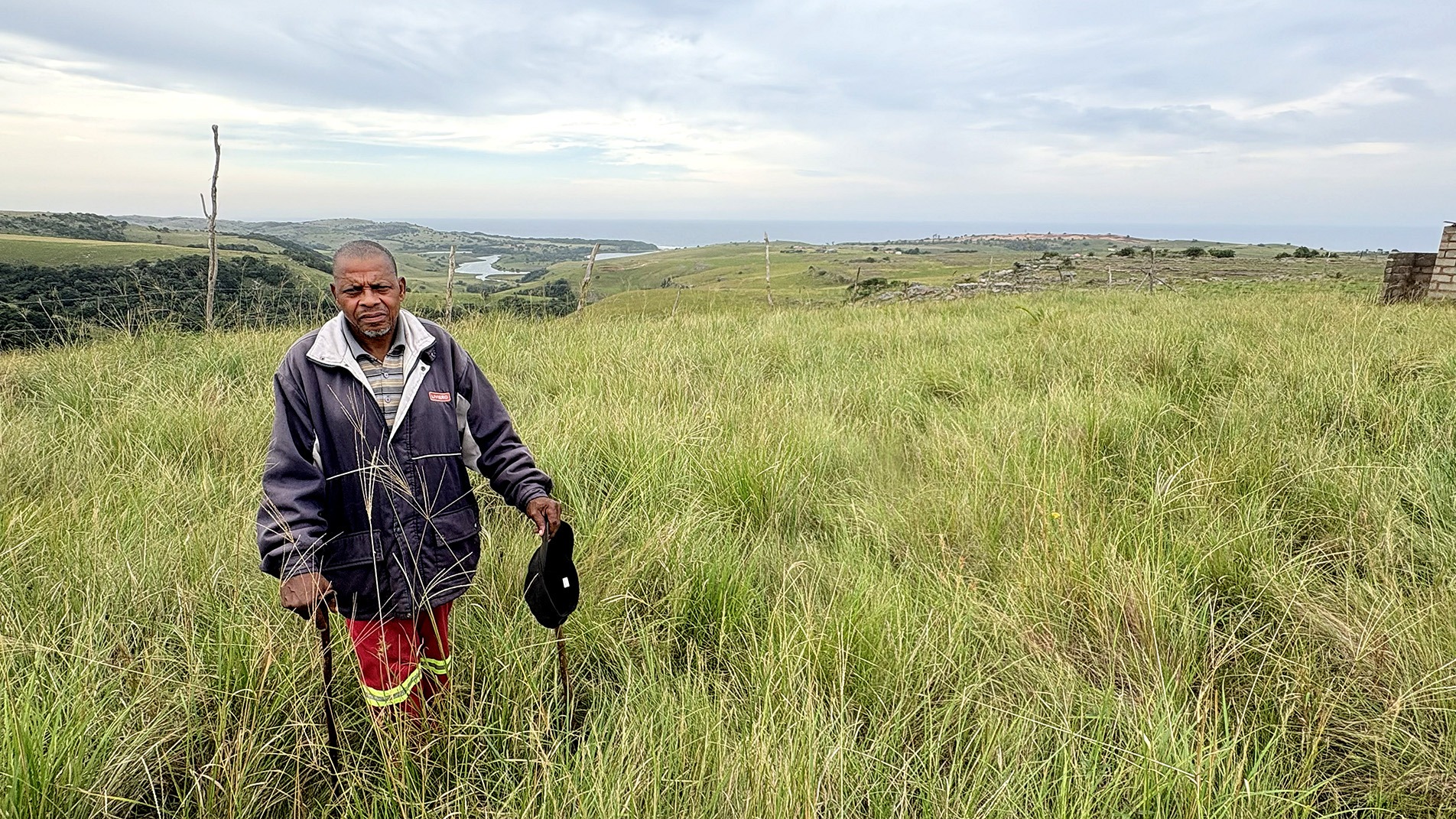
 The Sikhombe River mouth, just 4km north of South Africa’s newly minted Ramsar wetland at Mkhambathi Nature Reserve, would be irreversibly damaged if the community hadn’t stopped titanium mining in the dunes here. Retiree Valumsindo Fana is hopeful that the community’s traditional council will stand strong against unwanted extractive development. (Photo: Leonie Joubert)
 Nalo Danca was so engrossed in working his fishing line at the Strandloper River mouth on the Wild Coast one November day last year that it took him a while to clock that the person locking him in a choke-hold from behind might be law enforcement.
He’d say that he was fishing in his backyard, just as the amaMpondo have been doing for longer than recorded history. He’d also say that customary fishermen like him don’t need a permit to cast their lines here, and that he was doing so in a designated fishing spot.
The ranger who had him in the choke-hold would say that he was poaching in a nature reserve, finish and klaar.
Danca is from Nyavini village, just across the Mtentu River that marks the northern boundary between communal amaMpondo land on the Wild Coast and the Mkhambathi Nature Reserve. He’s not the first fisher from here to find himself in hot water.
/file/attachments/orphans/2IMG_8970copy2_196314.jpg "Last November, Nalo Danca set out with friends to catch a few fish in the Mkhambathi Nature<br>Reserve. His reading of the law is that he may do so without a permit. Law enforcement disagreed<br>and arrested him. (Photo: Leonie Joubert)")
Reserve. His reading of the law is that he may do so without a permit. Law enforcement disagreed
and arrested him. (Photo: Leonie Joubert)
But his case comes just as the reserve is declared a Ramsar wetland. Last week on Wednesday, 15 April, government officials jetted into this remote piece of the Wild Coast where they joined local leaders and communities to celebrate the declaration of South Africa’s 31st Unesco-recognised wetland of international importance, the first for the Eastern Cape.
Officials spoke with one voice of Pondoland’s untapped potential. They spoke of how the Unesco world heritage accreditation would boost tourism and stoke the local economy. They called for private investment in the infrastructure needed to support development.
What was missing from the celebrations was recognition that for the amaMpondo, development means the preservation of their heritage, and their role in keeping this stretch of coastline as relatively untouched as it is. They say they are the original conservation managers, whose relationship with the coastal habitat is what has made Mkhambathi a reserve worthy of international recognition, and kept the entire Pondoland coastline the biodiversity haven that it is.
They’ve been tending to its sour veld grasslands, coastal forests and fish-rich estuaries since before the Pondoland marine protected area (MPA) was declared in 2004, the Mkhambathi Nature Reserve established in 1977, or South Africa was even a country.
The amaMpondo want development, but in a way that allows their customs to continue. They want inclusive law-making and governance that allows them to continue to be the custodians of the land.
New N2: road to riches or ruin
for untouched Wild Coast?
/file/attachments/orphans/32024-07-21122510_273586.jpg "Centenarian Nozilayi Gwalagwala’s family survived the Pondoland Revolt of 1960. The younger<br>generation is bringing the same spirit of resistance to efforts to bring mining and other extractive<br>developments to their ancestral lands. For many amaMpondo, preservation of their heritage is<br>development, and on their own terms. (Photo: Leonie Joubert)")
generation is bringing the same spirit of resistance to efforts to bring mining and other extractive
developments to their ancestral lands. For many amaMpondo, preservation of their heritage is
development, and on their own terms. (Photo: Leonie Joubert)
It’s 66 years since it happened, but Nozilayi Gwalagwala still remembers clearly how the helicopters hovered above the grass next to her family’s rondavels, the pah-pah-pah-pah-pah of the blades, how she gripped her infant son — not 24 hours old, not yet named — how the police threw her husband into a military truck and sped away.
It was just before Christmas in 1960, six months after the Ngquza Hill massacre, where police killed 11 men and shot countless others in what was the climax of the Pondoland Revolt. Of the many arrested that day, 30 were executed by hanging in Pretoria.
The government had declared a state of emergency, and police were back to round up the last of the troublemakers who were boycotting tax impositions and resisting puppet chiefs. Gwalagwala’s husband was among them.
After that, Gwalagwala named her son Gunyazile, because he was born during a time when the “authorities forced the people”.
This year, she turns 100. Her larder brims with home-grown maize drying on the cob, green beans and a few bushels of cannabis, a staple in these parts. Her generation is recognised by heritage authorities for holding the line against the apartheid state back then. Subsequent generations say they’re bringing the same spirit to protecting their ancestral lands today, by keeping extractive mining and similar industrial developments at bay and preserving the kind of relationship with the environment that Gwalagwala’s generation handed to them.
The centenarian’s home looks down on to the red dunes of Xolobeni, whose titanium-rich sands kicked off a two-decade-long battle first to keep Australian company Mineral Commodities Ltd (MRC) out, then to stop marine prospecting by oil giant Shell, and to push back against Sanral’s proposed N2 highway development that locals fear will upend their culture and economy.
Xolobeni’s dunes and its untouched Sikhombe River mouth — a stone’s throw from the Mkhambathi reserve — would already be irreversibly changed without the amaMpondo’s determination to favour light-touch tourism as the economic driver, rather than the irreparable damage caused by mining.
/file/attachments/orphans/4P7190183_435688.jpg "The late Sikhosiphi Bazooka Radebe , whose 2016 murder is suspected to be connected to his<br>activism as an environmental defender, warned that the N2 highway development is a Trojan horse<br>that will bring industrial development to this relatively untouched part of the Wild Coast. (Photo: Leonie Joubert)")
activism as an environmental defender, warned that the N2 highway development is a Trojan horse
that will bring industrial development to this relatively untouched part of the Wild Coast. (Photo: Leonie Joubert)
All the dignitaries at the Ramsar wetland launch spoke of Pondoland’s untapped potential. They called for private sector investment to support this. But the contested development agendas were writ large, with questions remaining about what kind of investors will get the nod and whose development agenda the toll road will serve.
“Inclusive economic growth and job creation can go hand-in-hand with conserving biodiversity,” said DFFE deputy minister Narend Singh. “In recognition of the importance of Mkhambathi, (DFFE has) committed R17-million toward improvements to infrastructure and visitor access in the reserve.”
But Singh was frank that the DFFE can only prevent disruptive development from happening inside the reserve.
The N2 toll road will upgrade the existing highway between East London and Mthatha, along with the R61 that runs from Mthatha to Port St Johns and to Lusikisiki. From here, a stretch of new highway nearly 100km long will cut directly through Pondoland’s communal lands, to Port Edward.
The amaMpondo fear that the easy access of the highway will bring more people, city dwellers that will disrupt local customs, bring crime and brothels. With the highway comes the filling stations, the KFCs, the small supermarkets, and the bigger supermarkets.
“We cannot stop development,” Singh said in response to these concerns. “As long as it doesn’t impact on this protected area.”
Outside of the reserve, all bets are off.
“We appreciate the employment,” said Lwandile Gcume, representing acting amaMpondo king Daluxolo Sigcau at the event. “But we seek equity. We are the owners of the land, therefore we must be treated as such.”
He pointed to Norway, which he said had a strong economy because of draws on its marine economy and gas resources.
“Why can’t it be the same for us?”
/file/attachments/orphans/5IMG_8995copy_565195.jpg "Nkosi Sonjica has a permit to catch fish here as his lineage has for generations. He also ferries<br>tourists across the Mtentu River mouth, between the Mkhambathi Nature Reserve and the<br>communal amaMpondo lands north of the reserve. (Photo: Leonie Joubert)")
tourists across the Mtentu River mouth, between the Mkhambathi Nature Reserve and the
communal amaMpondo lands north of the reserve. (Photo: Leonie Joubert)
Ten years ago, long before the DFFE began applying for Mkhambathi’s Ramsar accreditation, a local environmental defender warned that the N2 highway was a Trojan horse for damaging extractive industries.
“It satisfies the needs for mining, and because we have rejected the mining, we definitely do not want it now,” said Sikhosiphi Bazooka Radebe, who at the time was the chair of the Amadiba Crisis Committee (ACC). Radebe was later gunned down outside his home in what many believe was an assassination linked to his role in pushing back against the titanium prospectors. His murder wasn’t fully investigated, his killers have not been identified and locals say that the N2 highway development continues to fuel internal community divisions.
The toll road may be a fait accompli, but the fate of the amaMpondo culture and ancestral lands are not, according to some die-hards.
“We still have hope,” said Valumsindo Fana, a retired migrant miner. “We have our traditional council. If that gets strengthened and works, if the council listens to the voices of the people, we might manage what (development) comes.”
Youngsters who want to grow tourism here fear the development trajectory already favours influential and wealthy tourism investors over smaller and less influential operations, referring to the ultra-elite lodge in Mkhambathi Nature Reserve.
/file/attachments/orphans/6IMG_9487copy_303648.jpg "Multi-day hiking trails are popular among tourists. Local guides accompany them, and trailers<br>sleep over in village homestays. (Photo: Leonie Joubert)")
sleep over in village homestays. (Photo: Leonie Joubert)
Out of bounds
Meanwhile, fishers like Danca, with little political, economic or social power, are disproportionately punished for their conduct here, argues Sinegugu Zukulu, director of the civil society group Sustaining the Wild Coast. Zukulu and fellow activist with the ACC Nonhle Mbuthuma, jointly received the prestigious Goldman Environmental Prize in 2024 for their efforts to stop Shell’s offshore prospecting.
Whether Danca was breaking the law or not when the rangers nabbed him depends on which of two pieces of marine law has the final word.
Many fishing communities and civil society organisations lobbying for their rights look to a 2018 Supreme Court ruling, which said that coastal communities engaging in customary fishing practices do not need a permit, even in the most heavily protected marine areas.
The Department of Forestry, Fisheries, and Environment (DFFE) disagrees, saying the Marine Living Resources Act (MLRA) does require them to have a permit.
But the provisions for getting such a permit show how big the gulf is between the air-conditioned offices of city bureaucrats and the realities on the ground in places like Pondoland.
The original MLRA provided for only three categories of fishers: big commercial operations, recreational fishing, and subsistence fishing. It didn’t recognise the thousands of bread-and-roses fishers like Danca: people who draw their livelihood from catching some fish for the pot, and selling some so they have cash for school fees, taxi fare, airtime and the like.
A 2014 MLRA amendment corrected this, and now includes a category for small-scale fishing. Fishers first have to apply to the minister to be recognised as falling into this category. Then, communities must set up co-operatives, which must be registered businesses, and which then receive a group permit. A fisher like Danca must join his local co-op to receive a permit.
/file/attachments/orphans/7IMG_8629copy_161881.jpg "Local farmer, agro-ecology trainer and tour guide Siyabonga Ndovela catches up with admin on<br>Signal Hill, one of the few spots within walking distance of his home next to the Mtentu River mouth,<br>where there’s phone reception. This village arguably needs phone connectivity more than it needs<br>tarred roads. (Photo: Leonie Joubert)")
Signal Hill, one of the few spots within walking distance of his home next to the Mtentu River mouth,
where there’s phone reception. This village arguably needs phone connectivity more than it needs
tarred roads. (Photo: Leonie Joubert)
For fishers who can’t get a licence in this way, some resort to the recreational fishing permit. But this doesn’t allow them to sell their catch; they’re only available through a post office, and a person must pay a fee for each permit application.
After canvassing many Pondoland fishers, it soon became clear how inaccessible this is for them.
How do off-grid, barely literate communities handle the red tape of business management when they don’t make sense of its provisions, and struggle to understand complicated forms? Many can’t go online because they don’t have a smartphone, spare cash to buy data, or even receive a few bars of phone signal because the networks are so patchy. There are very few working post offices left in this part of a province where it can take three hours to drive 100km, and there aren’t many taxis running to town.
Human rights attorney Wilmien Wicomb with the Legal Resource Centre has spent at least a decade lobbying for better realisation of small-scale and customary fishers’ rights. The key sticking point, she explains, is that while the MLRA allows for the DFFE minister to recognise the rights of such fishers, fishers don’t automatically benefit. They must first apply for recognition, which is more than just a legal technicality. In practice, it’s prohibitively inaccessible for fishers like Danca.
/file/attachments/orphans/8IMG_9334_913079.jpg "A storm blows through on the evening before the launch of Mkhambathi Nature Reserve as South<br>Africa’s newest Ramsar wetland of international importance. (Photo: Leonie Joubert)")
Africa’s newest Ramsar wetland of international importance. (Photo: Leonie Joubert)
None of this mattered in Danca’s moment of arrest, though. For him, what followed was a tussle that had the lanky 27-year-old punched in the face, pinned to the ground, and pepper-sprayed even after he’d been restrained. By Danca’s telling, even the second ranger present could see that he was swatting at his captor to defend himself, not as an attack. Danca says the second ranger tried to talk his colleague down from what appeared to be an excessive use of force.
In response to these allegations, the Eastern Cape Parks and Tourism Agency (ECPTA) said that according to the available information, Danca wasn’t assaulted.
“Minimum force, including the use of pepper spray, was applied in response to resistance during the arrest process. At this stage, there is no evidence to support claims of excessive force or misconduct by officials,” said ECPTA’s Oyanga Ngalika.
Ngalika said that permits were required for this kind of fishing in the protected area, that allocated spots were marked with signs, and that the reserve conducted “awareness and education engagements with surrounding communities to ensure understanding of access conditions and conservation requirements”.
When Danca and his friends set out with their fishing rods that morning, the plan was to catch a few fish to sell in the village for some much-needed cash.
The eight bream in his bag would have fetched about R2,000.
Instead, this catch kicked off a three-month ordeal: arrest, a month in jail, costly bail, repeated court delays, legal fees to a sometimes tardy lawyer, and, ultimately, an admission of guilt fine. The final bill: around R10,000. That’s roughly the value of a cow, a small fortune in this rural economy.
Why not let him off with a warning, asks Zukulu. Why punish individuals like him so severely, when illegal fishing vessels regularly trawl in this marine protected area? The punishment simply doesn’t match the crime, and even the question of it being a crime is up for debate, according to Zukulu and others.
Danca can’t make sense of the opaque and brutalising legal process, or its outcome. As he understood it, the R1,000 fine was an above-board way to make the whole affair go away. He didn’t realise that he was admitting guilt and that he now has a criminal record. DM