



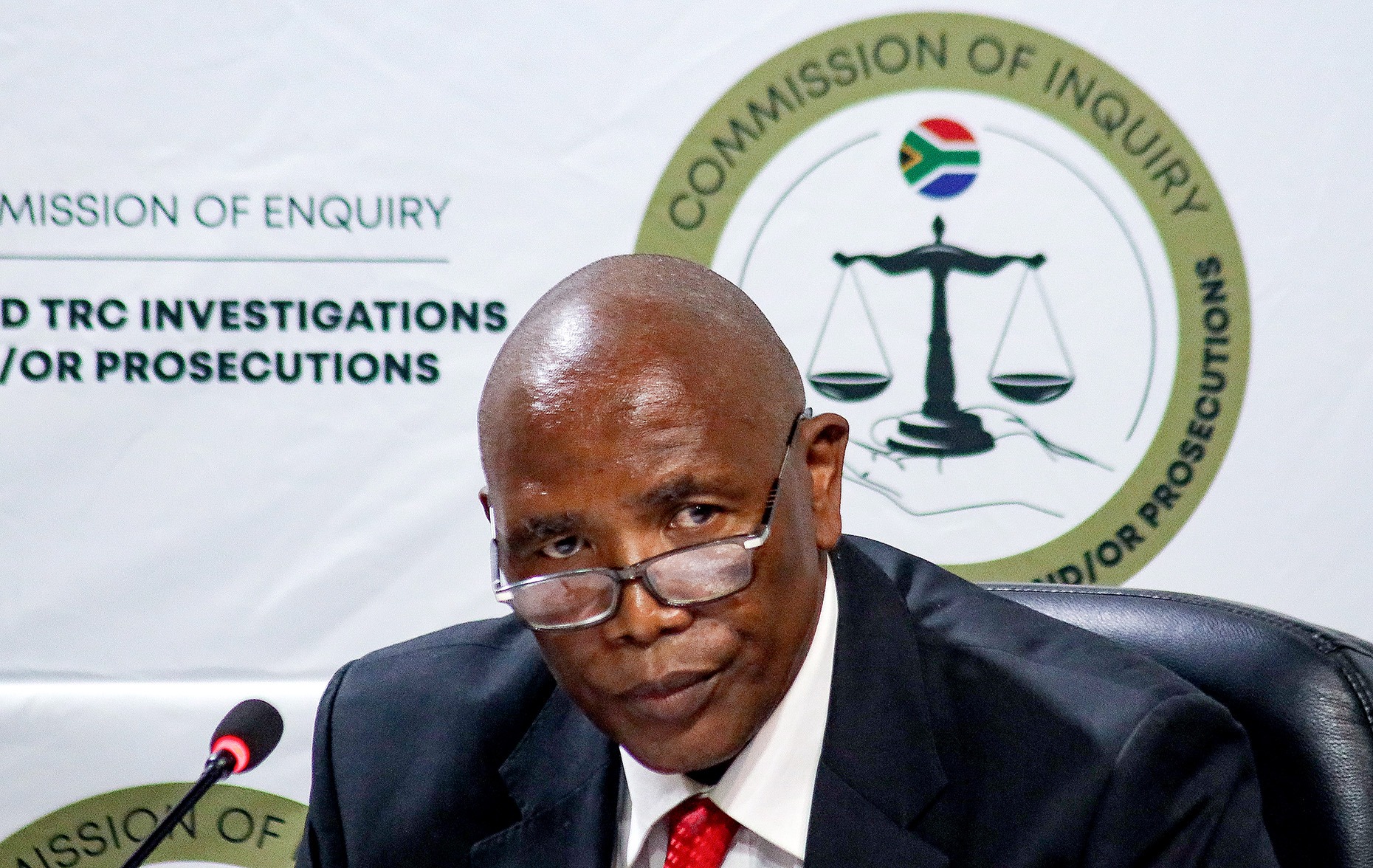
 Geophrey Ledwaba testifies before the Khampepe Commission on 22 April. (Photo: Fani Mahuntsi / Gallo Images)
Testifying at the Khampepe Commission of Inquiry in Newtown, Johannesburg, on Tuesday, Geophrey Ledwaba, the former head of operations at the Scorpions, said the “Calata Group” (families of murdered victims) had “mischaracterised” his 2003 instructions concerning TRC matters.
The families have claimed that following former president Thabo Mbeki's parliamentary speech in April 2003 calling for an Amnesty Task Team (ATT) to deal with the unfinished business of the Truth and Reconciliation Commission (TRC), individuals with “power and influence moved quickly to ensure TRC cases were shut down”.
The families specifically allege a “systematic blocking” of justice, claiming that whenever TRC prosecutors attempted to launch investigations, they were met with a wall of resistance. This obstruction supposedly took the form of a coordinated refusal by both the Directorate of Special Operations (DSO, or the Scorpions) and the South African Police Service (SAPS) to provide any investigative support.
Official NPA policy
Ledwaba was summoned to the inquiry to respond to a claim by the families that he had made a “remarkable decision” in July 2003 to halt DSO investigations into TRC matters.
He told the commission on Tuesday that this memorandum had been “incorrectly labelled” by the Calata Group as a “decision to stop the investigation of TRC cases”, while he was simply complying with official National Prosecuting Authority (NPA) policy.
This, he said, had dictated that all TRC cases that had been declared “priority crimes” be transferred from the DSO’s Special National Projects Unit to the newly formed Priority Crimes Litigation Unit (PCLU).
This unit, the commission has heard, was headed by advocate Anton Ackermann, a key witness, who has claimed that there had been behind-the-scenes political interference in TRC cases.
Mbeki’s permission
Ackermann has alleged that secret talks between the ANC government and former apartheid-era generals had derailed the search for truth, justice and accountability after the TRC hearings.
Divisional Commissioner Johannes De Beer, head of the SAPS detective service, informed Ackermann, in 2003, that the SAPS would not provide investigators for TRC cases.
De Beer had also suggested that the inaugural National Director of Public Prosecutions, advocate Bulelani Ngcuka, would approach Mbeki to obtain a final decision.
De Beer had noted that this position on prosecutions had been discussed and supported by the national police commissioner, Jackie Selebi and that SAPS leadership maintained that the investigation of these cases was “politically inspired”.
De Beer had insisted that SAPS would only investigate “upon receiving a written instruction from the President”. This had outraged Ngcuka as well as his successor, advocate Vusi Pikoli, who both viewed this as executive overreach in the independence of the NPA.
/file/attachments/orphans/ED_598502_796481.jpg "South Africa’s first NDPP, Bulelani Ngcuka. (Photo: Luba Lesolle / Gallo Images)")
The handover
On Tuesday, Ledwaba argued that Lukhanyo Calata — son of the murdered “Cradock Four” member Fort Calata — had misrepresented a memorandum in his founding affidavit. Ledwaba maintained that Calata took his 2003 instructions to investigator Andrew Leask “out of context” to support the claim that TRC investigations were being intentionally stifled.
He explained that because the PCLU had been mandated to “direct investigations and prosecutions” of priority crimes, the DSO was no longer responsible for these and his instruction to close files “was a necessary administrative step for the handover”.
Ledwaba explained that the establishment of the PCLU required a fundamental overhaul of the Special National Projects Unit’s mandate and operations.
Believing that the SAPS should take over the investigations of all TRC cases, Ledwaba instructed that existing files be closed and all materials — including those held in storage — be handed over to the PCLU. To facilitate this transition, he transferred two researchers to the unit and authorised DSO investigators to introduce witnesses to the SAPS investigators taking over the cases.
Legal quagmire
“It is also evident from my memo that I was concerned that the PCLU be assisted through a proper handover,” he told the inquiry.
“I also made it very clear to Mr Leask that this handover must assist the PCLU by ensuring that the DSO investigators who were charged with the investigation of TRC cases, introduce witnesses to the SAPS investigators who were to take over the TRC cases in their assistance with the investigation of the TRC cases.”
/file/attachments/orphans/ED_531009_689171.jpg "Andrew Leask. (Photo: Deaan Vivier / Gallo Images / Beeld)")
Ledwaba maintained that he had never halted or refused to investigate and had insisted that the PCLU follow the correct legal procedures by applying to the NDPP under section 28(1)(b) of the NPA Act.
He noted that when the PCLU eventually followed his advice and obtained such a directive from the NDPP in 2004, he had “duly complied and authorised the investigations” for the six matters requested.
Ledwaba said a meeting between him, Ackermann and his colleague advocate Chris Macadam was held in Ledwaba’s office on or about 15 July 2003.
Ackermann and Macadam had asked Ledwaba to assist the PCLU, specifically asking him to apply his legislative power as head of operations to declare these cases as “projects” under section 28(1)(a) of the NPA Act.
Ledwaba said he had informed the two prosecutors that he would not be able to assist and that the authority to initiate investigations under that specific section was outside his mandate.
He had “implored them to pursue the section 28(1)(b) avenue, which required them to approach the National Director of Public Prosecutions (NDPP) for a formal directive”.
Seniority issues
Macadam has described the meeting with Ledwaba in his submissions to the inquiry as “unpleasant” and alleged that Ledwaba had made it clear “in no uncertain terms” that the DSO would not investigate any TRC matters and that they should all be referred to the SAPS.
Ledwaba denied that the meeting had been unpleasant, stating he had simply communicated his legal position and that Macadam was unhappy that his request had been declined.
Ledwaba noted a “personal friction” in the meeting, observing that Ackermann and Macadam had been his seniors when he joined the Attorney-General’s office in 1995.
He believed their refusal to follow his advice stemmed from an unwillingness to accept guidance from someone they still regarded as a junior, despite him being their senior in 2003.
Ledwaba contended that this meeting did not represent a refusal to investigate, but rather a disagreement over the legal procedure required to authorise such investigations. DM
Comments
Scroll down to load comments...