



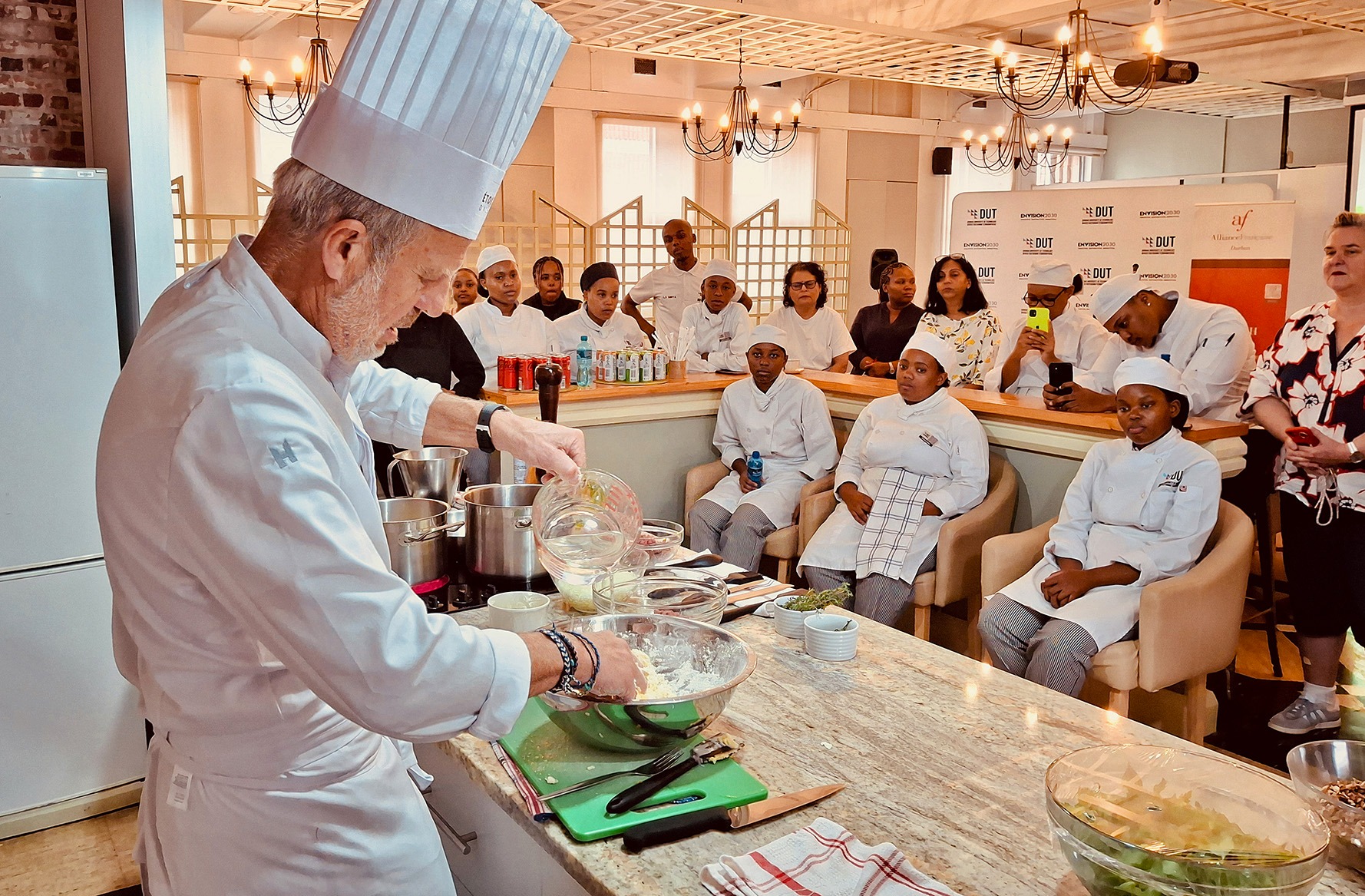
 Chef Michel Husser gives a masterclass to DUT students in Durban. (Photo: Wanda Hennig)
Michel Husser has a superpower. Cooking.
Sarah M’bodji has a superpower. Durban cooking.
Put the pair of them in a pot with a group of ripe-to-learn culinary students.
The resulting dégustation was an inspired collaborative masterclass presented by acclaimed Michelin-star chef Husser, whose family restaurant Le Cerf, in the Alsace region of France, has been the recipient of at least one Michelin star (two for more than 20 years) for an unbroken 90 years.
That “90 years” stopped me mid-sentence and led me on a detour into the history of the iconic Michelin dining guide. I had probably read, but forgotten, that Michelin tyres were behind the name. (I’ve never forgotten feeling like a clunky Michelin Man in stultifying layer upon layer of borrowed winter warmies when in Quebec for their winter carnival one year, but that’s another story.)
The Michelin tale started with the two brothers who founded the tyre company in a French village back in 1889. To help motorists (relatively few at the time) “develop” their trips and in turn, to boost car and tyre sales, they came up with the idea of a small red guide with maps and handy information. Like how to change a tyre and where to fill up or have an R&R stop along the way.
In 1920 the guide became more upscale. Lists of Paris hotels and categories of restaurants were added. And the brothers recruited mystery diners (the restaurant inspectors of today) to visit and review eateries anonymously.
In 1926 the guide began awarding stars to fine-dining establishments.
And just 10 years later, 1936, was when Husser’s family restaurant was first recognised by Michelin. Their star-studded story continues.
/file/attachments/orphans/ChefHusserprepsthefleischschnackawithFoodandNutritionstudentsAmandaNgcamuandNthabelengNxumalo_279338.jpeg "Leading by example, Chef Husser preps the fleischschnacka with Food and Nutrition students Amanda Ngcamu and Nthabeleng Nxumalo. (Photo: Wanda Hennig)")
Husser was on a 24-hour flying visit to Durban. His intention: to share, hands-on, inspiration, ideas and how-to from his 40 years of gastronomic expertise, with a specific focus on the Alsace region located in north-eastern France. Le Cerf, the family restaurant, is at the start of Les Routes Des Vins, the Alsace wine route, which runs 100km from north to south.
He was travelling with Isabelle Baumann-Lenot, who lives between the Alsace and Montreal, Canada. Her avocation is keeping the connection going between 67 Alsace associations around the world.
“Alsace guys really like to promote Alsace wherever they are,” she explains.
“When you have two, three, four Alsatian guys in Asia, India, anywhere, they like to get together to eat, have a glass of beer — it is a very rich region of France in terms of gastronomy and culture — and we encourage them to set up an association.” There are versions of the Friends of Alsace group in Cape Town.
/file/attachments/orphans/ChefMichelHusserinthedemokitchenwithDUTsProfAshikaNaickerandAllianceDurbansSarahMbodji_627693.jpeg "Chef Michel Husser in the demo kitchen with DUT’s Professor Ashika Naicker, left, and Durban's Alliance Française's Sarah M’bodji. (Photo: Wanda Hennig)")
Husser was born in Alsace. Literally in the family restaurant, he tells us as he runs through a series of slides and shares stories between coffee and snacks — biltong, cheese, almonds — which Professor Ashika Naicker, head of DUT’s Department Food and Nutrition, has set up in welcome at the Rendezvous restaurant, the campus venue adjoining one of the student food-prep kitchens.
Husser followed in the footsteps of his father and his grandfather. He formally trained at the Strasbourg (capital of Alsace) School of Hotel and Culinary Arts. He honed his craft in the kitchens of top eateries alongside acclaimed chefs. Then took over the family establishment.
“The only thing I know is cooking. Cooking is all I can do,” he tells the students, looking happy about it and between apologising for his charmingly melodic accented English. “Now my son is running the restaurant so I can be here, and it is really a pleasure for me because now it is time for me to take what I have learned in my life and share it. I am motivated and I hope you will enjoy it.”
Sarah M’bodji is the director of Alliance Française de Durban which, dating back to 1936, is the oldest Alliance in SA. When she arrived in the city going on three years ago with her abundant joie de vivre to take over this legendary French language and cultural centre, it had fallen into a dip before and during Covid-19. Disappeared off the radar for many. “Is there still an Alliance?” was a oft-heard comment when things started to bubble again.
Headquartered in Paris, the “prototype” Alliance was launched there on 21 July 1883 by a group including the scientist father of “bacteriology”, Louis Pasteur, and Around the World in Eighty Days author, Jules Verne. There are currently around 829 Alliance chapters in 137 countries (online stats vary).
Thanks to M’bodji’s drive, creative vision, bonhomie and good-natured kindness, Alliance Durban is back — on steroids — making waves and creating interesting and inclusive (you don’t have to be learning French) happenings around the city.
Regular French film evenings (subtitled, natch), including at Humble Café and St Clements restaurant; jazz evenings and poetry evenings at Hue Café, The Chairman, UKZN Centre of Jazz and elsewhere; women-in-business entrepreneurship collaborations, and lots more.
These on top of their acclaimed French language classes, French being an official language in 26 countries and one of the most geographically widespread languages in the world. Alliance works collaboratively with the language schools at UKZN and DUT and also offers classes in Portuguese and isiZulu.
After shuttering their longtime Morningside “headquarters”, which had been on the market for ages, M’bodji took the Alliance Française de Durban (at least temporarily) “nomadic” with pop-ups around the city, well publicised on social media (including their Instagram and Facebook) and on their website.
/file/attachments/orphans/Hands-onintheMasterClassChefMichelgetstheeggpastadoughreadytoroll_848881.jpeg "Hands-on in the masterclass, Chef Husser gets the egg pasta dough ready to roll. (Photo: Wanda Hennig)")
Back to the cooking master class. Chef Husser chose to showcase fleischschnacka, a speciality of the Alsace region with the Alsatian name translating as “meat snail”.
The simplicity of the dish is that it calls for leftovers for the meat-filling part, typically from pot-au-feu, a French “comfort food” dish of slowly boiled meat and vegetables.
At DUC there was no leftover pot-au-feu but the meat (minced pork neck, veal shoulder and minced beef) and veggies (chopped mushrooms and onions) were prepped and waiting in bowls in the Rendezvous demo kitchen, along with the garlic, parsley, eggs, salt and pepper and the noodle-dough ingredients (flour, eggs and salt).
The cooked meat, to which Chef Husser added water-dunked and squeezed bread “to give moisture” was spread on the fresh egg pasta. Great to see a good old-fashioned wooden rolling pin in action.
The meat-spread pasta, in turn, was rolled into tubes with cling wrap to hold them in place. Briefly, given the time-constraints, these were refrigerated, then sliced and pan-fried in butter.
/file/attachments/orphans/PreparingtheFleischschnacka_717170.jpeg "Fleischschnacka prep, rolling the egg pasta then spreading the meaty filling; bottom: slicing, then frying, the portions. (Photos: Wanda Hennig)")
“When you’re talking about French cooking, first, the basic ingredients must be very, very good. Where they are sourced, and the seasons, are very important. And you never throw anything away. We would scrub the vegetables before peeling and use the peels for bouillon or whatever…” Chef Husser said on the essential nature of French cooking.
“So good ingredients. A lot of love. Motivation. And we cook very slowly. You can’t cook French cuisine in five minutes.”
“What about the air fryer?” I ask him. “Everyone is using the air fryer.”
He looks bemused. “I don’t know this,” he says.
“I need a good pan, a good fire, and slow. So when you put (your ingredients) in the cocotte, when you’re cooking slow, the smell is better, the smell of the mix of the vegetables, the meat, everything is better. And you have to give it the time. That’s the problem. Most difficulty now with French cuisine is everybody is in a hurry. So they don’t get enough time to make real French cuisine. That’s the problem, too, in France.”
And the foundations of French cooking?
“When you’re working in a restaurant kitchen, you have to have discipline and consistency and rules are important. So, for instance, for (cutting) vegetables. If I tell you to cut the vegetables brunoise (fine dice) or julienne (matchsticks) or paysanne (thin, rustic shapes), it’s important to have good rules so you have consistency.”
/file/attachments/orphans/ChefMichelpan-friestheslicedfleischschnackaportionsinbutter_412221.jpeg "Chef Husser pan-fries the sliced fleischschnacka portions in butter. (Photo: Wanda Hennig)")
Then there are the dishes that set forth the foundational techniques.
“You learn the techniques and can use them to cook something else. Like pot-au-feu (that slow-cooked stew), like blanquette (veal, poultry, lamb, simmered in a lightly seasoned white stock).
“So, for example, boeuf bourguignon with red wine, you can revise and make it with springbok.”
Or other game meat?
“Yes, why not? Once you have the foundation, the core knowledge and ability, you can take it from there. Then, the talent of the cook makes the difference.”
While he attended cooking school, “I was trained by other chefs. I went to Alsace, Paris, the south of France… Cooking is a huge universe and I learn every day. If I learn something, I go to bed happy.”
Did you learn something today?
“Yes, I learned to do this sort of cooking with different pans.
“I am still motivated. It is very important to stay motivated. When I go to bed, I can think today was good because I learned something new.”
/file/attachments/orphans/ChefMichelpan-friesandplatesfleischschnackathestudentsservesampbeansandamaranth_930604.jpeg "Chef Husser pan fries, right, then plates, top left, the fleischschnacka; the students, in turn, served up a local specialty of samp, beans and amaranth and a slow-cooked cow’s head stew. (Photos: Wanda Hennig)")
Talking about Alsace food, Isabelle Baumann-Lenot asks me to think of France and to name any region known for its food that is not located in a famous wine region.
“All the regions in France known for their food have distinctive good wine. When there is an area with no wine, there is no real cuisine. They go together,” she says.
“Same as in Alsace, which is very much a wine area. The Rhine divides the region of Germany and Alsace, on the border. This river gives a lot of ingredients to the soil (the terroir). Even though it is the same river, the wine in Germany is not the same.
“We have an incredible diversity of wines in Alsace, which are very famous now. So we are very lucky to have the wine and the diversity of wine, and we also have the cuisine and the diversity of cuisine.”
I ask her to name three Alsace specialities.
Unsurprisingly, she tops her list with fleischschnacka.
“Then we have choucroute, which is a form of sauerkraut or fermented cabbage, made with sausages and pork and cumin and these little black juniper berries.” I read online that this is a festive dish with a strong sense of identity, embracing the Alsace philosophy of sharing, conviviality and generosity and that is made for big feasts, village celebrations and family gatherings.
The third dish she mentions is the Alsace bretzel, their version of the pretzel.
When I ask about the language, Baumann-Lenot tells me they speak Alsatian.
“I don’t speak it,” she says. “I am married with an Alsatian. It’s a German dialect, nothing French at all. It is a spoken language. You can sometimes read it, but it is really something that is transmitted from generation to generation.”
Married to an Alsatian… My mind pops to that question I’ve known women to ask themselves. What’s better? To grow old with a man or a dog? Does being Alsatian make you one and the same? Kind of reduce options – perhaps improve them?
/file/attachments/orphans/AcelebrationandagiftfromDUTstudentsattheendoftheMasterClass_209554.jpeg "A celebration and a gift from DUT students at the end of the masterclass (Photo: Wanda Hennig)")
About 10% of “creative and enthusiastic” students who graduate with a diploma or degree in food and nutrition (consumer science) at DUT become chefs, says Professor Naicker. The focus is more specifically on food research, recipe development, nutrition. Graduates mainly find work, she says, in big companies and organisations.
“We teach French culinary techniques, usually in a more applied and scientific way, rather than a pure traditional or fine dining context. So French techniques form the technical foundation of many of our dishes and we teach students core principles that translate directly into food science and product development.
“We teach French techniques that endorse consistency and precision such as mise en place (“putting in place”). We link them to food science principles and method such as an emulsification in sauces, heat-base cooking, roasting, braising, sautéing, thickening, roux-based systems. We use them to demonstrate science-based principles and techniques like protein denaturation, starch gelatinisation, fat-water interaction such as emulsification.
“And when we develop indigenous or functional food (like the samp, beans, amaranth and slow-cooked cow’s head stew the students prepped for their visitors) we draw on these classical French techniques.”
Back to that Michelin Guide. From small road-tripping beginnings, it now rates more than 40,000 establishments. Subsidiary guides have been added.
Over the years, controversy has raged. Chefs have been turned into celebrities. Chefs have returned their stars. France continues to have the most three-Michelin-star restaurants followed by Japan. South Africa has yet to feature. Not surprisingly, the Michelin Guide is now downloadable and digital.
And meanwhile, Michel Husser can share is legacy, knowing his son, Luca Husser, will continue the Le Cerf family heritage and stellar Alsace culinary story. DM
Visit Wanda Hennig’s website and follow her on Instagram.
Comments
Scroll down to load comments...