



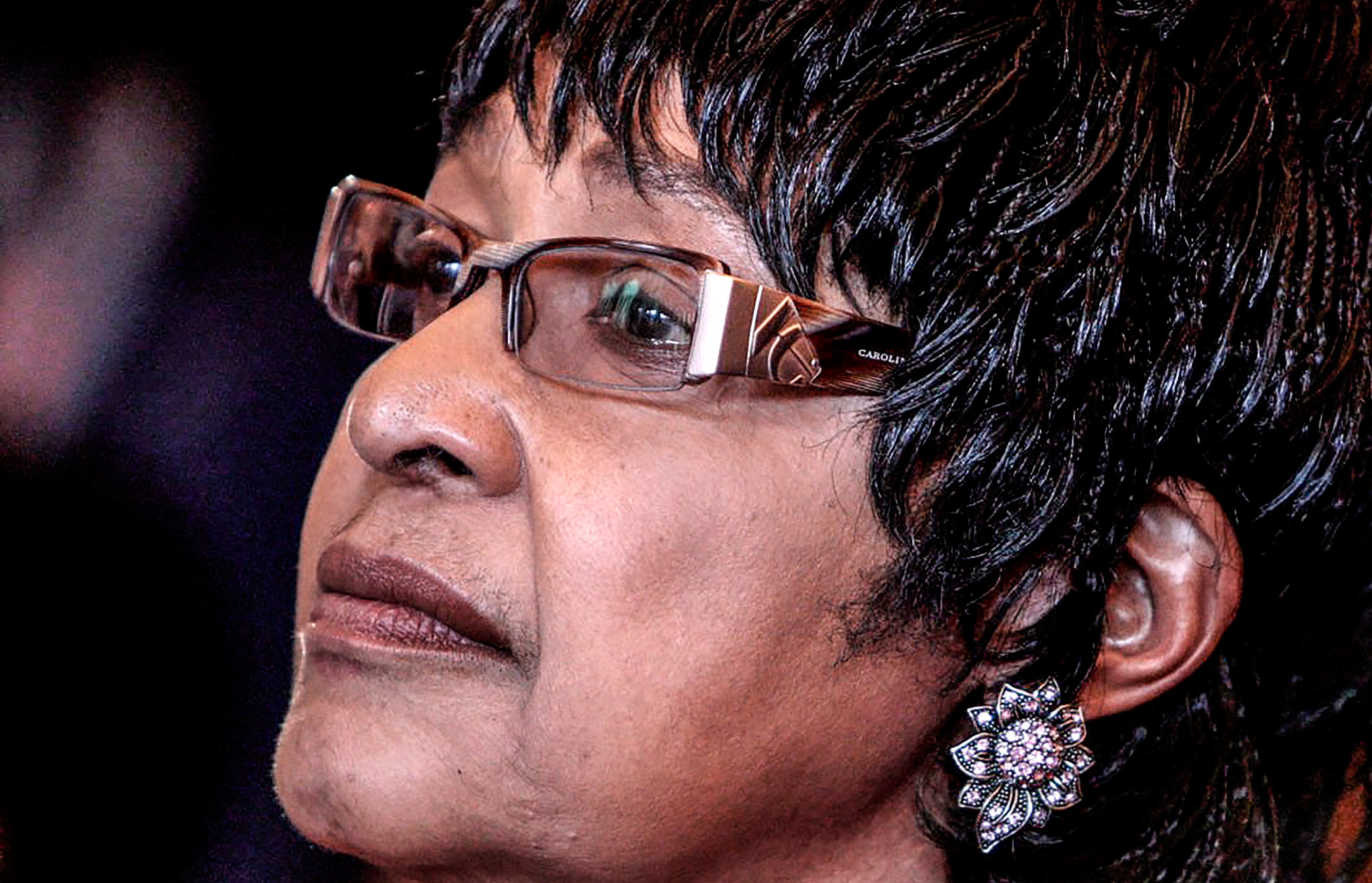
 Struggle icon and former president Nelson Mandela’s ex-wife, Winnie Madikizela-Mandela. (Photo: EPA-EFE / Jon Hrusa)
 When Princess Swati Mandela-Dlamini attended her niece’s unveiling 13 years ago, her grandmother, the late anti-apartheid activist Winnie Madikizela-Mandela, handed her the journal that Mandela-Dlamini would dedicate the next years of her life to.
“She said: ‘Darling, I’ve got this journal that’s been returned to me from when I was in solitary confinement from the late widow of my lawyer who was representing me at the time. And I’m going to give it to you and you decide what you want to do with it,” Mandela-Dlamini told Daily Maverick.
Mandela-Dlamini co-edited the journal alongside veteran journalist Sahm Venter and published it as 491 Days: Prisoner Number 1323/69.
/file/dailymaverick/wp-content/uploads/RebeccaWinnie1.jpeg "Winnie Madikizela-Mandela smiles during a celebratory event around the release of her book titled 491 Days in Johannesburg, August 8, 2013. REUTERS/Siphiwe Sibeko")
The best-selling autobiography details Madikizela-Mandela’s detention in solitary confinement, commencing with her arrest by the security police in the early hours of 12 May 1969. The autobiography caught the attention of Ivor Ichikowitz, the executive chairman of Paramount Group, who approached Mandela-Dlamini to work on an accompanying documentary.
Now, 13 years later, the seven-part documentary series, titled The Trials of Winnie Mandela, will air on Netflix on Thursday, 23 April 2026.
The docuseries was directed by the late two-time Emmy-winning documentary filmmaker Mandy Jacobson as part of the African Oral History Archive, a non-profit history initiative created by the Ichikowitz Family Foundation. In a statement written before her death, Jacobson referred to producing the documentary as “a delicate dance” between greatness and human fragility.
/file/attachments/orphans/1x11_332991.jpg "The poster for the Trials of Winnie Mandela, a seven-part docu-series produced by her granddaughters Zaziwe Dlamini-Manaway and Zamaswazi Dlamini-Mandela. (Image: Supplied / Flow communications)")
“We at the African Oral History Archive are clear that we do not produce hagiographies. We respect the value of critical examination of extraordinary leaders. In the end, I wanted this story to be as much a reflection of who we are, as it is about the life story of Winnie Madikizela-Mandela,” she wrote.
‘Very difficult parts of her story’
The team began production on the series almost immediately after the autobiography was published, combing through decades of archival footage and interviews with those who were close to the subject, including Madikizela-Mandela herself. As production began prior to her death in April 2018, she is featured in every episode.
“It was important for us to show her personal side, but also show the feminist, the icon, the politician, the activist. Because she was all those things. We want it to be all-encompassing and we want it to be holistic in the story that we told,” Mandela-Dlamini said.
The docuseries explores Madikizela-Mandela’s life as a political activist, speaking candidly about her own life.
The conversations held between her and her granddaughters touch on the good, bad and controversial, including her divorce from Struggle stalwart and former president Nelson Mandela, the infamous Mandela Football Club, and the kidnapping and murder of 14-year-old Stompie Seipei that continues to cast a dark shadow over Madikizela-Mandela’s legacy.
/file/dailymaverick/wp-content/uploads/2021/11/0000122421.jpeg "Winnie Madikizela-Mandela during an interview with the City press Newspaper at her home in Soweto. (Photo by Gallo Images/City Press/Leon Sadiki)")
Many of the conversations captured in the docuseries were held by the family for the first time in an intimate setting at their kitchen table.
“We didn't want to shy away from anything. We thought that it was important for even the audience to be able to see and go down that journey as well. So she gave us the permission to be able to go to those difficult, very difficult parts of her story,” said Mandela-Dlamini.
‘Constantly watched’ by police
For Mandela-Dlamini and her sister Zaziwe Dlamini-Manaway, producing the docu-series meant confronting the painful realities their grandmother had faced, starting with the journal that detailed her brutal assaults and threats of rape while in prison.
Going through the archival footage for the first time gave the two a stark picture of how extensively Madikizela-Mandela was surveilled by the apartheid state.
/file/attachments/orphans/GettyImages-483083385_977594.jpg "Princess Zaziwe Dlamini-Manaway (left) and Princess Swati Mandela-Dlamini. (Photo: Tibrina Hobson / Getty Images)")
“Mami was constantly surveilled by the apartheid police. They filmed her every move, 24 hours a day. So there’s a lot of archive on her, things we’d never seen as a family ourselves, because she was being recorded 24/7,” Manaway said.
Madikizela-Mandela played a notable role in the production, providing them with further guidance by telling them exactly who to interview, including the former members of the Mandela Football Club and Seipei’s family. Also included are interviews with journalists, jurists, supporters and critics mapping out the decades that shaped her legacy.
“Along the journey, we would always show her footage and interviews of this one and interviews with that one. So she also got to engage [with] the material because we wanted her to also see what we were doing. So she would say like, ‘Okay, you forgot to interview this person who is critical in this story.’ She was very much involved in the process and very much involved in the journey,” said Dlamini-Manaway.
/file/dailymaverick/wp-content/uploads/2025/04/0000097105.jpg "Winnie Madikizela-Mandela with Mpho Motjuoadi, Chris Hani and Joachim Ribiero de Sousa. (Photo by Gallo Images/Media24 Archives)")
The docuseries will be the second time South African audiences are able to gain intimate insight into the figure in her own words following the 2017 documentary Winnie, which was directed by Pascale Lamche. Like the 2017 film, the docuseries focuses on Madikizela-Mandela rather than Nelson Mandela and her journey to becoming one of the most polarising figures in the South African political landscape.
Both Dlamini-Manaway and Mandela-Dlamini view the docuseries not only as a way to protect their grandmother’s legacy, but also as a service to the country.
“Every survivor should be proud of her. We should be proud that we actually had a Winnie Mandela. So I want people to remember her and never forget her sacrifices because she gave [to] and served her people,” Mandela-Dlamini said. DM
The Trials of Winnie Mandela will be available for streaming exclusively on Netflix from Thursday, 23 April.