



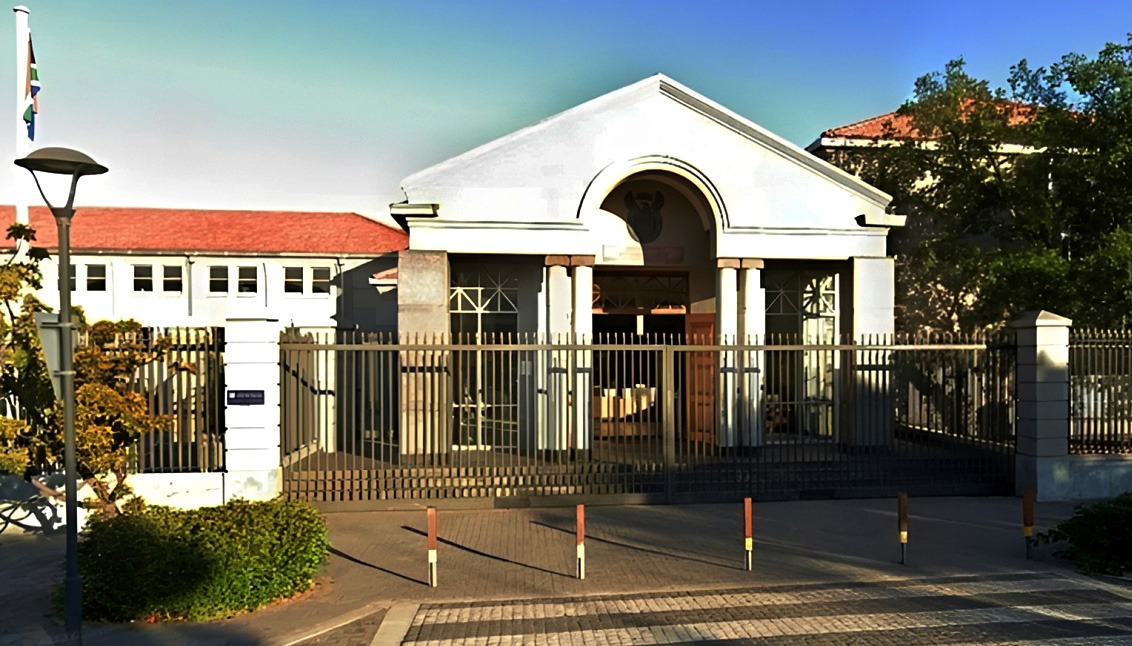
 The Eastern Cape Division of the High Court in Gqeberha, where four men will appear in connection with the brutal rape and murder of two girls in Nelson Mandela Bay in June 2025.
(Photo: Algoa FM)
The Eastern Cape Division of the High Court in Gqeberha, where four men will appear in connection with the brutal rape and murder of two girls in Nelson Mandela Bay in June 2025.
(Photo: Algoa FM)The charge sheet before court tells a story of calculated, methodical violence.
Five girls were in a house in KwaNobuhle, Kariega, when four men allegedly broke in. Two of the girls – Ibanathi Peter (17) and Sinothando Malinga (19) – were taken and did not return home.
Hours later the girls’ charred bodies were found near the house. It was later confirmed that they had been raped and stabbed to death before being set on fire.
Last week, three of the four accused made their first appearance in the Eastern Cape Division of the High Court in Gqeberha.
Anele Ngalo, Siphosethu Gomomo and Zubenathi Dyakumini appeared unbothered as they were led up from the holding cells under the courthouse and shuffled into the dock only to hear that their matter was postponed until next month.
Akhululwe Phungulwa was not present. The court was told he was already serving a sentence for another matter, but no further information was provided.
He will join his co-accused in the dock on 22 May when they are expected to hear about a possible trial date.
According to the charge sheet before court, the two victims were at a house with three friends in Hlosi Street, Kwanobuhle, on 17 June 2025.
The accused allegedly broke into the house and held all five girls hostage for an unspecified amount of time before taking Peter and Malinga and threatening to kill the remaining three girls if they told anyone about the incident.
It is alleged that they subsequently took turns raping Peter and Malinga before stabbing them to death.
Afterwards, their bodies were set alight, presumably in an attempt to destroy evidence or obscure their identities.
/file/attachments/orphans/GBVIbanathiPeter1_336185.jpg "Ibanathi Peter (17) was murdered in KwaNobuhle, Kariega, on 18 June 2025. (Photo: Supplied)")
/file/attachments/orphans/zana_892006.jpg "Sinothando Malinga (19) was murdered in KwaNobuhle, Kariega, on 18 June. (Photo: Supplied)")
Brutal rape and murders
The State alleges that the entire incident was premeditated and that the accused broke into the house with the intent to rape the girls.
The four accused face charges of conspiracy to commit rape and murder, housebreaking with the intent to rape and murder, two counts of rape, two counts of murder, two counts of defeating the end of justice and a count of intimidation.
Ibanathi (17) and Sinothando (19) were among four school girls brutally murdered in Nelson Mandela Bay in the span of one month last year.
The burnt body of Lithaliyanda Ntoni (12) was found in a field in Motherwell on 27 June. She went missing after leaving home to visit a nearby shop.
Days later, on 16 July, Michelle Ambraal (also 12) was reportedly raped and murdered and her mutilated body found in field halfway between her home and school in Bethelsdorp. She suffered from learning challenges.
No real action against GBV
While President Cyril Ramaphosa declared gender-based violence (GBV) a national disaster late last year, GBV activist organisations believe this is little more than lip service as no real action has been taken to stem violence against women and girls.
Last Friday, 10 April, the body of six-year-old Abigail Prins, from Motherwell, was found in a shallow grave among the dunes of St George’s Strand. It is alleged she was killed by her aunt and the aunt’s boyfriend.
/file/attachments/orphans/AbigailPrins_692232.jpeg "Six-year-old Abigail Prins was reported missing from her home in Motherwell in March 2026. Her body was found among the dunes near St George’s Strand on 10 April. (Photo: Supplied/SAPS)")
GBV activist and attorney Tania Koen, who is the chief executive of the Reeva Rebecca Steenkamp Foundation, said the President’s declaration needs to translate into action and preventative measures for it to mean anything.
“President Ramaphosa stated, inter alia, that the classification would enable expanded access to shelters, safe spaces, psychosocial counselling and community-based prevention programmes. In reality, gender-based violence statistics continue to rise. Shelters and safe houses are barely staying afloat, and limited resources remain their biggest challenge.”
Koen said there is no evidence of campaigns or educational reform programmes being implemented or rolled out.
She said unless drastic measures are implemented and resources allocated towards protecting women and children, South Africa will remain ranked among the countries with the highest levels of GBV globally.
“We’ve seen time and again that our government officials are good at developing policies, but they are sorely lacking when it comes to effectively implementing them.”
The co-executive director of Sonke Gender Justice, Bafana Khumalo, agreed with Koen that South Africa has no clear plan in place to fight the scourge of GBV.
“We’ve seen time and again that our government officials are good at developing policies, but they are sorely lacking when it comes to effectively implementing them.
“Declaring GBV a national disaster means nothing if there is no clear strategy or comprehensive plan on how to unlock resources and respond to the crisis.”
Khumalo said the incidence of GBV in South Africa is five times higher than the global average, and our country is losing more women and children than active conflict zones.
“I was never excited about GBV being declared a national disaster, because up to now there has been no specific actions taken and GBV is still on the rise.
“I am afraid this is nothing but bad news for our women and girls,” Khumalo said. DM
Comments
Scroll down to load comments...