



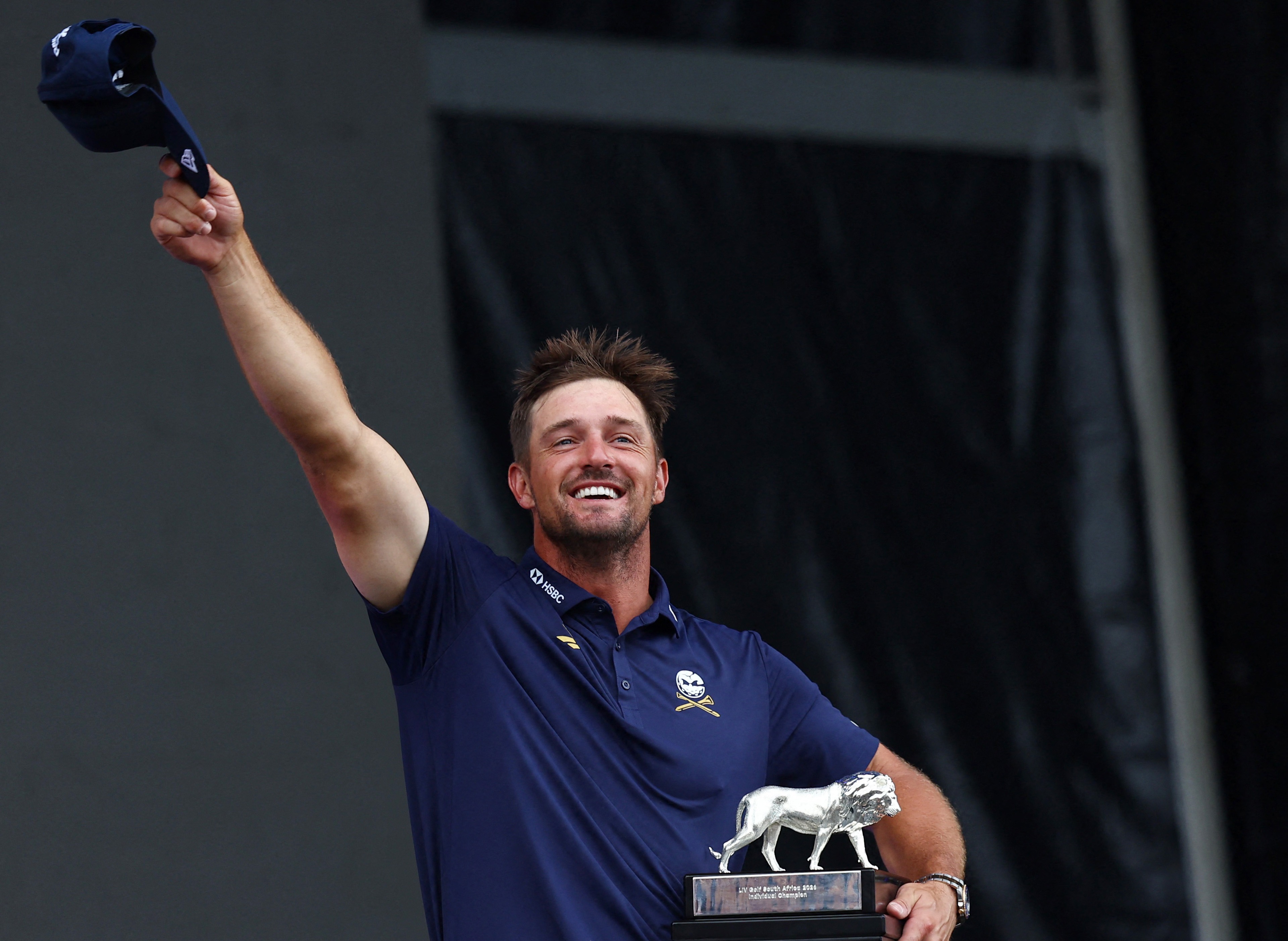
 Bryson DeChambeau celebrates with the trophy after winning LIV Golf South Africa (Photo: REUTERS/Siphiwe Sibeko)
Reports about the demise of the Saudi-backed LIV Golf in a swathe of publications appear to have been premature, but questions remain about the long-term future of the league.
Initially reports claimed that the Public Investment Fund (PIF), which underwrites the hefty cheques to sustain LIV, was going to announce the end of its funding after a meeting in New York on Thursday, 16 April.
That never materialised and instead LIV Golf chief executive Scott O’Neil sent a memo to staff stating: “Our season continues at full throttle.”
There has been no official statement to directly refute the reports about the league’s apparent demise from LIV Golf.
O’Neil appeared in a brief interview during the broadcast of its Mexico event taking place at Club de Golf Chapultepec in Mexico City this weekend and didn’t directly answer the question of whether the PIF would continue to fund LIV after this season.
/file/attachments/orphans/TL_2538910_625089.jpg "Scott O'Neil, the CEO of LIV Golf, (left) and SA Sports Minister Gayton McKenzie share a laugh at Steyn City in Gauteng. (Photo: Sydney Seshibedi / Gallo Images)")
“For us, we’re business as usual,” O’Neil said.
“If you want to ask me if this business is tough, I would say absolutely. If you asked me if we’re managed very tightly, I would say absolutely. Can this be challenging? Absolutely, and that’s what we signed up for. We signed up for this adventure, and it is the ride of a lifetime.
“How we go forward is what I’m really excited about. I talked about some structural changes. They’re coming. I rolled out the plan.
“If we keep the trajectory going the way we are and the revenue growth going, this is going to be a really good business for a really long time.”
Speaking to told Daily Maverick, a source close to the situation confirmed O’Neil’s remarks, adding “it’s business as usual”, as far as LIV Golf is concerned.
Certainly, the messaging from within the league is currently aligned and there is credible information to suggest that the 2026 season with $30-million prizes at each of its 14 stops, will continue as planned.
What happens beyond 2026 though, is unclear.
/file/attachments/2986/MSA_3756_703043.jpg "The LIV Golf SA team, the Southern Guards. They are (from left) Branden Grace, Louis Oosthuizen, Dean Burmeister and Charl Schwartzel. (Photo: LIV Golf)")
Saudi Arabia’s sports business
When the PIF launched LIV Golf in late 2021, the project was billed as a revolution. It promised to rewrite the economics of professional golf, challenge the PGA Tour’s dominance and showcase the Saudi Arabia’s growing influence in global sport.
While LIV Golf continues to operate and expand, the inaugural LIV Golf South Africa tournament at Steyn City being its latest addition, signals from Riyadh suggest that the era of open‑ended sovereign funding may be ending.
PIF’s future financial commitment beyond 2026 is now uncertain, and the implications reach far beyond golf – it seems there is a complete rethink over Saudi Arabia’s entire sporting investment portfolio.
The PIF itself launched a “Vision 2030” document, which shows a strong mindset shift from just funding leagues/teams without the hope of a return on investment to a new era of “portfolio discipline”.
Saudi Arabia’s sports strategy operates through multiple vehicles. PIF leads the global, high‑impact investments such as LIV Golf, Newcastle United in the English Premier League, the Saudi Pro League and the Savvy Games Group’s $30-billion esports push.
Surj Sports Investment, launched in 2023, focuses on domestic and regional growth: acquiring events, league rights and sports‑tech assets aligned with Vision 2030.
Other state entities handle event hosting such as boxing mega‑cards and Formula 1 races.
/file/attachments/2991/Copilot_20260417_093755_292815.png "Saudi Arabia has invested heavily in sport through various entities. (Graphic: DM)")
This layered structure reflects a shift in philosophy. The early years of Saudi sports investment were defined by chequebook disruption, headline‑grabbing deals designed to announce the Kingdom’s arrival. The next phase is about sustainable returns.
Surj’s language is telling. Its mandate emphasises “sustainable and game‑changing investments” rather than prestige buys. PIF, meanwhile, has begun signalling that projects must demonstrate commercial viability.
This week the PIF sold a 70% stake of Saudi Pro League club Al-Hilal to Kingdom Holding Company for about R6.13-billion. The PIF still owns three other Saudi clubs in Al-Nassr, Al-Ahli and Al-Ittihad.
/file/attachments/orphans/GettyImages-2270749733_306269.jpg "Karim Benzema of Al Hilal FC. (Photo: Abdullah Ahmed / Getty Images)")
But coming in the same week as the LIV Golf uncertainty, it added to the picture of tighter business controls.
In other words, PIF-owned properties must make money and become self-sustaining
In that context, LIV Golf looks increasingly like an outlier.
The LIV revolution
When LIV arrived, golf needed a shake-up. The PGA Tour had grown comfortable, predictable and structurally complacent. LIV landed like a hand grenade lobbed into a boardroom.
And the numbers tell the story.
In 2022, the last season before LIV’s full impact, the PGA Tour paid out roughly $427-million in official prize money.
By 2025, that figure had surged to around $560-million, a 31% jump in just three years.
World No 1 Scottie Scheffler’s 2022 haul of $14-million was eclipsed by a profitable 2025, when he won nearly $25-million in prize money – a 74% rise.
The number of players earning more than $1-million went up from 126 to roughly 165 between 2022 and 2025.
/file/attachments/2991/pga_prize_money_comparison_2022_2025_812302.png "Players on the PGA Tour have seen a 31% growth in prize money since LIV’s arrival. Source: PGA Tour. (Graphic: DM)")
The PGA reframed its Signature Events to combat LIV’s guaranteed money, and it saw purses leap from an $8-million average to $20-million, a 150% escalation.
You don’t need a PhD in sports economics to see what happened. LIV forced the PGA Tour to pay its players more.
Every player on the PGA Tour, from the superstars to the journeymen grinding for status, is richer today because LIV exists. That’s the irony at the heart of this whole saga. The disruptor made the establishment stronger.
But revolutions are expensive. And that brings us back to Riyadh.
Evolution
Behind the scenes, LIV’s future is being reviewed. Not in a crisis‑meeting way, according to O’Neil, but in a strategic‑portfolio way.
The kind of review that asks hard questions such as: what’s the long‑term value, what’s the domestic impact and what’s the commercial upside?
And more crucially: does this still fit the next phase of Saudi sports investment strategy?
/file/attachments/orphans/GettyImages-2238726568_866753.jpg "Yasir Al-Rumayyan, the governor of Saudi Arabia’s Public Investment Fund and LIV Golf chairman. (Photo: Warren Little / Getty Images)")
No one has announced anything. No one has pulled the plug. But officials have hinted, quietly, deliberately, that PIF’s direct funding may not continue beyond 2026.
That doesn’t mean LIV disappears. It means LIV must mature.
It must attract co‑investors. It must build a commercial spine. It must prove it can exist without a sovereign wealth fund underwriting every tee shot.
For a tour built on disruption, that’s a very different kind of pressure.
O’Neil has been bullish about selling equity stakes in the teams that compete on the LIV Tour.
South Africa’s Southern Guards sold out of merchandise at the recent tournament at Steyn City, but the idea of supporting a golf team is not part of the sport’s fabric.
O’Neil talks of making billions from equity sales in the teams, but as yet, there have been no announcements of private funding of individual teams.
Despite the “business as usual” claims, LIV Golf is at a crossroads at a time when the PIF, Surj and other Saudi sports investment vehicles are moving into a more speculative phase.
For LIV, that means the safety net is gone. The tour must now justify its existence on the same terms as every other sports property: value, relevance, sustainability.
The revolution is over. The reckoning has begun. DM
Comments
Scroll down to load comments...