




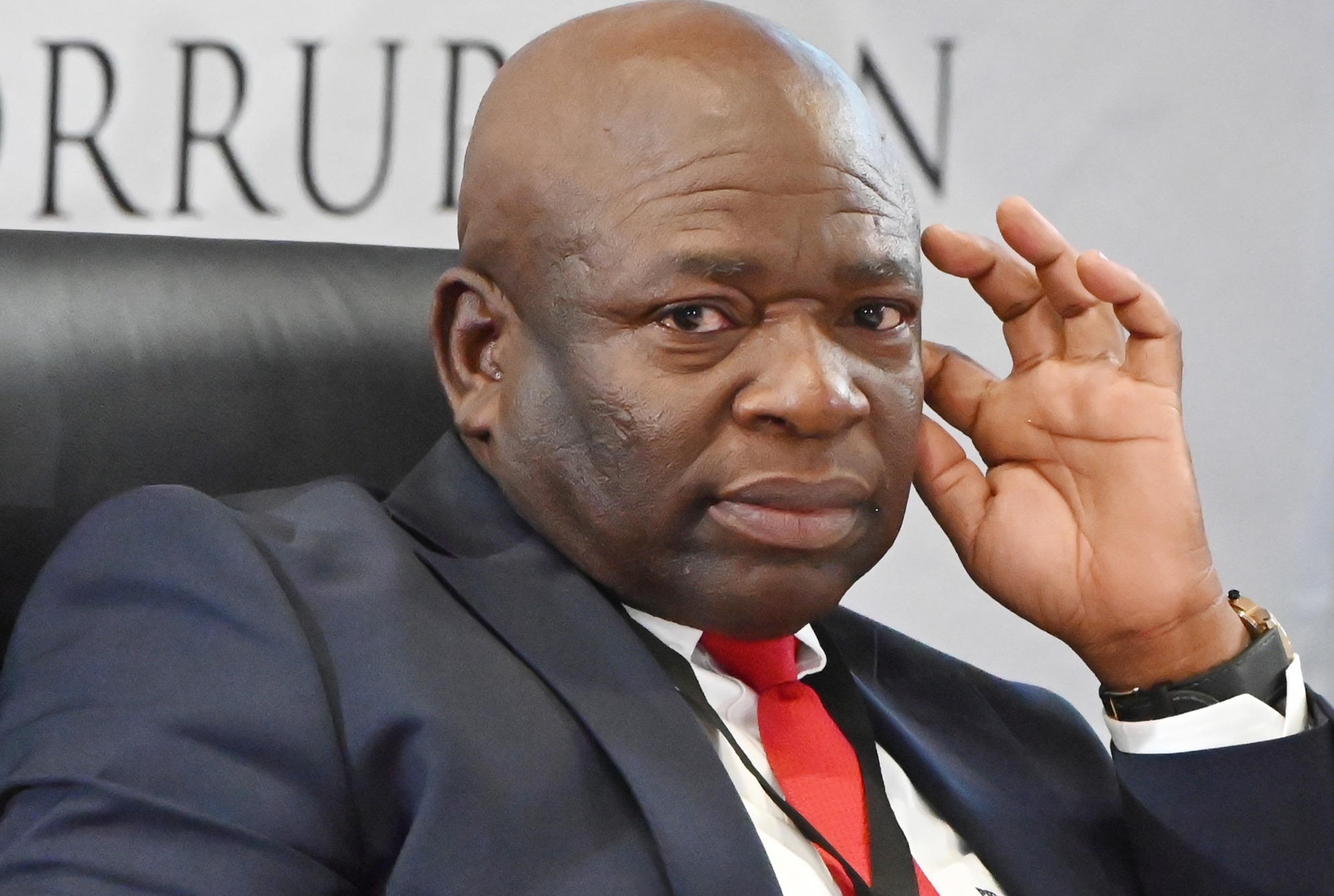
 Suspended Tshwane metro police director Tshukudu Malatji testifies at the Madlanga Commission on 9 April. (Photo: Frennie Shivambu / Gallo Images)
Five individuals have emerged as central figures in the alleged manipulation of Tshwane Metropolitan Police Department (TMPD) tenders worth R2.9-billion. They are: suspended City CFO Gareth Mnisi, suspended TMPD Deputy Chief Umashi Dhlamini, suspended director of Asset Protection Services Tshukudu Malatji, alongside Inspector Alfred Phiri and disgraced SAPS Sergeant Fannie Nkosi.
At the centre of the controversy is a 2016/17 tender for security services to protect property, assets and personnel at the TMPD. Evidence before the Madlanga Commission revealed that it was plagued by irregularities, missing documentation, and legal challenges. It was renewed in 2025.
On Thursday, 9 April, Malatji offered his version of events and attempted to refute the allegations against him.
He came under sustained questioning, as evidence leader advocate Mpilo Sikhakhane, alongside chairperson Justice Mbuyiseli Madlanga, and commissioners Sesi Baloyi SC and Sandile Khumalo SC, rigorously tested his account.
The scale of alleged tender rigging within the TMPD was exposed by the damning testimony of the TMPD’s chief, Yolande Faro, and its deputy commissioner, Revo Spies.
Spies told the commission that all deployments, monitoring of security companies and submission of invoices fell under Malatji’s authority.
He alleged that Malatji had ignored an instruction from Faro to halt ad hoc security deployments, resulting in one of the companies that benefited from the tender, Gubis 85 Solutions, being paid more than R59-million for services deemed unlawful.
Triotic Protection Services, reportedly linked to Tshwane’s deputy mayor, Eugene Modise, from the ANC, also benefited.
Fannie Nkosi’s brother’s company, Ngaphesheya Construction and Projects, received more than R2-million, despite being non-compliant with the tender and missing the submission deadline.
/file/attachments/orphans/ED_600674_478466.jpg "Sergeant Fannie Nkosi testifies at the Madlanga Commission on 18 March. (Photo: Frennie Shivambu / Gallo Images)")
The TMPD’s deputy police commissioner, Sean Bolhuis, told the commission that Malatji was required to inform him of any site allocations to service providers.
Bolhuis testified that during January and February 2025, he was neither approached nor made aware of any ad hoc site allocations to security companies. He said he was not consulted by Malatji, nor Dr KE Madihlaba, a senior superintendent at TMPD asset protection services, regarding these allocations.
Phiri allegedly signed deployment letters without authorisation for ad hoc sites to Gubis 85 Solutions while working in the division headed by Malatji, raising questions about how this could have occurred without Malatji’s knowledge or oversight.
Another allegation is that Gubis 85 Solutions contacted Malatji directly regarding outstanding payments spanning about seven months — raising the question of why the company would bypass normal channels and approach him personally.
About 50 bid documents reportedly went missing from the Bid Evaluation Committee, of which Malatji was a member, a body tasked with ensuring compliance with both the evaluation criteria and bid specifications.
Malatji distances himself from Gubis payments
Rejecting claims of complicity, Malatji told the commission: “I did not generate or create the purchases for Gubis 85 Solutions for ad hoc security services. I am unaware that Gubis 85 Solutions (Pty) Ltd received multiple allocations for the provision of ad hoc services.”
When questioned on whether he had neglected his duties by allowing a junior officer, Phiri, to unlawfully issue deployment letters — specifically to Gubis 85 Solutions — or if he had formally delegated that authority, Malatji denied both assertions.
“I have not delegated powers of allocation to anyone in respect of sites to be guarded by service providers under TMPD 02-2016/17. I did not approve or mandate the allocation of ad hoc security services to Gubis 85 Solutions (Pty) Ltd in the period between December 2024 and 30 June 2025,” was his response.
/file/attachments/orphans/ED_603226_513280.jpg "Tshukudu Malatji testifies at the Madlanga Commission on 9 April. (Photo: Frennie Shivambu /Gallo Images)<br>")
Malatji’s claims of innocence are in stark contrast to his role as an architect of the original 2016 tender. From the outset, he was the primary official tasked with crafting the technical specifications. His direct contributions formed the basis of the tender that was eventually forwarded to supply chain management and advertised alongside other tenders.
His involvement did not end there. He was subsequently appointed to serve on the Bid Evaluation Committee, alongside members from various departments, placing him at the centre of both the formulation and assessment stages of the tender process. Notably, he was also part of the committee during the period when 50 bid documents reportedly went missing.
After the documents disappeared, a decision was taken to cancel the tender. The matter was taken to court and, on 22 October 2021, Justice Malop Setosa found there was no basis to cancel the tender. He ruled that it must proceed and ordered that the tender be awarded to 22 companies.
In his judgment, he said, “I’m not aware of any missing bids and/or documents. Regarding the removal of the bids from SCM premises, the Bid Evaluation Committee took the bid documents to the Tshwane Leadership Academy in Pretoria.”
Malatji told the commission that he was unaware of the court order, despite having been the contact person when the tender was advertised.
Assistance in facilitating payment
Commissioner Khumalo pressed Malatji on why Gubis 85 Solutions approached him directly about non-payment for services rendered over seven months.
Malatji responded that the company probably realised that whatever had been promised to them had not materialised and, knowing the procedures, believed he might be able to assist in facilitating payment.
Khumalo, however, was not persuaded by this explanation. He pointed out that the only reason Gubis would approach Malatji directly was that it was armed with deployment letters issued by his department.
The commissioner also found it unusual that Malatji did not move to investigate Gubis’ site allocations, noting that he could simply have stated: “My department did not allocate any ad hoc sites to you.”
Justice Madlanga did not hold back in his assessment, putting it to Malatji that his claimed lack of knowledge was difficult to reconcile with his extensive involvement in the tender process.
Justice Madlanga pointed out that Malatji had been engaged from the outset, assisting with drafting the tender specifications, a critical first step once a decision to advertise had been taken.
Justice Madlanga told Malatjie: “You were intimately involved with the process right from the beginning. It goes further — you then became a member of the Bid Evaluation Committee, and that’s not the end. As Commissioner Baloyi pointed out, you were also the contact person. All of this indicates just how closely you were involved in the process.
“You then conduct evaluations, become involved in the Bid Evaluation Committee, and even prepare a report for the Bid Adjudication Committee — again indicating how closely you were involved.
“I find it very strange that, given how intimately involved you were in this process from the start, you claim not to know what the litigation related to, particularly when it concerned the missing documents.
“That part, the missing documents, you simply say you do not know about, and I find that very strange. You were involved from the beginning, through all the stages, but just before evaluation, you turn your back, and all of a sudden, you forget about the whole thing. I do not understand why you are defensive on this issue. You did not lose the documents.” DM