




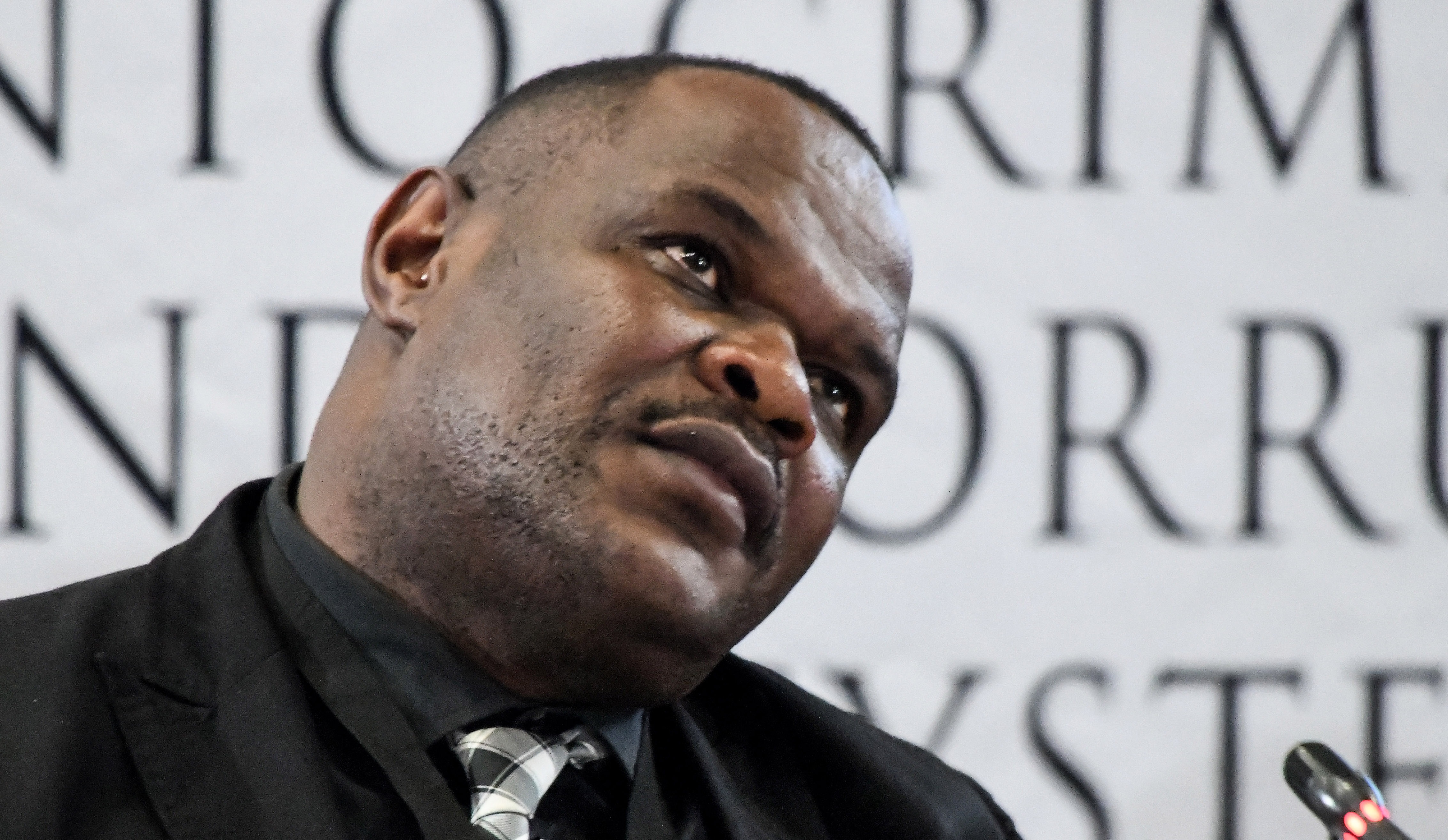
 Sergeant Fannie Nkosi testifies at the Madlanga Commission of Inquiry at Brigette Mabandla Judicial College in Pretoria on 16 March 2026. (Photo: Gallo Images/Frennie Shivambu)
 Six case dockets relating to violent crimes and marked “undetected” that were meant to be archived and out of circulation, along with guns and cash hidden under a mattress, are now at the centre of an investigation into controversial police officer Sergeant Fannie Nkosi.
Nkosi, who has been suspended and is attached to Gauteng’s Organised Crime Unit, will spend nearly a week in the hospital wing at Kgosi Mampuru Prison before applying for bail, as investigators probe his involvement in cash-in-transit and hijacking incidents whose dockets were kept at his home in Pretoria.
He appeared in the Pretoria North Magistrates’ Court on Tuesday, 7 April 2026, facing a string of charges, including possession of unlicensed ammunition, theft, defeating the ends of justice and failing to properly secure firearms and ammunition under the Firearms Control Act.
This comes after he was arrested last week following a raid at his home after a task team emanating from the Madlanga Commission received a tip-off regarding unlawful ammunition at the property.
Upon searching his home, police found firearms – including an R5, revolver and 9mm stored in a drawer – a stun grenade, dockets, as well as more than 100 rounds of live ammunition, under a mattress and bed, and in a vehicle.
Police also found “state-issued items” at various locations in the house, along with R52,700 hidden under a mattress, which they believe forms part of the proceeds of unlawful activities, according to the charge sheet.
Six dockets
National police spokesperson Athlenda Mathe told journalists, “Upon further investigation, what we found is that all these six dockets, when you look at the system, are closed as undetected. When you close a docket as undetected, it means you can’t find any links, there is no new information and the case is then archived… When a docket is archived, it is not allowed to be in possession of an investigating officer; it should be in a storage facility.
“Our team [has now] been deployed to the various police stations where these dockets were registered just to ascertain how he got hold of these dockets, what [these dockets are] doing in his possession, and what role he played, because a number of them [involve] cash-in-transit robberies,” Mathe said.
The incidents in question happened in various places, including Soshanguve, Roodeport and Limpopo between 2013 and 2022.
While it’s unclear what specific crimes the dockets relate to, at least one of Nkosi’s connections, Vusimuzi “Cat” Matlala, has allegedly been involved in cash-in-transit heists, although he hasn’t been convicted on such charges.
The prosecutor, Tholoana Sekhonyana, told the court the State could not proceed with Nkosi’s bail application as it needed time to ascertain his involvement with the dockets and also complete tests on the stun grenade and some of the items seized during the operation, with the results expected on Thursday.
/file/attachments/orphans/ED_600813_297226.jpg "Sergeant Fannie Nkosi testifies at the Madlanga Commission of Inquiry at Brigette Mabandla Judicial College in Pretoria on 18 March 2026. (Photo: Gallo Images / Frennie Shivambu)")
Nkosi’s lawyer, advocate Sizo Dlali, however, told the court that the State had failed to observe its due diligence, as the prosecution could have obtained the information over the weekend.
Dlali attempted to persuade the court that the case had no weight and that the further investigation that the State sought had nothing to do with the bail application itself.
“I am concerned as a citizen of this country. I thought police stations work 24 hours… that information is at their disposal… It is my submission that this is an abuse of the court process,” Dlali said.
The court ruled that while it was in the interests of justice to hear Nkosi’s bail application, the State also had a duty to carry out its responsibilities. The matter was postponed to next week.
Earlier, Dlali also told the court that Nkosi had not eaten since his arrest, citing safety concerns. After his failed bail bid, he again asked the court not to transfer him to a different facility.
“Are you asking me to break the law?” the magistrate responded.
She conceded that Kgosi Mampuru remained in Pretoria, meaning Nkosi’s family could still visit and bring him food if they wished.
The middleman
Last week’s raid was not Nkosi’s first brush with the law. In October 2025, police searched his home and found R325,000 in his safe, which he claimed belonged to his brother, who is in the security business.
Nkosi, who initially appeared at the Madlanga Commission as Witness F before his identity was revealed, faced intense scrutiny during his testimony.
His evidence revealed links between organised crime figures, police officials, municipal executives and political actors, with Nkosi acting as a connection between the SAPS and alleged members of the crime network known as the Big Five.
Matlala and Katiso “KT” Molefe, both facing criminal charges, have been identified by SAPS leaders as part of the Big Five, while the late taxi boss Jothan Zanemvula Msibi, known as Mswazi, was described as its leader.
Nkosi’s actions following the April 2024 murder of Vereeniging engineer Armand Swart drew particular attention. Swart’s killing, a case of mistaken identity linked to whistleblowing on SK Group’s inflated Transnet contracts, was followed by the arrests of Tiego “Floyd” Mabusela, Musa Kekana and Michael Tau, while Molefe was later arrested for allegedly orchestrating the hit.
Nkosi communicated with Ignatius Pheello Mothakathi, connected to Msibi’s network, after a Warrant Officer Zungu reportedly told him Mothakathi might know Mabusela. On that day, Nkosi had more than 20 calls with Mswazi and Zungu, using information from Zungu and an ID Mothakathi provided to confirm Mabusela’s arrest, effectively sharing real-time information about a suspect without informing the investigating officer.
The commission also heard that Nkosi had extensive links with Matlala. Police raided Matlala’s Waterkloof Ridge home on 6 December 2024, searching for his kidnapped business partner, Jerry Boshoga.
In the days leading up to and on the day of the raid, Nkosi and Matlala had spoken on the phone multiple times. Testifying at the commission, investigators have said they believed Matlala had been tipped off and had moved Boshoga.
Nkosi denied he tipped Matlala off, saying he asked him to hand himself over to answer questions in relation to the case. Boshogo remains missing.
The commission also revealed that Nkosi received R25,000 from Matlala, supposedly to provide a motorbike escort to a wedding, as well as the R325,000 found in Nkosi’s safe, which he claimed belonged to his brother in the security business.
Additionally, Nkosi told the Madlanga Commission he “knocked on doors” to help job seekers, while evidence suggested he played a facilitation role in Tshwane’s recruitment and tender processes, working with city officials, ActionSA, ANC and EFF members.
Nkosi is expected to return to court on Monday, 13 April 2026, for a formal bail application. Police did not rule out the possibility of adding more charges. DM