




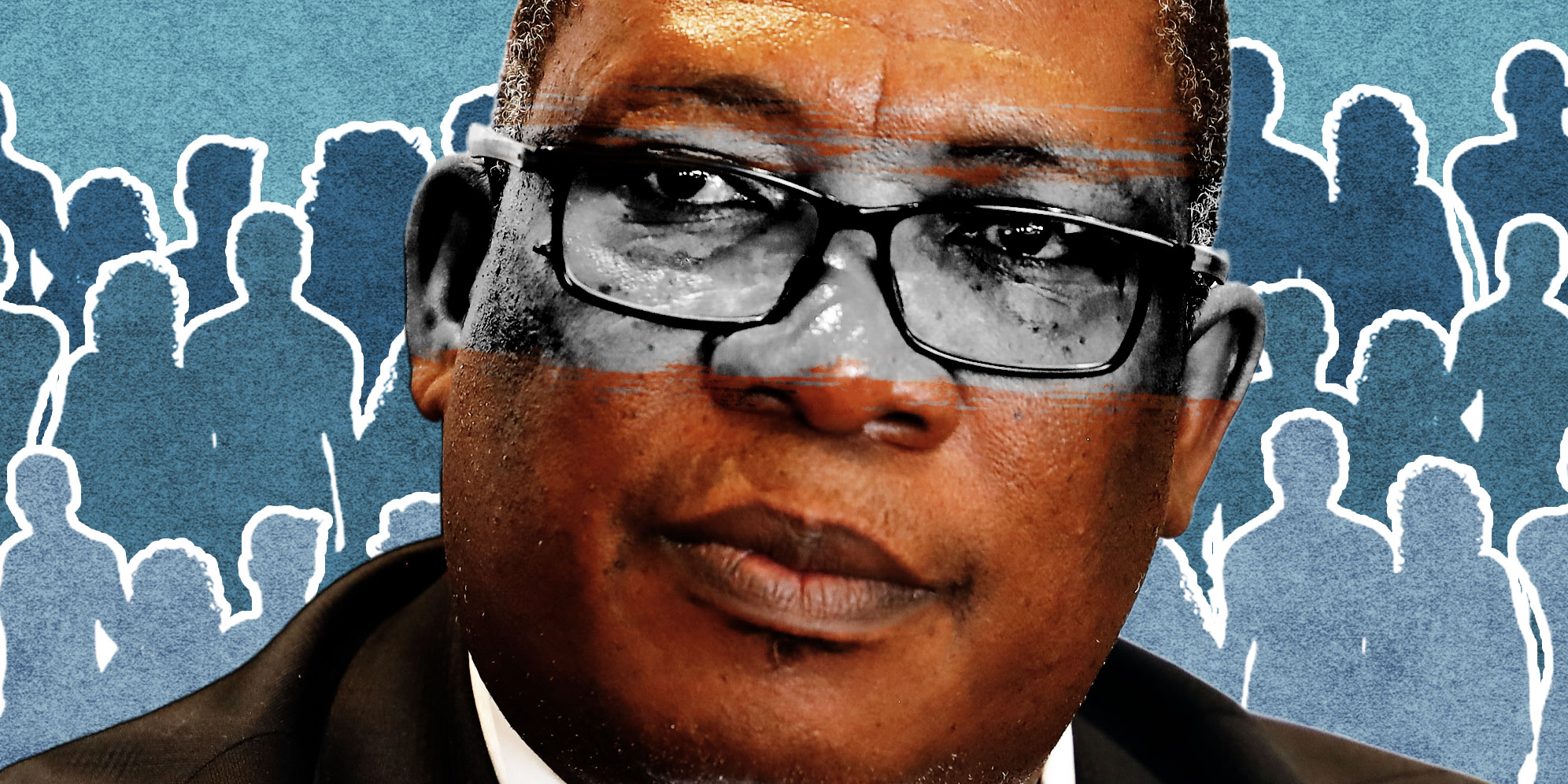
 Illustrative image | Gauteng Premier Panyaza Lesufi. (Photo: Gallo Images / Sharon Seretlo) | Crowd. (Image: Freepik)
 Gauteng Premier Panyaza Lesufi’s surprise coalition with the EFF as the ANC’s lead partner may signal a shift in future power-sharing arrangements.
The ANC is past its zenith and in the liberation movement epoch of decline. It is unlikely to win majority support in a national election, and it holds overall majorities only in the rural provinces.
More than 66 local councils are hung, showing that the era of single-party dominant democracy is over. Since 2024, South Africa has been governed by a 10-party Government of National Unity, and Lesufi has signalled that the post-President Cyril Ramaphosa ANC may take a different direction in future power-sharing negotiations.
On 1 April, Lesufi brought the EFF in as lead partner, giving the powerful position of Finance MEC to Nkululeko Dunga, who is the Red Berets’ lead in Gauteng. The EFF previously declined to participate in the provincial coalition because it only wants powerful portfolios where it can influence budgets and policies.
Since the 2024 national and provincial elections, when the ANC collapsed to 34.9% of the vote in Gauteng, Lesufi has led a minority government. He risked not being able to get the Budget through and so entered a radical, populist coalition. (You can read the background from Nonkululeko Njilo here.) To broaden the coalition, Lesufi said he was considering including the uMkhonto Wesizwe (MK) party as well, as EWN reported here.
/file/attachments/2990/COALITIONELECTIONS1_603930.png "Premier Panyaza Lesufi’s Gauteng coalition now has a majority after the EFF joined last week. (Graphic: Kevin Momberg)")
Power sharing
This could signal a form of power sharing that could take hold nationally as Ramaphosa’s term as ANC president draws to a close in 2027. His likely successor now is Deputy President Paul Mashatile, whose power base is Gauteng and who is close to Lesufi.
In his announcement, Lesufi said he had consulted the ANC nationally, but did not say who – he and party Secretary-General Fikile Mbalula do not see eye to eye. Mbalula has put the ANC in Gauteng under administration. The party is run by a provincial task team because it did so poorly in 2024. This put Lesufi’s nose out of joint as he is the ANC provincial chairperson.

The ANC Youth League has opposed Lesufi’s provincial Cabinet reshuffle as the SABC reported here, while the Sunday World also reported Lesufi’s own Gauteng comrades are unhappy with his decision to drop the ANC’s Matome Chiloane as the education provincial boss.
Corruption and poor service delivery have led to the collapse of support for democracy in Gauteng, according to new research by the Human Sciences Research Council (HSRC).
“Support for democracy as the preferred system is not a majority view in any province,” the HSRC survey for the Electoral Commission of SA (IEC) before the elections shows.
The chart shows that only 28% of people surveyed in Gauteng said democracy was preferable to any other kind of government; 26% said that in some circumstances, a non-democratic government could be preferable, while 39% were “fatalistic”, saying the system didn’t matter.
/file/attachments/2990/Screenshot2026-04-07at130806_142773.png "Demand for Democracy: Support for political regime type, by province. (Source: HSRC South African Social Attitudes Survey 2025/26)")
Near-existential crises
Gauteng is SA’s most populous province and largely comprises three metros – Johannesburg, Ekurhuleni and Tshwane. All three are run by coalitions, and each has near-existential infrastructure crises with water, roads, or electricity – and some have all three.
Add endemic corruption and unemployment, and the admixture has become bleaker for democracy than it was before. The survey found that openness to non-democratic alternatives is increasing across the country, according to Dr Benjamin Roberts, who is the HSRC research director for the Development, Capable and Ethical State Division.
“More than one in four people (26%) now see non-democratic options as acceptable in 2025/26,” the survey found. More than 80% of those surveyed said corruption had worsened, that the cost of living had risen, and that unemployment had worsened.
/file/attachments/2990/Screenshot2026-04-07at174325_405916.png "Demand for Democracy: Support for political regime type, 1999-2025 (%). (Source: Afrobarometer 1999-2009; HSRC South African Social Attitudes Survey (SASAS) 2011-2025/26)")
DM