




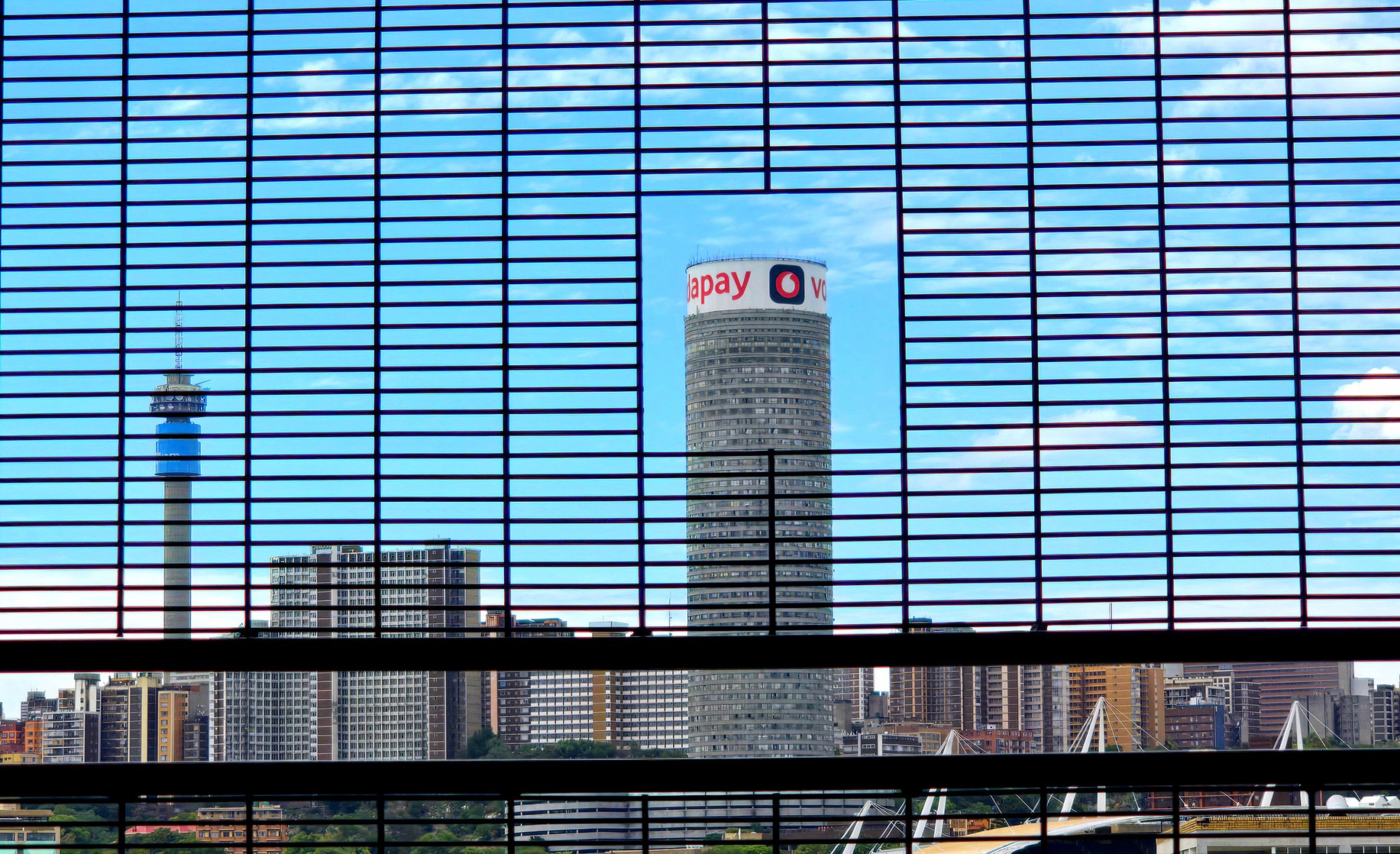
 Troyville Hotel views. (Photo: Bridget Hilton-Barber)
 1. Mozambican lunch and Jozi skylines
Authentic Portuguese Mozambican cuisine, grungy historic charm and fabulous city skyline views. The Troyeville Hotel began in 1939, serving the predominantly Jewish community that lived here, until the 1970s when the hood changed and the hotel became a central point for Portuguese-speaking immigrants fleeing conflict in neighbouring Mozambique and Angola.
/file/attachments/orphans/troyevilleskyline2_848330.jpg "Troyville Hotel views. (Photo: Bridget Hilton-Barber)")
That’s when the hotel got its reputation for Portuguese Mozambican cuisine – most notably prawns and baby chicken. The Troyeville remains a much-loved watering hole for locals, artists, activists, tourists and foodies. Head to the 1403 Rooftop Bar for those iconic Jozi skyline views.
2. A G&T at the longest bar in Africa, the Rand Club in Marshalltown
/file/attachments/orphans/randclub_379871.jpg "The Rand Club. (Photo: Bridget Hilton-Barber)")
Originally established as an exclusive “gentlemen’s retreat” in 1887 for the mining elite, the Rand Club is now an inclusive heritage institution and it’s worth a twirl and a gin at the longest bar in Africa – 31m of polished dark wood. This is Jozi’s oldest private members’ club and a six-storey Edwardian Baroque landmark in the city’s gold-rush history.
Historically all-white and men only, the Rand Club began admitting “men of colour” before it opened its doors to women, as late as 1993 (!!!!). Nelson Mandela’s portrait now sits alongside that of Queen Elizabeth (who visited in 1947 and was the first woman allowed to ascend the grand stairs). The Rand Club is a cultural spot, hosting talks and functions, book launches and tourist gatherings.
3. A walkabout in historic Kliptown, Soweto
/file/attachments/orphans/paintedshackkliptown_489968.jpg "A painted shack in Kliptown. (Photo: Bridget Hilton-Barber)")
Dating to 1891, Kliptown is Soweto’s oldest residential district, with a strong spirit and a rich history of African, Indian and Chinese traders. This is where the Freedom Charter was signed 70 years ago, later becoming the foundational document for the new South African Constitution.
/file/attachments/orphans/freedomsquare2_165821.jpg "Freedom Square. (Photo: Bridget Hilton-Barber)")
Take a tour of this thought-provoking space. On the one hand there’s a monument to Kilptown’s significant political history – the Walter Sisulu Square of Dedication – at its centre an imposing conical tower and 10 columns representing the 10 key principles of the Freedom Charter.
On the other hand, the surrounding residents are noticeably poor and face huge unemployment and a lack of basic services. The people of Kliptown remain resilient and organised, with inspiring community projects, youth programmes and local African churches.
4. Back to the South African movie stars of the Sixties and Seventies
/file/attachments/orphans/muraloutsideeyethu_437650.jpg "Mural outside Eyethu. (Photo: Bridget Hilton-Barber)")
While there are funky modern murals on the outside of the Eyethu Heritage Hall in Soweto, the interiors take you back to the 1960s and 1970s of black South African movies and music. Once the iconic Eyethu Theatre, the first black-owned cinema in Soweto, the building has been restored and transformed into a funky contemporary venue.
/file/attachments/orphans/tshabalalaandhiswifeeyethuheritagehall_629798.jpg "Ephraim Batana Tshabalala and his wife at the Eyethu Heritage Hall. (Photo: Bridget Hilton-Barber)")
The walls are decorated with posters of the famous stars of movies and music, and memorabilia such as movie tickets, newspaper cuttings and record covers. The cinema was built in 1969 by Ephraim Batana Tshabalala, the great entrepreneur of Soweto, who quit his job in 1946 with £20 in savings and began a meat business, then went on to build a retail empire that included garages, bottle stores, fish-and-chips outlets, supermarkets and dry-cleaning depots.
5. A taste of India at the Oriental Plaza and Fordsburg Market
/file/attachments/orphans/fordsburgnightmarket_973203.jpg "Fordsburg night market. (Photo: Bridget Hilton-Barber)")
The smell of incense and spices, the traditional colours of saris – the Oriental Plaza is an emporium of Indian delights with more than 300 shops selling everything from fabrics and clothes, to homeware and electronic goods. Built in the 1970s for Indian traders who were forcibly relocated from nearby Pageview under apartheid, it’s a great place for a stroll, a haggle and a bite.
It was built on the site of the former Red Square, a historic meeting point where anti-apartheid leaders including Nelson Mandela and other political activists launched the Defiance Campaign in 1952. The plaza is a central pillar of the Indian community, preserving traditions through family-owned businesses spanning generations.
The daily market at nearby Fordsburg Square is another wonderful place for food and authentic vibes in Jozi’s historical Indian and Muslim heartland. Think grilled chicken tikka, spicy kebabs, costume jewellery, incense, spices and traditional clothing like abayas. There is a night market on weekends.
6. Lunch in New Chinatown
/file/attachments/orphans/chinatown_948221.jpg "Chinatown in Cyrildene. (Photo: Bridget Hilton-Barber)")
New Chinatown is marked at each end of Derrick Avenue in Cyrildene by an ornate paigang (archway) serving as a symbolic entrance to the city’s most authentic Asian district. It’s like stepping into another world – inside are fresh markets, small supermarkets, fishmongers, herbalists, hair salons and traditional eateries serving Szechuan, Cantonese and Taiwanese cuisine.
/file/attachments/orphans/chinatowndetail_675623.jpg "Chinatown detail. (Photo: Bridget Hilton-Barber)")
Great for lazy Sunday lunches and food shopping. New Chinatown was established in the early 2000s by a wave of first-generation Chinese immigrants who left the old Chinatown on Commissioner Street on the back of the city’s then decline.
7. Coffee on Munro
/file/attachments/orphans/coffeeonmunro_330748.jpg "Coffee on Munro. (Photo: Bridget Hilton-Barber)")
Munro Drive is the place for those wow views of Jozi as the world’s biggest planted forest. This short but scenic pass in Houghton was built in 1892 and named after John Munro (a pioneer of the Johannesburg Consolidated Investment Company) and is renowned for its hairpin bend and great views across the northern suburbs and all the way to Pretoria and the Magaliesberg mountains on a clear day.
Munro Drive is close to the Wilds, a beautiful 16-hectare park on the city’s edge. Once neglected and dangerous, it’s now a glorious green lung, featuring indigenous gardens, pools and water channels, huge trees and more than 60 sculptures by artist James Delaney.
8. A dop at the Radium Beer Hall
/file/attachments/orphans/radiumbeerhallexterior_457508.jpg "Iconic and welcoming. (Photo: Bridget Hilton-Barber)")
/file/attachments/orphans/radiumbeerhall_199928.jpg "Framed history at the Radium. (Photo: Bridget Hilton-Barber)")
Originally opened as a tearoom by the Kalil family in 1929, the Radium Beer Hall in Orange Grove evolved into a historic landmark famous for its live jazz, Portuguese-influenced cuisine and vintage atmosphere. It also operated as a shebeen, serving alcohol to black patrons.
The name Radium apparently came from a joke – patrons would tell people they were going for “radium treatment” when they were actually going for a drink. Under the late owner, Manny Cabeleira, who took over in 1986, the city’s oldest surviving bar and grill broke traditional barriers by officially welcoming women and black patrons years before the end of apartheid.
/file/attachments/orphans/radiumblueplaque_176570.jpg "Plaque at Radium Beer Hall. (Photo: Bridget Hilton-Barber)")
The massive Burmese teak bar counter is more than 100 years old and where trade unionist Mary Fitzgerald (known as Pickhandle Mary) allegedly stood and gave rousing speeches during the 1913 miners’ strike. The Radium still has fascinating old photographs, vintage soccer pictures, old posters and newspaper clippings that record Jozi’s history.
9. First Sundays at Vic Yards
/file/attachments/orphans/entranceatvicyards_726761.jpg "Entrance to Vic Yards. (Photo: Bridget Hilton-Barber)")
/file/attachments/orphans/vicyards_219046.jpg "Vic Yards. (Photo: Bridget Hilton-Barber)")
Once a massive early 20th-century laundry, now a thriving creative and artisanal hub, Victoria Yards – or Vic Yards, as it’s known – comes to life on the first Sunday of every month. Wander the markets, check out the galleries, workshops and studios of artists and enjoy craft gin, strong coffee and freshly baked bread.
/file/attachments/orphans/graffitinearvicyards_579607.jpg "Graffiti near Vic Yards. (Photo: Bridget Hilton-Barber)")
The site was first built in 1913 as the New York Steam Laundry (later known as Advance Laundries) and was a huge operation at its peak, powered by steam boilers. By the late 20th century the site had fallen into severe disrepair, with crumbling factory spaces, panelbeaters and chop shops.
In 2015, developer Brian Green and partners came up with a vision for a sanctuary in the city where arts, artisanal skills and urban farming could coexist. DM