




 Illustrative Image: Auditor-General of South Africa Tsakani Maluleke. (Photo: Phill Magakoe) | SANDF soldiers. (Photo: Phando Jikelo / Parliament of SA) | (By Daniella Lee Ming Yesca)
Ahead of the imminent deployment of thousands of soldiers to South Africa’s crime-affected areas on Wednesday, 1 April, the Auditor-General has revealed that the Department of Defence (DoD) is unable to keep track of its own defence equipment.
In her latest report on the national and provincial audit outcomes, Auditor-General of South Africa (AG) Tsakani Maluleke found that the department “could not locate a number of assets” recorded in its own asset register in the 2024-25 fiscal year.
“The department’s inability to accurately track and maintain its strategic resources compromises mission readiness and national security,” Maluleke said in her report last week.
The DoD has been under fire from the AG in recent years for recurring issues such as unauthorised and irregular expenditure.
Maluleke’s 2024-25 audit findings come ahead of the deployment of about 2,200 South African National Defence Force (SANDF) troops to communities across South Africa on Wednesday, and raise questions about how resources can be adequately managed when the department is unable to fully account for what it owns.
Earlier this month, President Cyril Ramaphosa announced that the SANDF would assist the South African Police Service (SAPS) to combat illegal mining and gangsterism in the Eastern Cape, Free State, North West, Western Cape and Gauteng.
The deployment – the latest iteration of Operation Prosper – is expected to last until 31 March 2027, and has an estimated price tag of R823-million.
/file/attachments/orphans/WFD_4122_910177.jpg "A resident and her child look on as soldiers arrive to patrol the streets of Riverlea, Johannesburg, during a crime prevention operation on 11 March 2026. (Photo: Felix Dlangamandla)")
While some soldiers have already been seen in some parts of Gauteng, the SANDF stressed that those deployments were unrelated to Operation Prosper, during a joint briefing by the SAPS and SANDF to Parliament on Friday, reported News24.
At the briefing, Parliament heard that the 2,200 SANDF troops to be deployed this week were undergoing training.
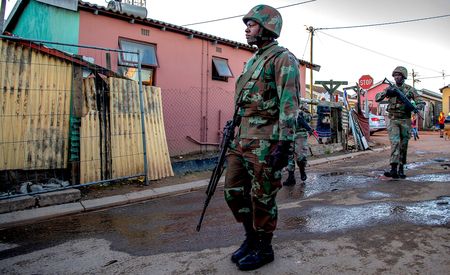
In a recent interview with Daily Maverick, Deputy Minister of Defence and Military Veterans Bantu Holomisa confirmed the soldiers would be issued equipment that included standard issue personal weapons, protective gear and operational support.
‘Material misstatements on moveable assets’
According to Maluleke’s report, the DoD was responsible for a R55.48-billion budget and a moveable asset base, which includes specialised military assets, of more than R68.92-billion in the 2024-25 financial year.
In 2022, the SANDF committed to implementing some consequence management to improve its audit outcome and address irregular and fruitless spending, which has not borne fruit.
The department has, year after year, continued to submit financial statements with material misstatements, which are not corrected, according to Maluleke. This has resulted in the DoD “receiving recurring qualified audit opinions for the past nine years,” she said.
“The department’s inability to accurately track and maintain its strategic resources compromises mission readiness and national security.”
According to the AG, material misstatements weaken the credibility of an auditee’s financial information. They also hinder management from making informed decisions on budgets, resource allocation and service delivery, which increases the risks of overspending, waste and service disruptions.
“The [department’s] 2024-25 financial statements were submitted with material misstatements on movable assets, investments, irregular expenditure, goods and services, contingent liabilities and employee compensation.
“The problems in internal control, process and capacity that cause the misstatements on moveable assets stem from incomplete and inaccurate registers, registers not submitted for auditing, as well as unverifiable assets. The weak controls and processes over record and asset management are due to inadequate information systems to accurately record assets, insufficient implementation and monitoring of daily and monthly controls, and a lack of leadership capacity in the asset management unit,” she said.
Maluleke also found that the department’s inadequate controls to account for defence equipment had resulted in an “increased likelihood” that these assets were not being safeguarded and were exposed to theft and misuse.
Daily Maverick requested details from Holomisa on the assets the DoD was unable to locate and the reasons for this.
He said the department acknowledged that during the 2024-25 fiscal year, “there were instances where certain assets reflected in the register could not be physically verified at the time of [the] audit”.
“This does not necessarily imply that such assets are permanently lost or stolen in all cases, but rather reflects deficiencies in asset tracking, verification processes, and record integrity,” he said.
/file/dailymaverick/wp-content/uploads/2025/05/WhatsApp-Image-2025-05-14-at-19.00.30.jpeg "Deputy Minister of Defence and Military Veterans Bantu Holomisa (centre). (Photo: Phando JIkelo / RSA Parliament)")
“The AGSA (Auditor General of South Africa) has, over a number of audit cycles, raised concerns regarding the credibility, completeness, and reliability of the department’s asset register, with some of these matters dating as far back as 2006.
“The assets referred to in the report are primarily moveable and operational defence equipment, which historically has been managed through a combination of manual, fragmented, and in some instances outdated record-keeping systems. These systemic weaknesses have contributed to challenges in reconciling physical assets with recorded entries in the asset register,” Holomisa told Daily Maverick.
According to Holomisa, the department inherited these challenges from the previous administration and, after assuming responsibility in 2024, the department “immediately prioritised” the development and implementation of an Audit Action Plan to address both historical and current audit findings.
He said that central to this interventions has been the establishment of a multi-stakeholder forum involving the AGSA, the Directorate for Priority Crime Investigation (Hawks), the Special Investigating Unit (SIU) and internal audit and governance structures, to “enable coordinated action, information sharing, and alignment” on corrective actions.
‘Overspent the most’
Maluleke’s audit report also revealed that, of all the national departments her office audited, the DoD “overspent the most, as in the previous year”. In 2023-24, the department recorded R3.46-billion in unauthorised expenditure.
According to her report, the DoD exceeded its budget by R2.51-billion in the 2024-25 fiscal year, due to overspending on employee costs and the unfunded deployment of the SANDF. This meant that SANDF troops were deployed without additional funding being officially allocated for an operation.
Read more: Joy in Eastern Cape as Ramaphosa extends SANDF deployment
/file/attachments/orphans/WFD_4227_618041.jpg "A resident uses a cellphone to photograph soldiers patrolling the streets of Westbury on 11 March 2026 during a crime prevention operation aimed at curbing gang violence in the area. (Photo: Felix Dlangamandla)")
The government has said the estimated cost of the Operation Prosper deployment will be covered by existing budgets.
During the briefing in Parliament on Friday, questions raised by MPs over Operation Prosper’s R823-million budget allocation went largely unanswered, reported News24.
In a statement on Friday, DA National Council of Provinces (NCOP) member on security and justice, Nicholas Gotsell, said the briefing “exposed serious gaps” around money, basic resources and the role of private security, which the SANDF announced would form part of their cooperation with SAPS.
“First, Parliament still does not have clarity on how the R823-million allocated to this deployment will be spent. We have asked whether proper financial controls, registers and audits are in place – not only for the many rands and cents the SANDF have requested, but for every weapon and every round of ammunition committed to this operation. Given the scale of corruption investigations already facing the Department of Defence, oversight over this budget is not a technical exercise; it is a constitutional duty,” said Gotsell.
Daily Maverick sent queries to DoD spokesperson Siphiwe Dlamini regarding the AG’s findings and Operation Prosper, but a response was not received by the time of publication. DM