




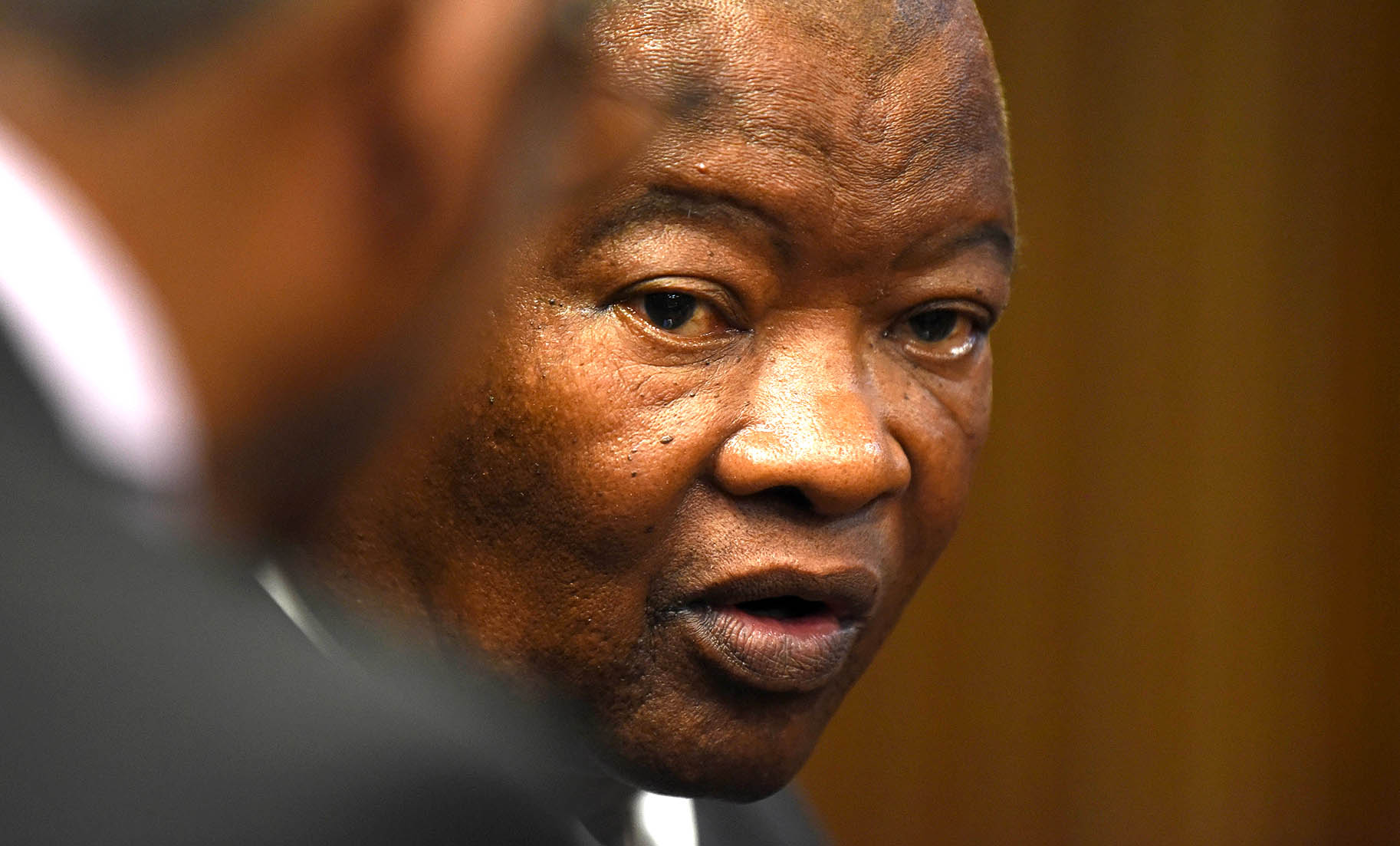
 Deputy Minister of Defence Bantu Holomisa. (Photo: Deon Ferreira)
 Question: Last week, President Cyril Ramaphosa told MPs that the SANDF would act as a ‘force multiplier’. Could you expand on this – what tasks are soldiers performing that SAPS isn’t?
Answer: When the President speaks of the SANDF [South African National Defence Force] as a “force multiplier”, he is referring to a very practical reality on the ground. There are areas in our country where the intensity, organisation and firepower of criminal elements, particularly in illegal mining and gang-affected communities, have outpaced the normal capacity of policing. In those instances, the SANDF brings scale, discipline and operational capability that strengthens the hand of SAPS [South African Police Service].
From my own experience, this is not about soldiers replacing the police, but about creating a stabilising presence. You will see patrols, area domination, support in cordon and search operations, and the securing of key sites. The legal mandate for arrests remains with SAPS, but soldiers are not passive; where necessary, they act within the law to protect themselves and civilians. This deployment is undertaken in terms of Section 201(2)(a) of the Constitution of the Republic of South Africa, 1996, read together with Section 18 of the Defence Act, 2002 (Act No. 42 of 2002), which provides for the employment of the SANDF in cooperation with the South African Police Service.
Q: Can you elaborate on what you mean by: ‘The legal mandate for arrests remains with SAPS, but soldiers are not passive; where necessary, they act within the law to protect themselves and civilians’?
A: [There] is often a misconception that soldiers deployed internally are either fully empowered as police officers, or alternatively that they are simply standing by without any authority to act. Neither is correct.
In law, the primary responsibility for arrests and criminal investigations rests with the SAPS, as provided for under the South African Police Service Act, 1995 (Act No. 68 of 1995), read together with the Criminal Procedure Act, 1977 (Act No. 51 of 1977). However, soldiers deployed in support of SAPS are not rendered powerless in situations where immediate action is required.
Read more: The SANDF arrives in Joburg as communities call for ‘permanent’ deployment
/file/attachments/orphans/WFD_4240_365128.jpg "Soldiers walk in an area dug up by illegal miners during a crime prevention operation on 12 March 2026, targeting zama zamas. The operation formed part of efforts to clamp down on illegal mining activities and restore law and order. (Photo: Felix Dlangamandla)")
In practical terms, if a soldier is confronted with a direct threat to life, whether their own, a fellow officer, or a civilian, they are empowered to act in self-defence and in defence of others, consistent with common law principles and the applicable provisions of the Criminal Procedure Act. In certain circumstances, they may also detain a suspect, but such action is limited and must be handed over to the SAPS without delay.
From my own experience, I can tell you that these situations are not hypothetical. When you place armed personnel in volatile environments, especially where heavily armed criminal elements are involved, you must ensure that they are able to respond decisively within the confines of the law. That is what we mean when we say they are not passive.
Q: What are the Rules of Engagement for troops deployed?
A: The Rules of Engagement are clear, and I want to emphasise this: our soldiers are not deployed into communities as a combat force, but as a disciplined support instrument of the state. The use of force is tightly controlled, guided by the principles of necessity and proportionality, and aligned with the Constitution, the Defence Act, and applicable provisions of the Criminal Procedure Act…
Every member deployed understands that they are operating among our own citizens, and that imposes a higher standard of restraint and professionalism.
Q: Have the Rules of Engagement for this specific deployment been drafted, and will they be made public?
A: Yes, the Rules of Engagement for this specific deployment have been formally drafted, approved, and communicated through the chain of command prior to deployment. This is standard practice for any operation of this nature…
On the question of whether they will be made public, one has to strike a balance. While there is a legitimate public interest in transparency, there are also operational considerations. Certain elements of the Rules of Engagement, if disclosed in full detail, could potentially compromise the safety of our troops or undermine operational effectiveness.
That said, the principles underpinning the Rules of Engagement are not secret. They are rooted in the Constitution, particularly the Bill of Rights, and include necessity, proportionality and accountability. Those principles are non-negotiable, and they guide every action taken by our members on the ground.
Q: You said the use of force is tightly controlled. Have these 2,000 soldiers been issued any equipment to use in their operations?
A: Yes, [they] have been equipped appropriately for the environment in which they are operating. It would be irresponsible to deploy personnel into areas characterised by organised criminal activity without ensuring that they have the necessary means to protect themselves and carry out their mandate. This includes standard-issue personal weapons, protective gear and operational support equipment.
The use of any such equipment is governed strictly by the Rules of Engagement, as well as the broader legal framework, including the Defence Act and the Constitution.
Q: Can you clarify the chain of command aspect of the deployment? When a soldier is in Westbury or Bishop Lavis, is he taking orders from a police colonel or a SANDF commander?
A: On the question of command, there should be no ambiguity. The SANDF remains under its own military command at all times. A soldier in Westbury or Bishop Lavis does not take direct orders from a police colonel. What happens instead is coordinated planning and execution through joint structures such as NatJoints [National Joint Operational and Intelligence Structure].
Read more: How the SANDF’s crime-fighting role could threaten state legitimacy
SAPS retains jurisdiction in law enforcement matters, but operations are jointly planned. In practice, this means that objectives are agreed upon collectively, and each service executes its role within its own command structure. That distinction is important, and it is well understood operationally, and is consistent with the framework established under Section 201(2)(a) of the Constitution and the Defence Act governing cooperation between the SANDF and SAPS.
Q: The deployment has an R823-million price tag. You have raised concerns in the past about the SANDF’s funding shortfalls. Can the department afford Operation Prosper without compromising its defence obligations?
A: The reality is that this operation is being implemented under constrained fiscal conditions. The Department of Defence is already under pressure, and this deployment is not funded within the baseline allocation. It requires internal reprioritisation, and that is not ideal.
Read more: The changing global order — why SA needs to radically boost defence spending
/file/attachments/orphans/6I1A5428_960726.jpg "Confiscated generators and compressors are loaded on to a truck during an operation targeting illegal mining activities on 12 March 2026. (Photo: Felix Dlangamandla)")
However, the responsibility to stabilise the country and support law enforcement cannot be deferred because of budgetary pressures. It does, however, reinforce the point I have consistently made, that the defence function must be adequately resourced if it is to meet its obligations as contemplated in the Constitution and the Defence Act.
Q: What specific areas or programmes are being cut to pay for this deployment?
A: At this stage, the reprioritisation is being managed internally within the Department of Defence, and it primarily affects operational and maintenance budgets. This includes… the deferral of certain non-critical maintenance programmes, limitations on training exercises that are not immediately essential, and the postponement of some planned activities.
We are, in effect, balancing immediate domestic stabilisation needs with long-term defence preparedness. That is not a sustainable position indefinitely, and it is something that must be addressed at a policy and budgetary level in line with the obligations set out in the Defence Act and broader national security framework.
Q: Does it concern you that we’re committing nearly a billion rands to this deployment primarily because SAPS is unable to hold the line against organised crime and gang violence?
A: I would not characterise this deployment as a response to a failure by SAPS. Rather, it reflects the evolving nature of organised crime in South Africa. Illegal mining, in particular, has become highly sophisticated and, in some instances, heavily armed. The Constitution… provides for the SANDF to support the police in precisely these circumstances. This is a reinforcement of state capacity, not an admission of collapse.
Q: There is public concern, in light of the Will for Peace Exercise and subsequent Board of Inquiry to probe whether the President’s instructions over Iran’s navy participation were disobeyed, that the SANDF top brass is becoming increasingly defiant of political oversight. What is your response?
A: The SANDF remains firmly under civilian control, as provided for in Section 202 of the Constitution, which affirms the President as Commander-in-Chief and establishes civilian oversight of the Defence Force. I say this without hesitation. There are always robust engagements between the political leadership and the military command, as there should be in any healthy democracy. But those engagements do not translate into defiance.
Read more: SANDF apparently defied presidential orders to remove Iran from a joint naval exercise
Where concerns have arisen in the past, they have been addressed through the appropriate institutional processes. The principle of civilian oversight is intact and respected.
Q: So, are you confident that the SANDF leadership is fully subordinated to the GNU’s executive authority during this deployment?
A: Having served in uniform myself, I have a clear appreciation of the discipline and command culture within the military. I am satisfied that the current leadership understands its constitutional obligations and operates within that framework.
The SANDF is not an autonomous entity; it is an instrument of the state, accountable to the executive and ultimately to the people of South Africa, in line with the constitutional framework governing the security services.
Q: How are you overseeing this deployment to ensure that troops on the ground don’t overstep their mandate?
A: Oversight of this deployment is something I take seriously. There are clear directives, reporting lines and accountability mechanisms in place. The chain of command is active, and there is continuous monitoring of operations.
At a practical level, this includes regular briefings, situation reports and coordination with other security structures. The intention is to ensure that the mandate is executed properly and that there is no deviation from the rules governing the deployment, as set out in the Defence Act and applicable operational directives.
Q: If a civilian is harassed or injured by a soldier during this deployment, is the Military Ombud equipped to handle domestic complaints in real-time?
A: Any instance where a civilian is mistreated is taken seriously. There are mechanisms in place, both within the SANDF and externally, including the Military Ombud, established in terms of the Military Ombud Act, 2012 (Act No. 4 of 2012), to receive and investigate complaints.
These processes are not theoretical; they are functional, and they are there to ensure accountability. Where wrongdoing is found, consequences follow. That is essential to maintaining public trust.
Q: What is being done with this deployment to fix the issues in SAPS and use the space to effect investigations and arrests of top figures?
A: This is, in many ways, the most critical aspect of the deployment, because the presence of the SANDF on its own does not resolve the underlying problem. What it does is create the operational space for SAPS and other law enforcement agencies to act more effectively.
In areas where the SANDF is deployed, you will see a stabilisation effect, reduced open conflict, and a disruption of criminal operations. That creates the conditions necessary for intelligence-driven policing. SAPS, supported by specialised units, can then focus on investigations, building cases and targeting higher-level figures within organised criminal networks.
Read more: Army deployment alone will not end gang violence
/file/attachments/orphans/6I1A5228_187689.jpg "A soldier removes bags from holes dug by illegal miners during an operation on 12 March 2026 targeting illegal mining activities in Randfontein. (Photo: Felix Dlangamandla)")
From a coordination perspective, this is being managed through established interdepartmental structures, including Natjoints, ensuring that the deployment is not just a show of force, but part of a broader, integrated strategy. I have always maintained that success will not be measured by how many soldiers we deploy, but by whether this intervention leads to sustained law enforcement outcomes, arrests, successful prosecutions and ultimately the dismantling of criminal networks. That is where the real test lies.
Q: What does success look like to you at the end of this deployment?
A: Success, in my view, must be measured in real terms for the communities affected. If, at the end of this deployment, we see a meaningful disruption of illegal mining networks, a reduction in gang-related violence and communities beginning to experience a sense of normality and safety, then we would have achieved something of value. But beyond statistics, success is also about restoring the authority of the state in areas where it has been challenged. That is a fundamental responsibility, in line with the constitutional obligation of the state to ensure safety and security. DM
This interview, which took place via email on Tuesday, 17 March 2026, has been edited for length and clarity.