



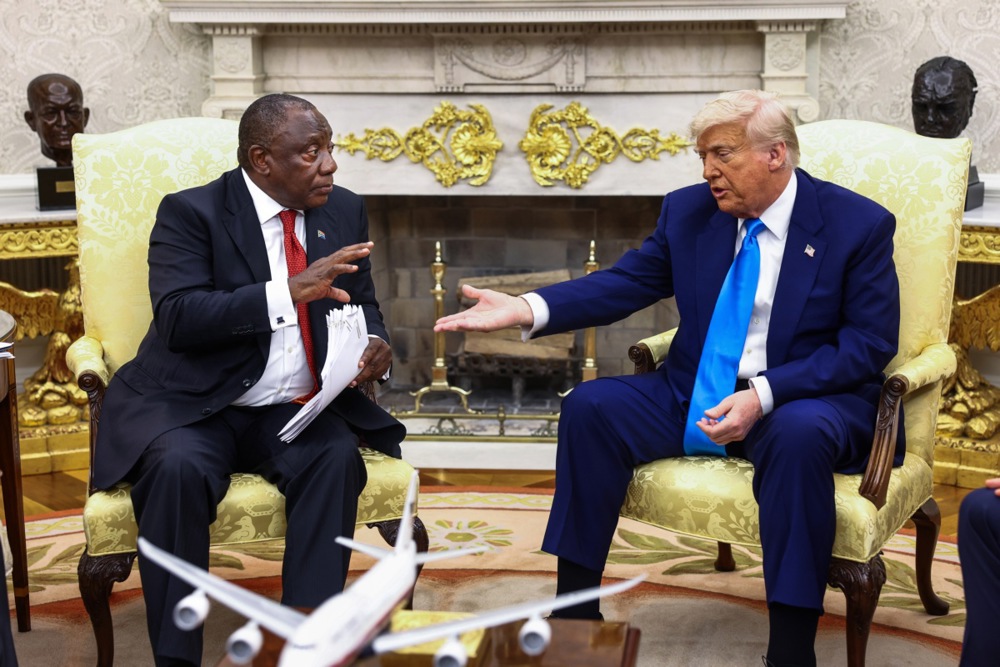
 US President Donald Trump meets with South Africa’s President Cyril Ramaphosa in the Oval Office of the White House on 21 May 2025. (Photo: Jim Lo Scalzo / EPA-EFE)
 /file/dailymaverick/wp-content/uploads/2025/10/label-analysis-2.jpg)
Is President Cyril Ramaphosa intentionally leaving the US ambassador post vacant to avoid further diplomatic fallout with a combative Washington?
That impression has been reinforced by the government appointing the capable senior career diplomat Thabo Thage as South Africa’s deputy ambassador in the US, effectively making him chargé d’affaires — or acting ambassador — in the absence of an official ambassador.
In addition, Ramaphosa’s international investment adviser, Alistair Ruiters, has been functioning very smoothly as South Africa’s chief negotiator with the US.
It’s been just over a year since Ramaphosa’s first official ambassador to the second Trump administration, Ebrahim Rasool, was abruptly declared persona non grata by US Secretary of State Marco Rubio and expelled from the US, after insinuating in a public webinar that Donald Trump was a white supremacist.
/file/dailymaverick/wp-content/uploads/2025/03/ED_551269.jpg "Reporters interview Ebrahim Rasool at Cape Town International Airport on 23 March after his return from the US. (Photo: Theo Jeptha / Gallo Images / Die Burger)")
A few months later, Ramaphosa appointed former deputy finance minister and now successful businessman Mcebisi Jonas as his special envoy to the US. But the Trump administration denied Jonas the necessary diplomatic visa to visit the US — almost certainly because in 2020 he had publicly called Trump a “racist, homophobe and a narcissistic right-winger”.
So, for a year, Ramaphosa has supposedly been looking for an ambassador to the US. In the meantime, Ruiters, though based in Pretoria, has been building solid relations with the US State Department.
US officials in Washington and the US embassy in Pretoria like him for his objective approach and his ability to listen and not declaim — unlike some other SA officials. Top Democratic Alliance officials, including party leader John Steenhuisen and Western Cape Premier Alan Winde, told Daily Maverick months ago that Ruiters was doing an excellent job and was the obvious candidate to become US ambassador.
But it didn’t happen. Later, officials told Daily Maverick that the government had realised that Ruiters’ efficiency was partly due to his location in the Presidency, “and the ability to shorten time frames for decision-making, versus going via the normal diplomatic channels”.
/file/attachments/orphans/493273151_1118122527011449_695197650941248281_n_607708.jpg "Dr Alistair Ruiters. (Photo: X)")
The Americans also respected the fact that they had contact with someone in the highest office in government to address their issues.
“So it’s not as if, you know, it was something that was carefully considered, but for the time being, we thought it’s better to continue in that kind of modus operandi than to try and change course,” an official explained.
The Presidency also realised that in a new diplomatic landscape, an unorthodox approach could work better.
“The Trump administration, in any case, operates in very unorthodox ways in diplomacy. So they operate through people who are not regular ambassadors or whatever. And so maybe that works for them,” said the official.
Chargé in charge
Meanwhile, the government’s decision — first reported by Africa Report — to appoint Thage, the acting chief director for North America in the Department of International Relations for the past four years, as acting US ambassador, has also reinforced the perception that Ramaphosa is in no hurry to appoint an ambassador.
Sending an ambassador requires formal US government approval — known as agrément — from Washington. As deputy ambassador, Thage would not require it, so there is no chance of being refused. He is already well known to the US embassy because of his current position.
He also reportedly played a role in resolving a spat between SA and the US in December last year over the Trump administration’s policy of granting white Afrikaners refugee status in the US on the grounds — completely unproven — that they are being persecuted in South Africa.
“He’s really, really good, and a seasoned diplomat,” said one of his colleagues.
/file/attachments/orphans/Gok3eWRWgAAr4xb_363898.jpg "Thabo Thage. (Photo: Khumbudzo Ntshavheni / X)
<br>")
One official noted, though, that Thage’s appointment was also in line with the normal four-year rotation of diplomats.
SA officials told Daily Maverick that the appointment of Thage and the success of Ruiters’ mission did not rule out the possibility of an ambassador being appointed to the US at some time. But it certainly reduced the pressure to do so.
The question has come into focus again with the arrival in South Africa of Trump’s ambassador, Leo Brent Bozell III. While Bozell’s presence has underscored the lack of a South African ambassador in Washington, it has also highlighted the complexity of appointing one.
Within days of his arrival, Bozell was “démarched” — called in to be officially rebuked — by the Department of International Relations and Cooperation for using “undiplomatic language”. Bozell had told a public seminar that “I don’t care what your courts say”, referring to decisions by the Supreme Court of Appeal and the Constitutional Court that singing the Struggle song “Kill the Boer” was not hate speech. Bozell insisted it was.
He also claimed that South Africa had more than 150 laws “aimed against whites” and that the Trump administration was “running out of patience” with the South African government.
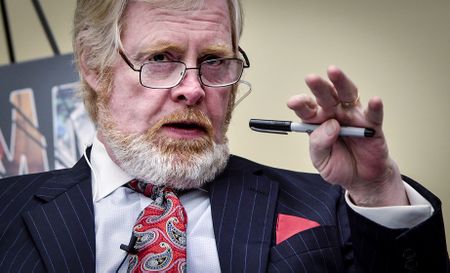
The dispute highlights Ramaphosa’s persistent struggle to find an opportune moment for a US ambassadorial appointment. A new controversy always seems to be springing up, increasing the risk that whoever Ramaphosa proposes might be rejected by the Trump team in retaliation for the latest perceived slight, such as the démarche on Bozell.
Bozell has also newly underscored the demands which the Trump administration has on SA — not only to outlaw “Kill the Boer”, but also to exclude US firms from broad-based black economic empowerment (BBBEE) regulations, ensure land expropriation policies are fair, and give white farmers more security protection — not to mention addressing Pretoria’s closeness to Iran and other foreign postures.
Moving forward?
On the one hand, having an ambassador in Washington should theoretically help to resolve these issues. On the other hand, the issues seem so intractable that they merely serve to keep tensions alive — and to jeopardise the prospects of any ambassadorial candidate being accepted by the US.
Bob Wekesa, director of the African Centre for the Study of the United States at Wits, said: “I see this as a lack of confidence from Pretoria on the effectiveness of diplomacy at the ambassadorial level, given Rasool’s being ejected from Washington, DC, and the fact that any South African diplomat who ends up there will face lots of backlash. They will be blocked. They will not have space to tell the South African side of things.
“So, it’s as if South Africa is saying ‘We’re not really interested in diplomacy, at least over the next couple of months.’”
Wekesa said the US had just sent a high-profile ambassador, Bozell.
“And South Africa has responded almost symbolically by signalling we are not interested in engaging at that level, by sending a chargé d’affaires.”
Last week, The New York Times suggested that the démarche on Bozell indicated that Pretoria had “given up trying to reason with Trump officials” because it was a futile exercise.
/file/dailymaverick/wp-content/uploads/2025/03/peterfab-Bozell-USambassador.jpg "The US ambassador to South Africa, Leo Brent Bozell III. (Photo: Kris Connor / Getty Images)")
One well-placed SA official disagreed, saying that the good relations that Ruiters and others had established with the US had built a good foundation that was helping to weather storms like the démarche of Bozell.
“What happened last week was not easy to deal with, but we’re dealing with it,” said the official, adding that he didn’t expect the US to retaliate to the démarche.
He noted that Bozell had walked back his remarks, and he expected him to mellow further as he spent more time in South Africa.
He added that he believed that there remained room for compromise between the US and SA on the “five asks”, as Bozell described them, the US’s main demands.
He said SA and the US were working particularly on a possible compromise on the BBBEE issue, about which Bozell felt strongly.
Ramaphosa’s spokesperson, Vincent Magwenya, told Daily Maverick that Ramaphosa felt “no pressing reason to rush an ambassadorial appointment”.
“Thabo’s appointment is a bit of a routine appointment in terms of regular resourcing of missions. Fortunately, in this instance, he has been working on the US desk and also working closely with Alistair.
“So, in that sense, there will still be better coordination and collaboration. However, it’s not a ‘replacement’ for an ambassador. The President still feels that we remain sufficiently represented in all of our engagements with the various levels of the Trump administration and that there’s no pressing reason to rush an ambassadorial appointment.” DM