




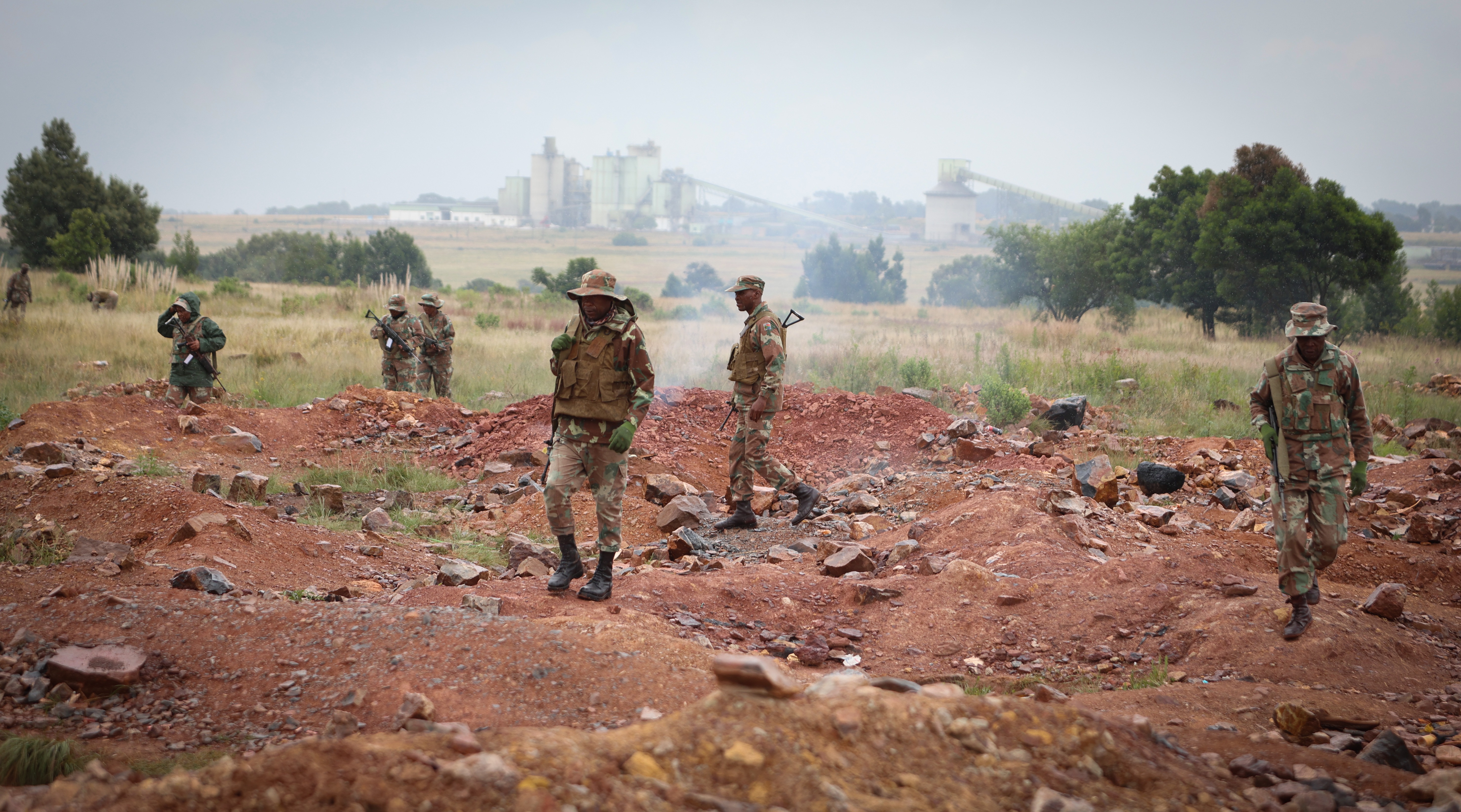
 Soldiers patrol an area where illegal mining takes place during a crime prevention operation in Randfontein on 12 March. (Photo: Felix Dlangamandla)
 On Thursday, 12 March, President Cyril Ramaphosa said the deployment of the South African National Defence Force (SANDF) to fight gangsterism and illegal mining in multiple provinces differed from past deployments.
Ramaphosa told MPs the SANDF would be a “force multiplier” and would be deployed, for example, to support high-risk search operations and cordon off roadblocks. It could also be used to patrol critical infrastructure, which would free up police for investigations.
“Our people are happy,” said Ramaphosa during a question-and-answer session in Parliament.
“In the past, when there were soldiers deployed, it would drive a lot of fear in the hearts of our people because ... soldiers are trained just to shoot and kill.
“This time around, we have developed our defence force capabilities so well that they build bridges, they save people who are in danger. They also help with supporting the police.
“So we have now a defence force, much as many people may be critical of them, a defence force that is well-attuned to serving the people of South Africa, and they’re already doing a fantastic job.”
/file/attachments/orphans/WhatsAppImage2026-03-12at163952_916817.jpeg "President Cyril Ramaphosa responds to questions from members of the National Assembly on 12 March. (Photo: Zwelethemba Kostile / ParliamentofRSA)")
Ramaphosa said that the army and police would work with structures such as the National Prosecuting Authority and Crime Intelligence to help dismantle gangs, including their financial networks, with the SANDF freeing up law enforcement “to do its work”.
“We’ve already seen how the defence force has been welcomed,” said Ramaphosa.
Soldiers are already on the ground in Gauteng and will also be deployed in the Western Cape and Eastern Cape to fight gangsterism, and in the Free State and North West to combat illegal mining.
From gangs to mining
Soldiers were deployed in Johannesburg on Wednesday and patrolled multiple communities. On Thursday, the SANDF and SAPS conducted raids on illegal miners at two abandoned mine dumps outside Randfontein as part of Operation Prosper, the Gauteng leg of the SANDF deployment, which includes 550 soldiers who will be deployed until 30 April 2027 at a cost of R80-million.
At the first mining site in Randfontein, suspected illegal miners fled on foot as heavily armed forces arrived. Several SANDF trucks and SAPS vehicles entered the remote area, navigating rough terrain away from a nearby informal settlement.
/file/attachments/orphans/6I1A5424_994162.jpg "Authorities pull up a generator that was found operating down a cliff near a dam in Randfontein on 12 March. (Photo: Felix Dlangamandla)")
/file/attachments/orphans/6I1A5428_960726.jpg "Confiscated generators and compressors are loaded onto a truck during the operation targeting illegal mining activities on 12 March. (Photo: Felix Dlangamandla)")
Soldiers and police searched deep holes believed to be linked to illegal mining activity, and security forces set fire to piles of suspected gold-bearing materials believed to have been prepared for processing.
At a second site, security forces confiscated equipment believed to be used in illegal mining operations, including about eight large generators, other machinery and ropes.
The site appeared to have been occupied for extended periods, with clothing, shoes and food items scattered about.
/file/attachments/orphans/6I1A5220_660384.jpg "A soldier stands in a hole to remove a hammer and chisel belonging to illegal miners in Randfontein on 12 March. (Photo: Felix Dlangamandla)")
/file/attachments/orphans/6I1A5361_299850.jpg "Soldiers carry a confiscated compressor during the operation on 12 March. (Photo: Felix Dlangamandla)")
/file/attachments/orphans/6I1A5305_607238.jpg "Authorities remove equipment belonging to illegal miners on 12 March. (Photo: Felix Dlangamandla)")
The SANDF has been deployed on multiple occasions in the past to fight both gangsterism and illegal mining, with critics saying there was little to show for it.
Mametlwe Sebei, the president of the General Industries Workers Union of South Africa (Giwusa), said residents near mining communities like Randfontein were exposed to “catastrophic levels of violence and criminality”.
Giwusa went to court during the siege on illegal miners in Stilfontein in 2024 to advocate for the miners’ rights. More than 90 miners died during that joint operation by the SAPS and SANDF.
“We understand completely why many residents, terrorised in their own homes, will welcome the sight of the SANDF as a relief and believe it might provide a solution to the spectre of criminal violence haunting their communities. Their desperation is legitimate, and their cry for safety is a cry we echo,” said Sebei.
But he argued that the state was cracking down on artisanal miners rather than organised syndicates, without differentiating between the two.
“The military is not trained for civilian policing. We saw the disastrous backlash during the Covid-19 lockdown, where soldiers, operating under unclear rules of engagement, brutalised the very communities they were meant to protect.
“Deploying the SANDF into the complex social fabric of our townships is a recipe for confrontation, not safety. It criminalises an entire community rather than isolating the actual criminals.” DM