




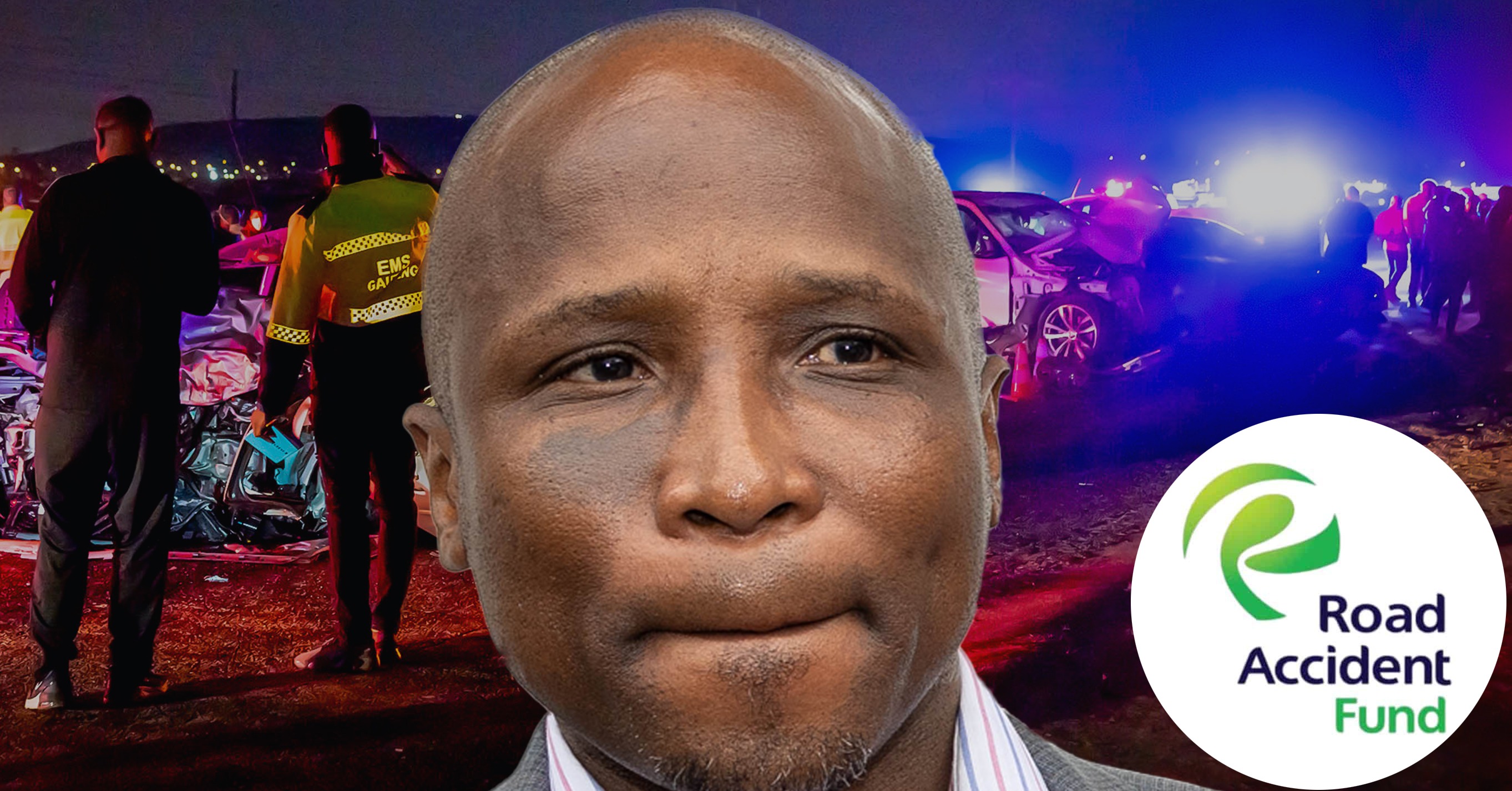
 Illustrative image: Crash on the Golden Highway. (Photo / Shiraaz Mohamed) | Road Accident Fund logo. (Photo: X) | Former RAF CEO Collins Letsoalo. (Photo: Papi Morake / Gallo Images)
 Penny-wise South Africans are basking in the general Budget hurrah.
A bit of good news is like a tonic, boosting cautious optimism that SA Inc has finally started to tidy its books and is poised to turn the corner.
But the ticking time bomb of state-owned enterprise (SOE) debt, particularly the calamitous Road Accident Fund (RAF), threatens to explode.
Debt estimates of the RAF differ. The problem is that the RAF debt is not properly quantified. Contingent liabilities could be above R400-billion. RAF contingent liabilities are potential future costs linked to the fund that are not yet fully certain, but could fall on the RAF, and ultimately the state, if certain claims, court matters or funding risks materialise.
Daily Maverick reported on this in October, but the needle has not shifted in the interim.

Current liabilities are about R100-billion.
With minimal cash reserves, the RAF faces a liquidity crisis that could spill directly onto the national balance sheet.
Moves are under way to address Transnet’s debt, and last year Eskom improved its financials, paving the way for SA’s first credit ratings upgrade in 20 years.
But the RAF is beset by well-documented corruption and maladministration: a chamber of horrors; around every turn, there is another terrifying pop-up.
ActionSA MP Alan Beesley, who has spearheaded recent parliamentary attempts to demand accountability at the RAF, recently ratcheted up calls for an update from the Special Investigation Unit (SIU) on the case against the errant parastatal’s former CEO, Collins Letsoalo.
Political parties want the SIU to speed up its probe into the RAF. The focus is on Letsoalo’s tenure from 2020 to 2025.
In October last year, four months after Letsoalo was put on special leave, his RAF colleagues told Parliament the SIU had uncovered RAF bank accounts with between R1-million and R100-million.
They said the RAF’s payment processes were vulnerable to fraud.
‘A sociopathic CEO’
In November, ahead of a parliamentary Standing Committee on Public Accounts (Scopa) inquiry into the RAF, Beesley called Letsoalo a “sociopathic CEO”.
He said criminal charges had to be investigated against Letsoalo, who earned R6-million a year for five years, plus a 40% performance bonus.
At the time, Beesley also called for dereliction charges to be laid against the RAF board because the Auditor‑General had issued disclaimed or adverse audit opinions for five consecutive years.
Letsoalo snubbed Parliament and defied a subpoena to appear before Scopa. His contract with the RAF ended in August, but he was placed on special leave in May, pending the outcome of the SIU probe.
In August, Transport Minister Barbara Creecy appointed an interim RAF board to address a monumental backlog of complaints against the RAF.
/file/dailymaverick/wp-content/uploads/2025/10/creecy.jpg "Transport Minister Barbara Creecy. (Photo: Department of Transport)<br>")
Creecy wrote to President Cyril Ramaphosa to ask him to expand the scope of the SIU’s investigation into the RAF.
Her announcement followed a litany of allegations against the RAF, including:
- Letsoalo was implicated in an investigation into a R79-million lease in Johannesburg, among other issues.
- A 200-bed Johannesburg hospital was closed in May 2025 after the RAF failed to pay more than R300-million in outstanding debt.
- In 2025, a whistleblower submitted a complaint to the RAF board accusing senior executives of manipulating procurement processes, splitting invoices to bypass approval limits and receiving VIP treatment from service providers in apparent exchange for contracts.
- Letsoalo pitched himself as a clean-up guy taking on “greedy and corrupt” lawyers, an image at odds with a lavish R4-million staff party, which included R40,000 spent on executive drinks.
- In May last year, Scopa said the RAF had failed to ensure that senior officials were vetted for suitability.
- The RAF did not appoint a chief claims officer for more than two years despite the backlog of claims.
- The RAF had litigated against the Auditor-General for two years.
- The RAF also accumulated more than R15-billion in default judgments and was often excoriated by the courts for delaying proceedings.
‘Not rocket science’
In 2024, the KwaZulu-Natal Personal Injury Attorneys Association wrote to Creecy outlining their complaints against the RAF.
A member of the association told Daily Maverick that Letsoalo’s regime had complicated and delayed claims processes to reduce the RAF’s debt burden.
“They made the process extraordinarily hard. They demanded that claims be sent by registered mail, but then refused to acknowledge them.
“This issue is being challenged in the Supreme Court [of Appeal] now. Collins kicked the can down the road, but the contingent liability has just kept on growing. It overshadows Eskom’s debt by a country mile.
“Personal injury claims are not rocket science: prove liability, then look at quantum. The RAF has so many matters on the trial rolls because they fail to manage claims properly. It takes them years to verify an accident report. They are clogging the courts with issues they should be competent to handle. In most courts, there are many RAF matters that proceed without the RAF being present. Most RAF matters should never get to court.
“Their work is straightforward. Insurance companies do this every day. Corruption flourishes in this state of chaos. All the while, the RAF’s liability is growing.”
In November last year, Rise Mzansi MP and Scopa chairperson Songezo Zibi described the RAF as a “train wreck” after the suspension of Letsoalo, the RAF’s chief financial officer, and two other executives.
/file/dailymaverick/wp-content/uploads/2025/10/2024-05-14T145806Z_1918884265_RC2CQ7AAVVON_RTRMADP_3_SAFRICA-ELECTION-PARTY.jpg "Standing Committee on Public Accounts chairperson Songezo Zibi. (Photo: James Oatway / Reuters)")
‘Enormous financial leakage’
Zibi said the RAF had 430,000 outstanding claims, some dating back more than a decade. The value per claim had increased by 70%, and legal fees per claim had quadrupled.
“There’s enormous financial leakage in the RAF.”
Last week, Zibi said he was finalising Scopa’s report for release this month.
He said the estimate of the RAF’s total debt liability was above R400-billion, but the RAF put the immediate liability at about R100-billion.
“The RAF is technically insolvent. On average, they get about R50-billion a year [from fuel levies]. Their overheads are about R7-billion, and they pay out about R43-billion.”
But the fund has an unknown class of claims that were rejected and are the subject of a pending Supreme Court of Appeal judgment, which could see thousands of claims reinstated because they were unfairly dismissed by the RAF.
The RAF will have to process these, along with its backlog of claims, many of which are unknown and unquantified.
The fund used to handle 250,000 claims each year. It now handles only 70,000.
“They have more than 400,000 claims on the books, and then this unknown number [to be determined after the court ruling]. It is an avalanche. It could be R100-billion; it could be R150-billion, it could be more,” said Zibi.
According to the Treasury’s 2026 Budget Review released last month, the RAF’s long-term provisions are expected to rise from R387-billion this financial year to R426-billion by 2028/29.
“You have layer on layer of problems,” said Zibi. “The fiscus can’t deal with that.”
Zibi said legal opinions were being sought on how to change the law so the RAF can cap payouts for future loss of income and medical expenses. The aim is also to pay in staggered amounts rather than a lump sum. However, new laws are unlikely to come into effect until next year.
“Lump sum payments make it nearly impossible for the RAF to remain liquid. You need a way of making the fund fair and equitable to take care of as many people as possible and not bankrupt itself.”
Zibi said that recommendations seeking punitive action against mismanagement were one thing; making the fund viable was another.
“You probably can’t make changes retrospectively. Treasury is still stuck with the R100-billion-plus problem. If the RAF could fix all its administrative issues and finalise all its claims tomorrow, it would collapse. This is one of the largest debts on South Africa’s balance sheet. A resolution has to be mindful of financial realities. The finance minister is apprised of our work. There is a systemic risk here.
“Resolving this is like unravelling spaghetti.”
Potential solutions
Beyond the ticking debt time-bomb, Zibi said immediate steps could be taken to fix the RAF. It could finalise some matters without going to court. It could appoint a panel of arbitrators to resolve cases where parties can’t settle, and an independent medical panel to assess injuries rather than pay for two sets of medical experts, as it currently does.
Beesley says the RAF’s debt exposure demands scrutiny of all SOEs, some of which threatened to be wrecking balls gone rogue.
“For five years, the CEO milked the RAF with a salary of R10-million a year, including incentives, and he collapsed the RAF. The board did nothing despite various adverse AG reports. The impact on the fiscus is astounding.
“It has to be funded. In accounting terms, we call it a real, true liability. In other words, the taxpayer will have to fork out for this. The current liability of R100-billion must be seen in the context of total liabilities of R500-billion, nearly one-fifth of the national government’s entire annual budget. Roleplayers have their head in the sand on this. It is flabbergasting.”
While the RAF board has been replaced, the errant CEO is out, and the state wrestles with the debt, personal injury lawyers are still vexed.
One told Beesley: “We’re looking forward to the Scopa report. Nothing has changed since the Letsoalo regime … some victims are worse off.”
Attempts to improve the settlement of RAF claims appear to have backfired. In some high court jurisdictions, such as Gauteng, a directive making mediation mandatory for all civil trials (intended to reduce court backlogs, particularly RAF litigation) has been blamed for worsening delays.
Advocate Justin Erasmus, chair of the Personal Injury Plaintiff Lawyers Association, has lodged a high court application to set aside the directive, as hardly any mediation is taking place. This comes to court in June.
Erasmus said Gauteng courts deal with about 300 RAF matters a week, and each takes about a day. There are 25 state attorneys to do this work. “They just can’t cope. If you can’t mediate, then you need to go to a special interlocutory court, and that is swamped. You can’t get a default judgment either. If you can get a trial date, it is for November 2033. The courts will face a tsunami soon if this is not resolved,” said Erasmus.
His comments were bolstered by correspondence between lawyers that was shared with Daily Maverick. It brings home the anguish of road accident victims languishing in pain, unable to afford rehabilitation. For them, the RAF’s crisis isn’t an abstract fiscal dilemma. It means their compensation is mired in a morass of corruption and delay.
One lawyer said in correspondence: “Personal injury plaintiffs are being denied access to justice. I wonder if members of the judiciary are aware of just how badly this system is operating and the absolute lack of effort by the RAF. As for the payments, my firm received 2% of what the RAF owes our clients in February.” DM