




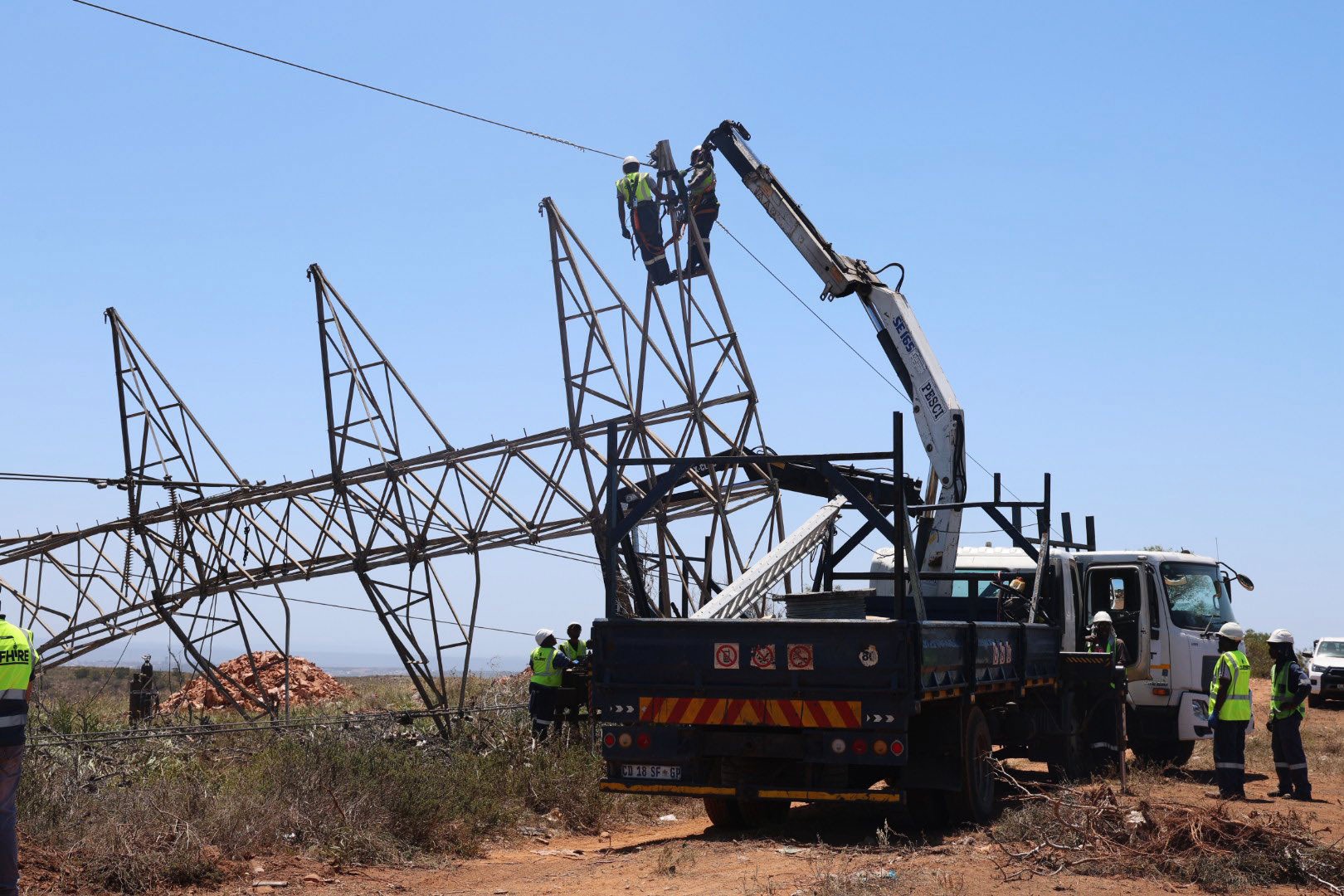
 One of the 132kV transmission towers that collapsed In January 2026. (Photo: Facebook / Nelson Mandela Bay Municipality) (Photo: Facebook / Nelson Mandela Bay Municipality)
 Despite an internal report warning that the Nelson Mandela Bay Bushy Park 132kV pylons have reached the end of their design life, the metro has yet to allocate the budget necessary for their repair or replacement.
The failure to act raises the prospect of a third collapse on the line, which has already twice plunged parts of Gqeberha into darkness and cost businesses millions in losses.
Calls were made by political parties for the metro to prioritise the repairs or replacement of the pylons after it was discovered that the city was in possession of a report that detailed the poor condition of the towers along the Greenbushes-Betheldorp line up to the Chelsea-Arlington-Summerstrand line.
DA MPL and mayoral candidate Retief Odendaal wrote to Mayor Babalwa Lobishe and acting city manager Lonwabo Ngoqo on 5 March, calling for urgent funding to be allocated before the situation deteriorated further.
His letter followed the two costly collapses when four towers fell on the Chelsea-Arlington-Summerstrand line in August 2024, leaving Summerstrand and surrounding areas without power for close to two weeks, and a further collapse in January 2025 that plunged half the city into darkness.
/file/attachments/orphans/ED_560373_172910.jpg "Retief Odendaal, DA MPL and mayoral candidate for Nelson Mandela Bay. (Photo: Gallo Images / Die Burger / Lulama Zenzile)")
“I note with concern the fact that you have not made funding available in your adjustment budget to replace and/or refurbish the rusted pylons on the aforementioned line,” Odendaal wrote.
“Whilst you indicated that you would investigate my findings with regards to the state of the compromised pylons on the line, I would remind you that you are already in possession of documentation that states that these pylons are compromised and that they have reached their design life,” the letter said.
Former acting head of the electricity and energy directorate Tholi Biyela cautioned the metro about the deteriorating state of the overhead line, which was exacerbated by vandalism.
/file/dailymaverick/wp-content/uploads/2025/09/Tholi-Biyela-1.jpg "Former Nelson Mandela Bay acting executive director for electricity and energy directorateTholi Biyela (Photo: Supplied / Nelson Mandela Bay Municipality)")
“The Bloemendal-Greenbushes Industrial and the Chatty-Rowallan Park 132kV overhead lines are being vandalised at present, and further works are needed to be done to stabilise the network,” the report tabled in November 2024 read.
In the letter, Odendaal said the metro was also convinced that the line had been compromised, and that more than half of the new pylons on the Bushy Park section had been installed a few years ago, but had not been used.
“It’s against this backdrop that I wish to put on record that any delay in attempting to secure the line by either replacing and /or refurbishing the pylons will expose the city to adverse and unnecessary risk,” Odendaal’s letter said.
“Should the line break whilst the city has been fully aware of their compromised state, the municipal administration will have little defence against potential damages claims by business and /or private households alike.”
Odendaal emphasised the importance of securing the power line, stating that the budget required to attend to the completion of the pylon replacement project was small compared with the economic and reputational costs the metro would suffer should a further 132kV line breakage occur.

Municipal spokesperson Sithembiso Soyaya said the towers were among assets undergoing technical assessment and, once this process was concluded and the relevant municipal planning and budget processes were completed, the metro would implement the interventions, in accordance with approved infrastructure and capital investment frameworks.
“Infrastructure interventions of this nature are governed by established municipal planning, engineering assessment and budgeting frameworks. In line with the Municipal Finance Management Act (MFMA) and the city’s infrastructure planning processes, any intervention involving strategic electricity infrastructure must first be informed by verified technical assessments conducted by the relevant engineering authorities.”
Soyaya said the assessments determined the appropriate course of action, whether it was refurbishment, reinforcement or replacement, after which the matter had to be prioritised within the municipality’s capital infrastructure programme and processed through governance and budget approval structures before implementation could proceed.
“The municipality therefore cautions against public commentary that may create the impression that the city is either unaware of the matter or failing to prioritise it, as per its mandate,” he said.
He said the city recognised and appreciated the concern over the integrity of electricity infrastructure in the Bushy Park area.
Odendaal said on Tuesday that he received an acknowledgement of receipt from Lobishe’s office for the letter, but has heard nothing from Ngoqo.
‘Massive losses’
Odendaal said businesses suffered massive losses resulting from the previous pylon collapses. It would be catastrophic if this recurred.
“How do they recover against the municipality, because one of the biggest problems that businesses face is that once insurance companies learn that damages were as a result of lack of maintenance from the municipality, they refuse to pay.
“Some will only cover if it was an act of God, or vandalism.”
Odendaal said the purpose of his letter was to place on the record that Lobishe and Ngoqo knew about the state of the pylons and needed to act.
/file/attachments/2985/Babalwa_530406_682997.jpg "Nelson Mandela Bay Executive Mayor Babalwa Lobishe. (Photo: Andisa Bonani)")
“Should anything happen, those insurance companies will have the right to recourse against the municipality… I don’t want them to take action against the municipality, but we [the DA] have a responsibility to intervene when we know infrastructure has been compromised.
“Our biggest problem in the city is job creation and unemployment. No business will invest in a city that doesn’t have a reliable electricity supply.”
Odendaal said the city promised to make a plan when the first pylons collapsed, but when the urgency receded, the commitment to replace the pylons vanished.
Freedom Front Plus councillor Bill Harington said the failure to prioritise this in the adjustment budget raised serious questions about planning and risk management in the municipality.
/file/attachments/orphans/pic_154615.jpg "Nelson Mandela Bay Freedom Front Plus councillor Bill Harington (Photo: Facebook / Bill Harington)")
“One would have expected that such an incident [pylon collapse] would have served as a clear warning to the administration that critical electricity infrastructure requires urgent attention and investment.
“Electricity transmission infrastructure is not optional infrastructure, it is essential for the functioning of the city. When pylons are allowed to deteriorate to the point where rust and structural weakness become a concern, the consequences can be severe,” said Harington
He indicated that the risk for businesses was immediate and measurable. He said extended power outages disrupted production, damaged equipment, interrupted supply chains, and ultimately led to financial losses.
“Small businesses often do not have the resources to absorb prolonged outages or invest in expensive backup power solutions. For residents, the consequences range from safety risks and food spoilage to the breakdown of essential services that depend on electricity,” Harington said.
“There is also a broader economic implication. The municipality is already struggling to attract and retain investment. When basic infrastructure, such as electricity transmission towers, becomes unreliable, it sends the wrong message to investors and undermines confidence in the metro’s ability to manage critical services.” DM