



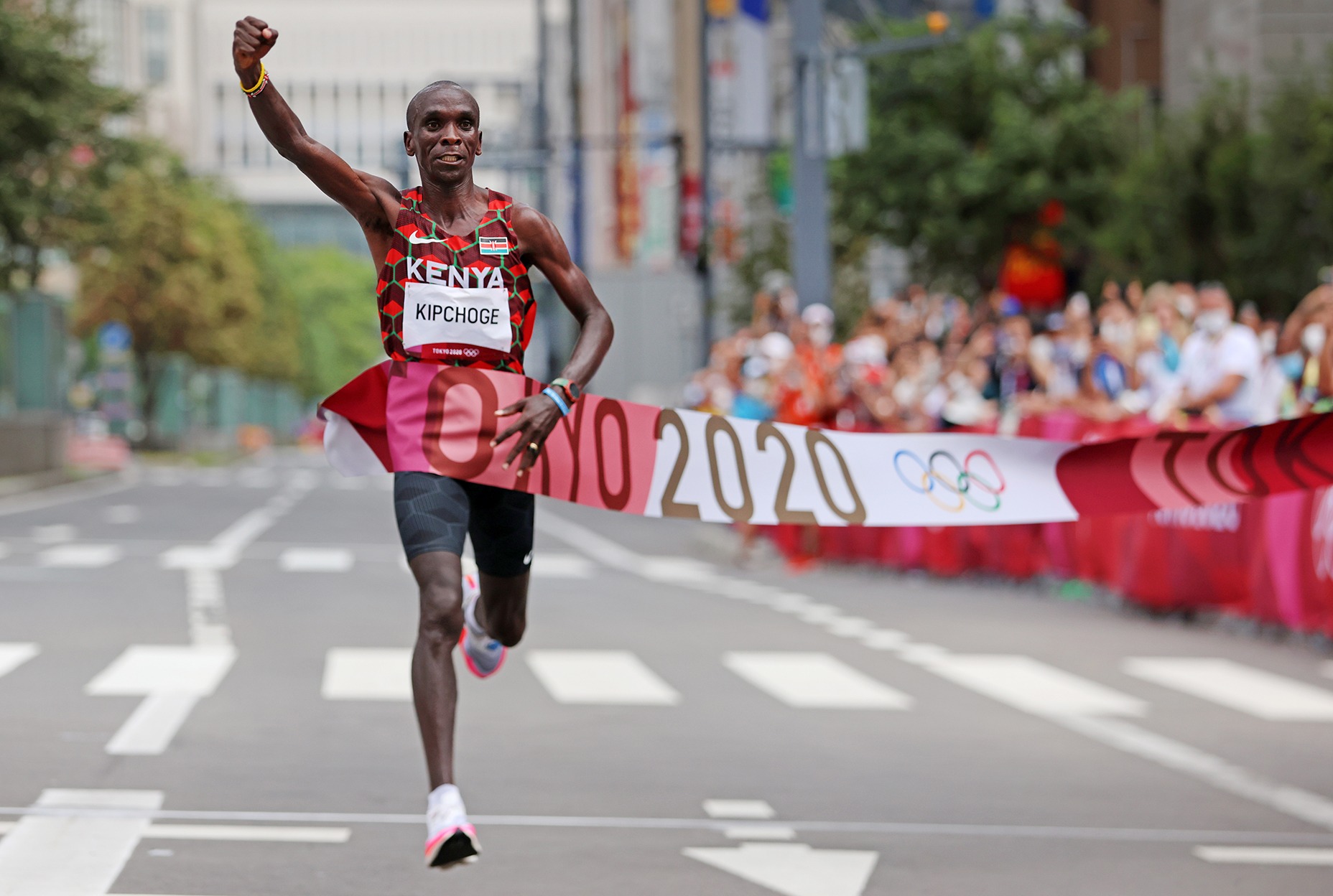
 Kenya's Eliud Kipchoge celebrates winning the gold medal at the 2020 Tokyo Olympics. (Photo: Lintao Zhang / Getty Images)
 The Cape Town Marathon endured a torrid time last year when organisers were forced to cancel the 2025 race just hours before the starting gun was due to go off because of severe wind conditions that made the course unsafe.
It led to accusations of incompetence and negligence by some athletes, who were furious, especially as the wind died down significantly soon after the race was called off.
It was doubly embarrassing as the 2025 race was set for its final evaluation to become Africa’s first World Marathon Major (WMM) event. Due to the cancellation, that evaluation did not take place.
/file/dailymaverick/wp-content/uploads/2025/10/TL_2473585.jpg "Disappointed participants after hearing news of the cancellation of the 2025 Sanlam Cape Town Marathon on 19 October 2025 due to safety concerns over high winds. (Photo: Ashley Vlotman / Gallo Images)")
It has taken race organisers some time to smooth things over with athletes and WMM organisers.
Therefore, the announcement that Kenya’s Eliud Kipchoge, the greatest marathon runner of all time, will take part in 2026 is good news on all fronts.
Kipchoge has redefined what’s possible over 42.2km and has spent the latter part of his storied career using his fame and platform to encourage people to keep moving.
The great Kenyan, at the age of 41, might not start the Cape Town marathon as a favourite, but who would dare count him out, even if his main objective is not winning in the Mother City?
Eliud’s Running World
And the star’s inclusion is beneficial to both parties. Kipchoge’s presence will naturally raise the status and global appeal of the Cape Town Marathon.
For Kipchoge, the Cape Town event, as arguably the best marathon in Africa, gives him a platform to promote his running vision.
Kipchoge has set out to run a marathon on each of the seven continents over the next two years. He aims to inspire people to lead healthier lives while uniting the world through running.
/file/dailymaverick/wp-content/uploads/2022/09/14GettyImages-1427161765.jpeg "Eliud Kipchoge wins the BMW Berlin-Marathon in a world record time of 2:01:09 on 25 September 2022. (Photo: Alexander Hassenstein / Getty Images)")
Kipchoge’s goal is to visit each continent to meet, and run alongside, local running communities and fans. The project also raises funds for the Eliud Kipchoge Foundation, focused on preserving our environment and providing education in areas that need it most.
“Africa is where my journey as a runner began and where the foundation of my success is deeply rooted,” said Kipchoge. “To start this World Tour in Cape Town is very special.
“It is about celebrating the strength of African running and inspiring the next generation. To race my first ever marathon on the African continent holds deep meaning for me.”
Organisers did not shy away from the fact that having Kipchoge in the field will aid their WMM qualification cause.
“Eliud represents the very best of what running can inspire,” said race CEO Clark Gardner.
“To see him race our streets, meet our communities and engage with young runners across the city will be incredibly powerful. Moments like this remind us what is possible when the world’s greatest athletes connect with the places and people that shaped the sport.”
It’s also a coup because, despite his success – two Olympic gold medals and the official (which he no longer holds), and unofficial world records, Kipchoge has competed in only 25 official marathon races. He won 16 of them.
Generally, Kipchoge has limited himself to two marathons a year – focusing on punishing and repetitive training in Kaptagat, Kenya, and less actual racing.
As he has aged, Kipchoge is actually running more in a competitive environment.
In 2025, he ran three marathons – London, Sydney and New York – and this year he might do three more, with Cape Town being the first.
/file/dailymaverick/wp-content/uploads/2022/04/h_57265849.jpg "Kipchoge in action during the ‘Marathon pour Tous’ event (Marathon for all) as part of the Paris 2024 Olympic and Paralympic Games build-up on the Champs Élysées in Paris on 10 October 2021. ( EPA-EFE / Yoan Valat)")
‘Moon landing’
Nearly 70 years ago, Roger Bannister broke the four-minute mile, and in 2019, Kipchoge ran the 42.2km marathon in under two hours – one hour 59 minutes and 40 seconds, to be precise.
It was not a race in the true sense. It was a planned assault on a barrier of human achievement that was attempted in near-perfect conditions and on a near-perfect course in Vienna with the help of pacemakers.
On that day, Kipchoge achieved what seemed impossible – like Bannister 68 years earlier – in pushing the boundaries of human achievement further along a limited spectrum through a combination of science, technology, physiology and sheer talent.
It’s a limited spectrum because humans will never run a marathon in a few seconds, but we still don’t know what the ultimate barrier is. Kipchoge proved that it’s not two hours.
/file/dailymaverick/wp-content/uploads/Tucker-runningshoes1.jpg "Kipchoge breaks the two-hour marathon barrier on 12 October 2019 in Vienna. (Photo: EPA-EFE / Christian Bruna)")
He represents the best of humanity in so many ways. Walking and running are the most basic of human traits, and Kipchoge is the tip of a seven billion-strong spear on the planet today.
Genetic superiority, social circumstances and a long heritage of running have combined to make athletes from specific pockets of Africa create new standards in distance running. Kipchoge’s 2019 record-breaking feat recalibrated what we believe is possible.
African athletes, particularly from East Africa, have dominated middle and long-distance running since the 1960s.
When Bannister clocked three minutes 59.4 seconds at Iffley Road in Oxford in 1954 to dip under the mythical four-minute mark, it was a different world.
Bannister achieved what physiologists at the time considered beyond the realms of possibility, but their data was almost exclusively limited to studies of Caucasian athletes from Western countries.
Black African athletes hardly competed in international events outside the Olympics.
African talent revealed
It was only in the 1960s that the world started to appreciate the latent running talent coming from Africa, in particular.
Barefooted Ethiopian Abebe Bikila started the evolution of African middle and long-distance running dominance with marathon gold at the 1960 Rome Olympics.
Bikila’s moonlight finish in the Eternal City, having covered the 42.2km course over Rome’s rough streets without shoes to break the Olympic record by seven minutes 47 seconds, remains one of the greatest athletic achievements in human history.
But even that has to defer to what Kipchoge did in Vienna.
Kipchoge’s one hour, 59 minute and 40 seconds run was described as the athletics’ equivalent of the moon landing or scaling Everest for the first time. The two-hour marathon barrier was broken. And it took almost as many people and as much time as the moon missions to plan and execute.
But as Kipchoge has matured and won the titles and accolades, he’s also come to realise that his achievements can be a force for good in the world. Like a training run or a race, he doesn’t want to waste a second.
Before the 2022 Laureus World Sports awards, he told Daily Maverick: “Sport has its own unique language – sport can talk to the youth, to the woman, to the man and children in a different way. Sport is the way to go in this world.
“I really want to go around the world – in North America, in Indonesia, in Thailand – just to run and to show people that sport is great. It can bring unity, it can make you healthy… it can make you think positively. That’s the only way to make our world a united world.” DM