




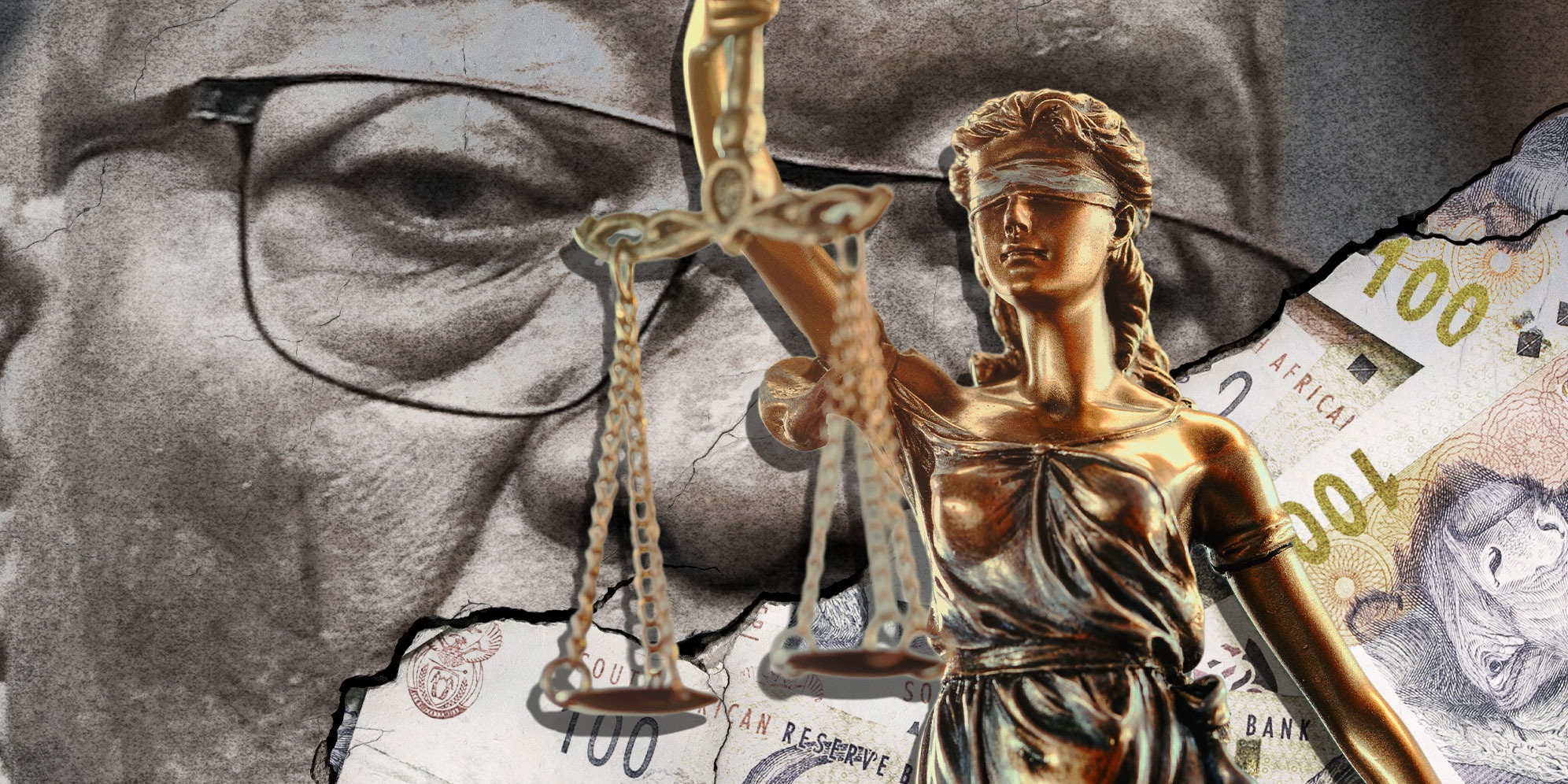
 Illustratiive Image: Former president Jacob Zuma. (Photo: Gallo Images / Darren Stewart) | Money. (Image: iStock) | Lady Justice. (Photo: iStock) | (By Daniella Lee Ming Yesca)
 /file/dailymaverick/wp-content/uploads/2025/10/label-analysis-2.jpg)
It is often said that justice delayed is justice denied. Unfortunately, the evidence shows that the only limit to how long an accused can deny their date with justice is their bank balance. This should be reviewed. If only to restore the balance between the rights of the accused and the rights of the victim.
Two weeks ago the convicted murderer and rapist Thabo Bester lost an application to overturn a decision to move him to the eBongweni Super Maximum Prison in KwaZulu-Natal.
His response was to bring a second application, making the same request, on the same grounds.
It too was denied.
He lost nothing through doing this. Instead, he gained a few hours of relative freedom in a courtroom rather than his cell.
The villain of the moment, Vusimuzi “Cat” Matlala, has recently brought application after application, sometimes for bail, sometimes to be moved from eBongweni back to Pretoria.
Their inspiration for this might well have been former president Jacob Zuma, who has brought application after application on any issue he can think of – whether to challenge the decisions to prosecute him, to remove the prosecutor or whatever his legal team dream up.
The net consequence is that the case against him has not started.
There has been a very real consequence for the future direction of the country as a result.
There can be no doubt about the power of the spectacle of a politician who has to give answers under oath. It has the potential to change the entire narrative, and the future of that politician and the country.
/file/attachments/orphans/ED_597796_631802.jpg "Vusimuzi ‘Cat’ Matlala in the Johannesburg High Court on 26 February 2026. (Photo: Gallo Images / Luba Lesolle)")
Even though it was not a court of law, the fact that politicians had to answer questions under oath at the Zondo Commission must have played an important role in the ANC’s loss of support in the 2024 elections.
The current inquiries might have a similar impact on the careers of people such as Senzo Mchunu.
Equally, answering questions under oath has the power to accelerate a politician's career.
While Zuma might have something to fear from undergoing cross-examination, it would also be an opportunity for him to tell his story.
As Julius Malema has shown since at least 2011, a political performance from the dock has huge power.
/file/attachments/orphans/ED_593340_900763.jpg "Julius Malema appears for pre-sentencing in the firearms discharge case at the East London Regional Court on 23 January 2026. Malema was convicted in October 2025 of unlawfully possessing and firing a firearm in public, from a 2018 incident where he fired a rifle at a rally. (Photo: Gallo Images / Randell Roskruge)")
Even if Zuma’s trial had not progressed to the point where he would have to testify (normally at the start of the case for the defence, and even then there is no obligation on the accused to testify), witnesses would have testified against him.
This could have changed the political narrative for millions of people.
The reason this happens, of course, is that there is nothing for Zuma, or Bester or Matlala or a Special Forces general in the SANDF, to lose.
When they lose an application, and all of the subsequent appeals, it is impossible to take any punitive action against them.
This means the only limit to the delay they can introduce to the system is money.
An ordinary person would not be able to pay the lawyers what it costs to do this (while Matlala and Zuma clearly have resources, the source of Bester’s legal fees may still be a mystery).
Judges appear almost powerless to stop it. They do not have the legal authority to tell a person not to bring an application. And once it’s brought they have to adjudicate it.
The only, very limited, power they have is to say they will only decide the case on papers. That removes the option of endless oral arguments and speeds things up.
The reason the law allows this is that it is based on the constitutional obligation to treat a suspect as innocent until proven guilty. That is rooted in the Freedom Charter and was a response to the oppression of apartheid.
In our parliamentary politics there appears to be virtually no appetite to change this, or at least reform the legal system that allows the rich to escape justice indefinitely.
This may be because some in Parliament have good reason to believe that they might need this option in the future.
But away from Parliament, the fact that vigilante groups now appear to literally control certain areas shows that people have given up on the criminal justice system.
They are aware that murderers like Bester and suspects like Zuma are able to abuse the system. They also know the system will not work for them and thus they take things into their own hands.
This in turn leads to more violence and killing.
Of course, it is difficult to contemplate what reforms could be implemented that would prevent this kind of tactic.
But some measures could be considered. Perhaps there could be a simple limit to the number of applications that can be brought before a trial starts. The decisions a judge makes in pre-trial applications could only be allowed to be appealed when the verdict of the trial is appealed.
That alone could shorten the time it would take for a trial to begin and evidence to be heard.
Another, probably more controversial suggestion would be some kind of punitive measure for an application that is deemed pointless. This could be done through costs, with judges allowed to increase the scale of costs in relation to the assessed pointlessness of the original application.
Another approach would be to put more obligations on the lawyers and advocates who represent clients who bring these applications. While they have a duty to take instructions from their clients, perhaps they could also be obligated to honestly tell their clients that an application is hopeless.
Legal bodies, such as the Legal Practice Council, could insist that their members sign a code of conduct promising that they will not engage in litigation that is aimed only at wasting time.
There are some who might dismiss the above as just the meanderings of a member of the commentariat who has a political agenda.
But these delays have serious consequences for our entire society. And, most importantly, for the victims of crime. It is often forgotten that they have rights too. They must have the right to see a case concluded one way or another, and to close that chapter on their lives and finally move on.
Voters must surely have a right to know the facts of the cases around Zuma, particularly because they have divided the country for more than 20 years.
But more importantly, we have a right to justice.
And that is being denied.