



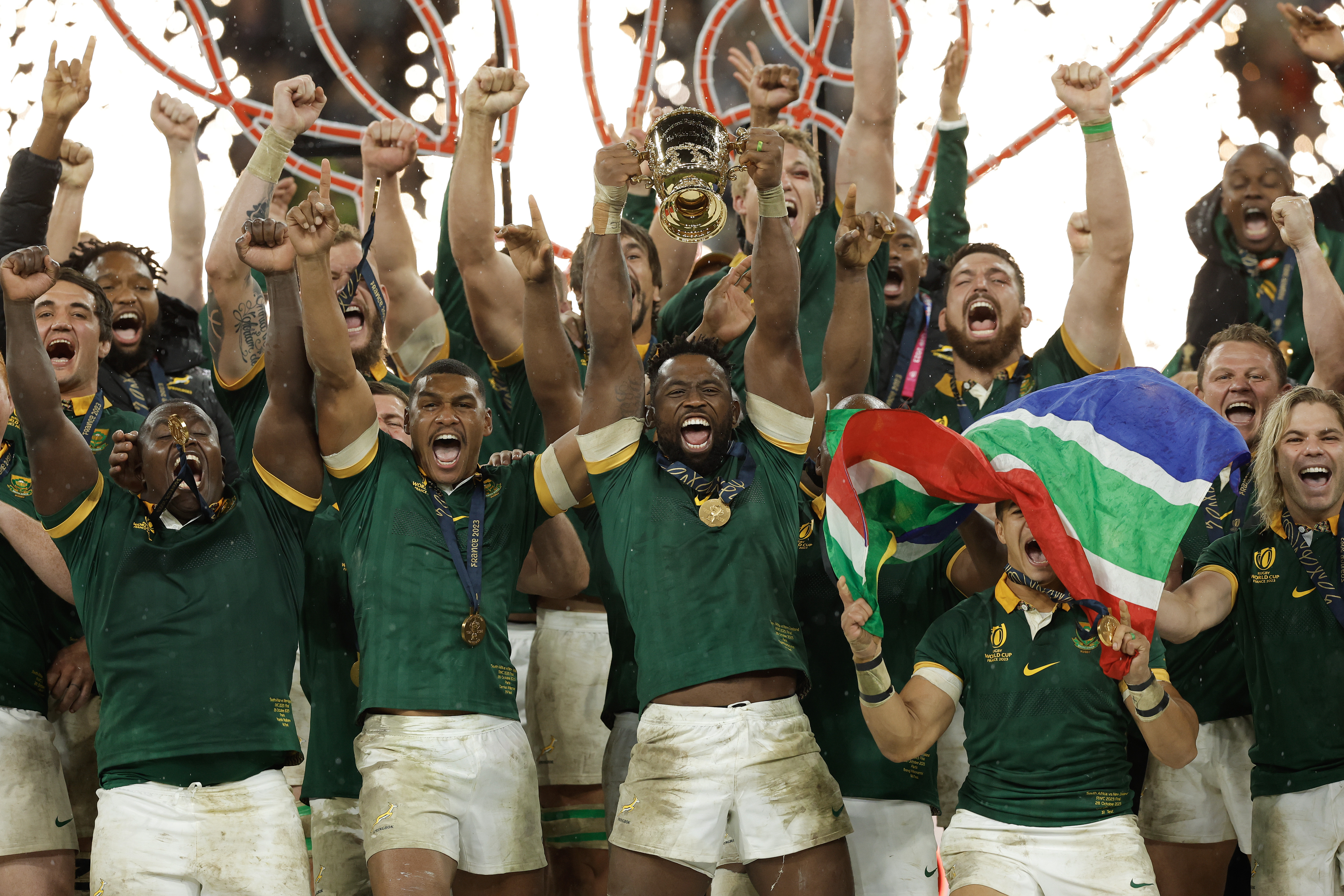
 South African captain Siya Kolisi lifts the Webb Ellis Cup after the Boks won RWC 2023 with a 12-11 victory over New Zealand in Paris. (Photo: Tom Jenkins / Getty Images)
 /file/dailymaverick/wp-content/uploads/2025/10/label-analysis-2.jpg)
A recent Daily Telegraph report highlighting a “sixfold decrease” in drug testing by the South African Institute for Drug-Free Sport is, on the surface, a jarring statistic.
But the logical gymnastics it took to go from that starting point to being given as the reason why the Springboks have won back-to-back Rugby World Cups, was impressive.
In a country where rugby dominates sporting discourse and involves millions of participants from schools through to the professional level, any perceived slackening of doping control is bound to raise eyebrows. However, to link it directly to the Springboks’ back-to-back World Cup triumphs is not just a leap – it’s a fundamental misrepresentation of the “global net” that governs modern professional rugby.
The Telegraph’s story implies throughout that the current Boks are drug cheats, without actually saying so. They display an old picture from a pre-RWC 2019 game as some sort of “proof” of doping.
/file/attachments/orphans/WhatsAppImage2026-03-03at092633_486666.jpeg "The picture that did the rounds on social media after the Boks beat Japan 41-7 in a RWC 2019 warm-up match in Kumagaya. (Source: Unknown)")
Further using the positive doping tests and convictions of a handful of players over the past decade such as Chiliboy Ralepelle, Elton Jantjies and Aphiwe Dyantyi as “evidence” of systemic doping, is sensationalist.
“The significant drop in testing has coincided with the Springboks becoming the most dominant force in Test rugby, winning back-to-back World Cups in 2019 and 2023,” the report states.
“South Africa is the nation with the highest number of convicted dopers in rugby with 89 violations in that time, which is around 20 per cent of the entire total worldwide.”
The implication is obvious.
/file/attachments/orphans/120088820_303390.jpg "Former Bok hooker Chiliboy Ralepelle is one of a few South African players who received a doping ban. (Photo: Hannah Peters / Getty Images)")
Global team
What the story fails to address, because it wouldn’t suit the narrative, is that the current Bok squad is among the most tested group of rugby players on the planet – even with SA Institute for Drug-Free Sport’s drop-off in testing.
The narrative of a “testing vacuum” relies on the outdated idea that elite South African players exist solely within the jurisdiction of their home-grown agency. This ignores the reality of a globalised sport.
More than a dozen members of the current Springbok squad play for international clubs in France, Japan, Ireland and England.
When a player such as Bath’s Thomas du Toit, or Leicester’s Jasper Wiese (when he was there) steps onto a pitch in Europe, they aren’t waiting for a knock on the door from an SA Institute for Drug-Free Sport official, they are subject to the rigorous, year-round testing protocols of French Anti-Doping or UK Anti-Doping.
Japanese-based players such as Damian de Allende, Pieter-Steph du Toit, Faf de Klerk and Jesse Kriel, among others, face similar scrutiny from Japan’s doping controllers. Ditto RG Snyman and Jean Kleyn in Ireland.
/file/dailymaverick/wp-content/uploads/2022/11/Rugby-Jantjies-problems_32.jpg "Former Bok flyhalf Elton Jantjies is another who failed a doping test and was banned. (Photo: Gordon Arons / Gallo Images)")
But even locally based SA players are not only subject to scrutiny from the SA Institute for Drug-Free Sport’s.
SA’s elite players compete in the cross-border United Rugby Championship and European Professional Club Rugby competitions, which are subject to UK Anti-Doping and French Anti-Doping testing.
And when the Springboks play outside of SA, their entire squad is at the mercy of the doping controls of other jurisdictions.
At the very bottom of the Telegraph story, it even quotes a World Rugby spokesperson confirming the rigorous testing Boks players undergo.
“South African players, alongside many other nations, will be in our testing pool so we test them all year round, including out of competition. Our out-of-competition testing includes home visits.
“Players will also be tested by us at Rugby World Cup, European Professional Club Rugby competitions if they play in them, and as part of [what was] the autumn international series.
“Lab issues in SA have occurred before, and where we face those issues in that country or any other, samples are shipped overseas, which is established and acceptable, provided shipment follows World Anti-Doping Agency guidelines.”
Issues
Ironically, over the past two years the only Bok squad member to breach doping protocols is prop Asenathi Ntlabakanye, who was prescribed medicine containing a banned substance by a specialist and declared it on a form.
/file/dailymaverick/wp-content/uploads/2025/08/TL_2422530.jpg "Springbok prop Asenathi Ntlabakanye faces a doping hearing later this month. (Photo: Richard Huggard / Gallo Images)")
The SA Institute for Drug-Free Sport was the agency that has sanctioned him, although the case is far from clear-cut as Ntlabakanye has strong evidence he was let down by medical professionals.
He is currently playing for the Lions in the United Rugby Championship and not provisionally suspended. That’s because there was no adverse finding emerging from a doping test – it was negative.
But Ntlabakanye is facing charges because he declared the medication he was taking on a form, which contained a prohibited substance. That case will reveal some interesting and uncomfortable facts for allegedly negligent doctors.
Under World Anti-Doping Agency regulations though, Ntlabakanye is likely to face at least a two-year ban due to the policy of strict liability.
What is undeniable is that the SA Institute for Drug-Free Sport, in its current form or its previous incarnation, has routinely caught dopers in rugby.
Craven Week has long been a touchy subject where players have been caught – sometimes as many as five doping violations in one year.
But the tone of the Telegraph piece is to heavily imply some sort of systemic doping in South African rugby, and lists the 11 successful doping cases involving professional players in 30 years.
It’s 11 too many of course, but is it really a sponsored doping programme, as implied?
/file/dailymaverick/wp-content/uploads/2023/06/GettyImages-1063012236.jpg "Former Bok wing Aphiwe Dyantyi served a four-year ban for doping. (Photo: Mike Hewitt / Getty Images)")
Government failure
What is true and undeniable is that the national government is failing the SA Institute for Drug-Free Sport and the entire doping system.
In 2023 Daily Maverick broke the story that the Springboks faced playing the quarterfinal of Rugby World Cup 2023 under a neutral flag because SA was not compliant with the World Anti-Doping Agency’s anti-doping code. That was not due to the SA Institute for Drug-Free Sport’s negligence, but rather to government apathy/incompetence.
On 23 September 2023, the World Anti-Doping Agency issued a statement confirming that SA had not updated its anti-doping code and had fallen foul of the agency’s mandatory compliance requirements, and faced consequences starting with a flag ban.
On the back of Daily Maverick’s reporting, the government was roused into action and in April the following year, after gaining an extension, the amendment to the draft bill was made and gazetted.
It never needed to get that point as SA Institute for Drug-Free Sport had done the work and held information sessions well in advance of the original World Anti-Doping Agency deadline. It was a huge embarrassment for SA, and by extension the SA Institute for Drug-Free Sport.
The South African anti-doping system took a further hit in 2024 when the agency formally suspended the accreditation of the South African Doping Control Laboratory (the Laboratory) in Bloemfontein due to “multiple non-conformities with the International Standard for Laboratories”. This was done on the recommendation of the Laboratory Expert Advisory Group, which monitors the agency’s accredited laboratories globally.
The Bloem Lab had its accreditation fully withdrawn last year, and as a consequence the SA Institute for Drug-Free Sport is having to send samples to overseas laboratories for testing. That costs more and has led to fewer tests because of a funding shortfall, which the Telegraph points out.
“According to figures published by the World Anti-Doping Agency (Wada), the number of tests carried out within rugby by the South African Institute for Drug-Free Sport (Saids) fell from 785 in 2015 to just 127 in 2024,” the Telegraph notes.
The SA Institute for Drug-Free Sport, under CEO Khalid Galant, is pursuing alternative sources of income through sponsorship and other funding models. But this should be part of the national sports budget.
The institute received a baseline grant of R31-million in 2025/26, which is projected to rise to R33.6-million by 2028. But costs of testing have soared as they must be sent to Qatar or Belgium and paid for in US dollars or euros. There is no denying that the constraints on the institute to do an effective job are immense and serious.
/file/attachments/2989/1181615597_771885.jpg "Siya Kolisi and Francois Louw during the Rugby World Cup 2019 champions parade in Cape Town following victory at RWC 2019. (Photo: Ziyaad Douglas / Gallo Images / Getty Images)")
But in the context of Springbok players, the connection between two World Cup wins and doping abuses is non-existent and potentially libellous.
Sensationalism sells, especially when it targets a dominant team. It is easy to point to a photo of world-class athletes in peak physical condition after a brutal two-month build-up to RWC 2019 and cry foul.
But the “cloud” over SA’s success is largely manufactured by ignoring the global net that catches elite players every day, and into which all Bok players fall. DM