




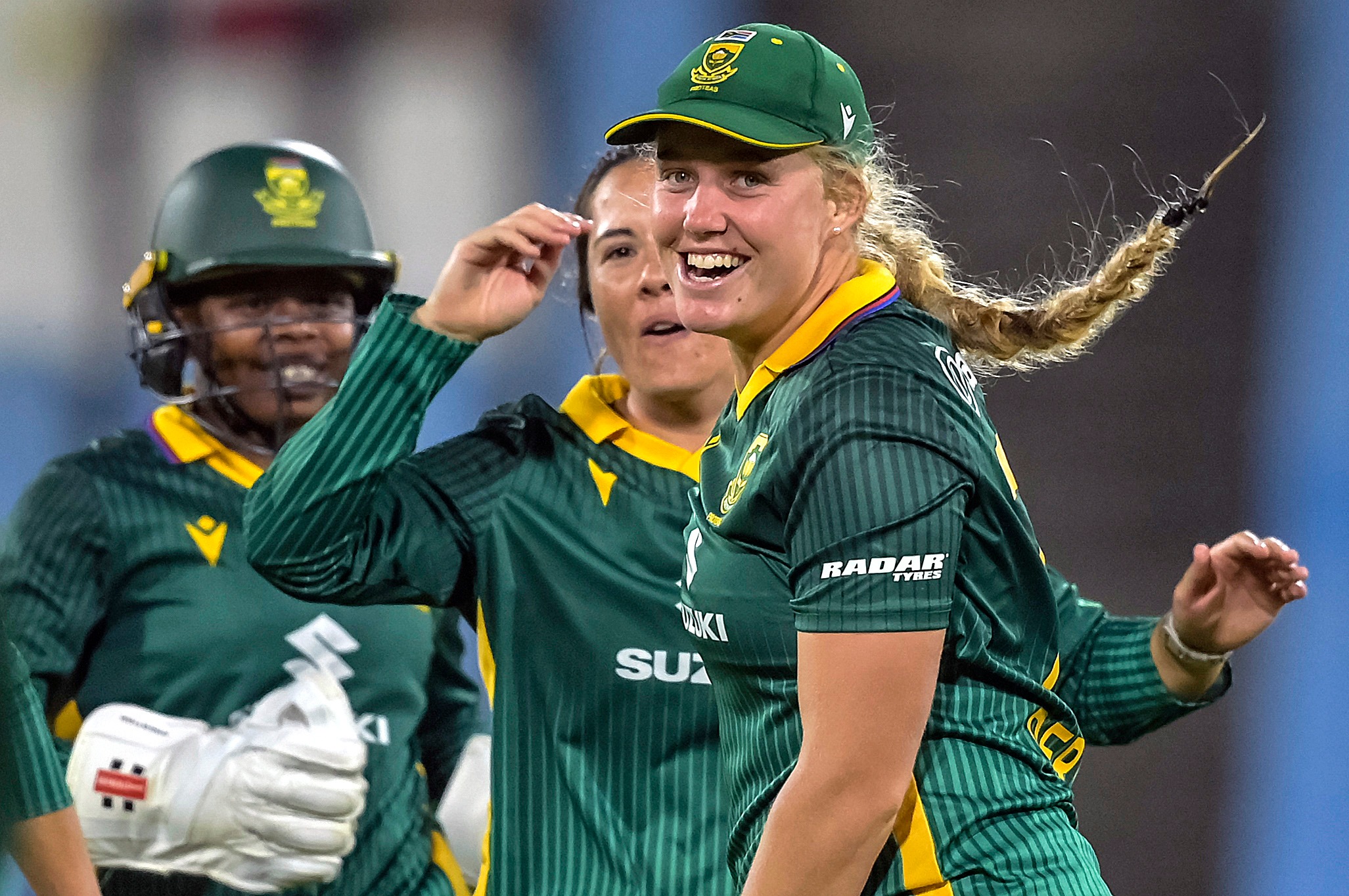
 Proteas all-rounder Annerie Dercksen celebrates after another wicket during the second Women's ODI against Pakistan at SuperSport Park on 25 February 2026. (Photo: Christiaan Kotze / Gallo Images)
 Despite securing both the T20 International and One Day International (ODI) series against Pakistan, the Proteas Women leave the tour with as many questions as answers.
Moments of sloppy fielding and inconsistent bowling exposed cracks that, against stronger opposition, could prove decisive, forcing the side to go back to basics if they hope to finally claim a maiden World Cup title.
For half a decade, the Proteas Women have established themselves among the sport’s elite.
Three consecutive World Cup final appearances have cemented their reputation as genuine contenders and a side few opponents can afford to underestimate.
Yet the final step has remained elusive.
Another opportunity awaits in June, when South Africa (SA) travels to England for the Women’s T20 World Cup starting 12 June.
With a tough pool awaiting them, the Proteas will need precision and consistency across all departments if they are to turn sustained promise into a historic breakthrough.
/file/attachments/orphans/TL_2493249_536209.jpg "Nondumiso Shangase and head coach Mandla Mashimbyi in the nets in Cape Town. (Photo: Grant Pitcher / Gallo Images)")
Back to basics
Currently, the Proteas are playing a bilateral series against Pakistan where they won the T20I series 2-1, and have won the ODI series 2-0 with one more game left to play.
Despite their dominance against the South Asian squad, the series has exposed gaps within the fielding and bowling units.
In their second ODI against Pakistan on Wednesday, the Proteas were sloppy in the field with a few dropped catches and ill-disciplined line and length. They bowled a staggering 24 wides.
Read more: Rabada bounces back in style after Markram’s backing as Proteas crush Windies
Prior to that, in their dead rubber T20 game against Pakistan, the Proteas delivered a poor performance as they suffered a 53-run defeat.
In that game, the women bowled eight wides, while fielding proved inconsistent for the hosts, who executed four run outs but dropped five catches.
/file/attachments/orphans/TL_2525220_103631.jpg "Ayanda Hlubi and Annerie Dercksen celebrating with teammates during the series against Pakistan. <br>(Photo: Christiaan Kotze / Gallo Images)")
(Photo: Christiaan Kotze / Gallo Images)
Coach’s admission
“We haven’t been great on the field,” Mandla Mashimbyi, head coach for the Proteas Women, admitted to Daily Maverick. “We’ve been putting down a couple of catches unnecessarily […] And that’s probably one of the biggest ones... that we’re not doing the simple things well enough all the time, so we just have to have the patience in our processes and just focus on executing the simple things very well.”
While Mashimbyi recognises that there is room for improvement in the fielding and bowling, it is nothing to be “concerned” about.
However, the coach does acknowledge that the team may have to revert to basics and be focused and engaged if they want to be competitive.
“It’s been a good series so far […] and we’ve been playing some really good cricket,” said Mashimbyi. “The scary thing about this team is that the potential that we have as a team is still there and we’re winning.”
Depth and flexibility
Perhaps a correlation could be drawn between the impressive results the Proteas Women are getting with an increase in depth and flexibility in the squad.
As Annerie Dercksen noted in a post-match interview after the second ODI against Pakistan, the batting unit is no longer reliant on the openers to set the platform, with greater depth allowing others to build or recover the innings.
“I think it’s well documented that in the past, if (Laura) Wolvaardt doesn’t perform, it will be hard for us to win matches,” said Mashimbyi in agreement. “What I challenge the team is that we can’t rely on one or two players. We need to rely on the whole squad and the whole team.
/file/attachments/orphans/TL_2524908_697675.jpg "Sinalo Jafta scored her maiden T20I half-century during the series against Pakistan. <br>(Photo: Christiaan Kotze / Gallo Images)")
(Photo: Christiaan Kotze / Gallo Images)
“Since I’ve taken over, I’ve seen that growth within the group where different people are putting their hand up when it matters, and that bodes well for this team,” he said.
If anything, this series against Pakistan has also highlighted the progress and growing depth within the South African squad, with several players delivering standout performances.
As usual, captain Wolvaardt dominated with the new ball when she scored a 38-ball 61 in the first T20I match against Pakistan, setting the tone for the series.
Teammate Sinalo Jafta scored an unbeaten 57 off 38 balls, her maiden ODI half-century, in her milestone 50th ODI appearance on 22 February.
Read more: Laura Wolvaardt — A skipper who steps up when it matters most
Putting up her hand in the bowling order is young gun Ayanda Hlubi, who has only played 16 games across ODI and T20. During the opening T20 game against Pakistan, Hlubi announced herself when she took three wickets in three overs.
The South African women’s all-rounder game is also strong, and can provide a unique flexibility for the team and team selection, said Mashimbyi.
Kayla’s ‘disciplined spell’
In the opening T20, Kayla Reyneke delivered a disciplined spell, claiming two for 13 from four overs at an economy rate of 3.25.
She then went on to bat an unbeaten 29 runs off 16 balls, earning herself player of the match and a spot on the squad for the upcoming New Zealand bilateral series.
It was also the first senior national call-up for the former South African Women’s U19 captain.
Then in the first 50-over game against Pakistan, Suné Luus produced an exceptional performance when she delivered an unbeaten 76-ball 93 and restricted Pakistan by claiming two for 31.
This past Wednesday, 24-year-old Annerie Dercksen delivered a stellar all-round effort when she top-scored a 68-ball 90 to steer SA to a dominant 361 for eight.
Pakistan fought hard with the bat, but Dercksen had another hand in removing key players when she claimed three wickets.
“A lot of teams don’t have that, where you get people that can bowl and bat,” Mashimbyi told Daily Maverick, when asked about the relatively large number of all-rounders in the team.
“You don’t want to have too many of them, but when you do have them, it’s almost like it allows you to be flexible,” he said. “It’s actually a good thing for us, and this is something that I’ve found here, and I just worked with it to find the best formula for it to work for us.”
/file/attachments/orphans/TL_2451200_821182.jpg "Proteas Women head coach Mandla Mashimbyi believes his side has the potential to win a World Cup. (Photo: Lubabalo Lesolle / Gallo Images)")
Preparation for tough pool
In preparation for the upcoming T20 Women’s Cricket World Cup, the Proteas will travel to New Zealand for a bilateral series where they will go up against the Black Caps in five T20Is and three ODIs between 15 March and 4 April.
They will then return home for a five-match T20I series against India before they head off to England in June for the World Cup.
The Proteas have a tough pool in the World Cup with India, Australia, Pakistan, Bangladesh and Netherlands, however, Mashimbyi believes the squad have shown that they have what it takes to claim their first World Cup trophy.
“We’ve shown that we can beat the best in the world and also we’ve shown that we can get to a final so that should give us a boost in terms of our belief, and knowing that we can actually do it and we can beat anybody in the world,” he said. DM
The Proteas Women will play their final ODI match against Pakistan this Sunday, 1 March at 10am.