



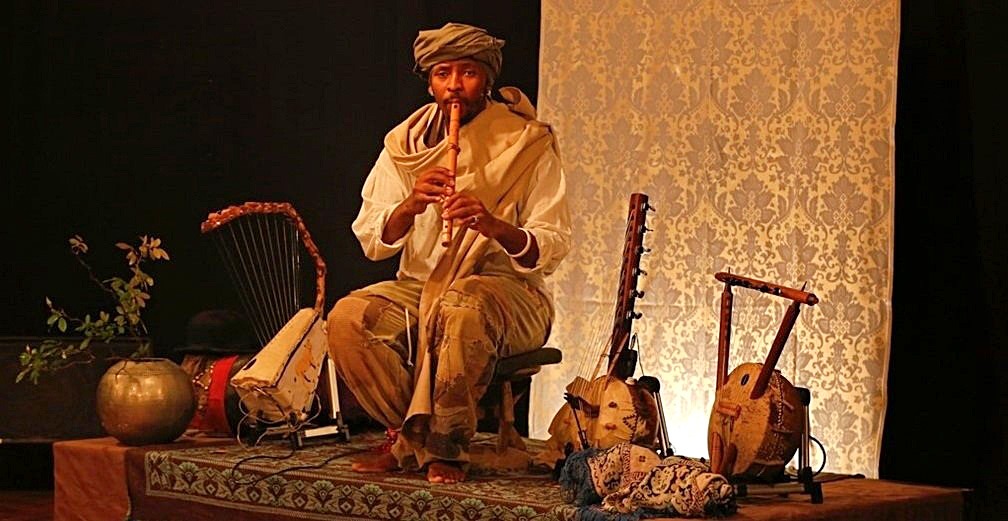
 Nkosenathi Koela as Orpheus in The Stranger, a ritualistic adaptation of the Orpheus myth. (Photo: Yusuf Abrahams)
 Theatre-maker Brett Bailey is no stranger to creating theatre that transcends the ordinary, defies easy categorisation, perplexes.
He has previously created such boldly idiosyncratic works as the multimedia musical Samson; an ambitious take on Verdi’s opera, Macbeth, set in postcolonial Africa; and the contentious performance installation, Exhibit B.
In recent years, he has staged unusual immersive performance events at Spier, where he lives and works and continues to purposefully distance himself from mainstream theatre. He has always avoided commercial art, preferring methods and approaches that veer outside established boundaries while pushing the envelope in order to provoke and prompt audiences to think, feel and respond in new ways.
His latest production is The Stranger, a ritualised dramatisation of the Orpheus myth, which he has recreated in various forms over the past two decades.
He’s had “a quiet obsession with the Orpheus myth” since stumbling on it in the early 2000s.
“It won’t let go of me,” he says. “It resonates powerfully with something inside me. I return to it again and again trying to capture the essence of it.”
Bailey calls Orpheus “the first poet-musician of classical mythology”, someone whose “exquisite music attracted animals, trees, and even rocks towards him”. He represents “the capacity of artists to create form and meaning out of seemingly chaotic reality”.
“Orpheus is many things to me,” Bailey says. “He embodies the creative, organising principle that manifests within us; an artist whose creative skill is so in tune that it both reveals the underlying order of the cosmos and creates that order out of chaos. He’s an outsider who enriches society with the gifts he brings.”
Orpheus is also shamanic, says Bailey, in the sense that “he moves between physical and metaphysical realms”.
“He is connected with the sacred, shimmering beauty both of the natural world, and of so many objects, structures and thought systems shaped by human genius.”
/file/attachments/orphans/BrettBaileyworkingwithperformerSiyaMvandabainrehearsal_YusufAbrahams_772113.jpg "Brett Bailey working with performer Siya Mvandaba in rehearsal. (Photo: Yusuf Abrahams)")
Bailey has created various theatrical iterations of the myth over the years, including Orfeus at Spier in 2006, which he reconceptualised for the National Arts Festival the following year, and again reworked for performances in Amsterdam, Vienna and Hannover in 2009 and 2011.
He rewrote it as The Stranger for the National Arts Festival in 2024, which brings him to the current version, which has been reworked yet again.
“Each time I revisit it, I rework it, making new associations, integrating new threads,” he says. “It is a perfect vehicle for my artistic concerns with the synthesis of ritual and theatrical performance, and the interweaving of the myths of diverse cultures in order to bring contemporary issues to the surface. In this case, xenophobia, racism, misogyny and violence.”
Bailey believes it “is so appropriate for our historical moment, wracked as it is by death, conflict, alienation and confusion, and characterised by disrespect for the natural world and the devaluation of beauty and of soul”.
In this latest telling, Orpheus is an immigrant who brings his transformative songs to a Cape Town afflicted by xenophobia.
“His story amplifies the enrichment that foreigners can offer to our increasingly phobic societies,” Bailey says. “Orpheus arrives in Observatory having travelled for years from a small, rigid African town: he’s treated as yet another immigrant, a stranger, not to be trusted.
“But the music he performs here expands the consciousness of all who hear it, and he’s celebrated. At least until – when his art becomes too complex, too textured to contain in a box – he’s perceived as a threat, and eventually murdered by a mob.”
Music, which runs throughout the piece, is also key to the consciousness-expanding intention of the performance.
Collaborating with Bailey in the role of Orpheus is the transdisciplinary, multi-instrumentalist composer-artist Nkosenathi Koela, who works with the transformative sonics of indigenous African music.
/file/attachments/orphans/CollaboratingwithBaileyintheroleofOrpheusisthetransdisciplinarymulti-instrumentalistcomposer-artistNkosenathiKoela_YusufAbrahams_787140.jpg "Collaborating with Bailey in the role of Orpheus is the transdisciplinary, multi-instrumentalist composer-artist Nkosenathi Koela. (Photo: Yusuf Abrahams)")
Koela, whose ancestors include a line of traditional instrumentalists, diviners and healers, is a creator of Afro-spiritual soundscapes that serve as sonic bridges between realms. It is said that “to hear his sound is to hear the ancients; stories of pain, loss, love and hope, to journey into the unimagined and reimagined”. His music has been described as “sonic alchemy”, connecting spiritual, traditional and modern soundscapes in ways that “provide healing and emotional resonance”.
For The Stranger, Koela has composed a score for three musicians; Bailey describes it as “profoundly moving”.
Not that such emotional resonance or the beauty of the music will necessarily offer easy answers or any kind of straightforward logic. Bailey acknowledges that the art he strives to create is that which “complexifies reality”.
Bailey says he is “more interested in ritual than theatre in this work”. More than a staged play or a dramatised story, it’s a kind of immersive ritual, a meditation on the fragile interconnectedness of all life forms, and on the power of art to heal and transform.
“Ritual and theatre are distinct, yet overlapping spheres,” he says. “Ritual often employs theatrical devices (such as costume, staging, role play) and theatre occasionally draws on ritual (aesthetics, texture, structure, and maybe transformational intent). The Stranger feels and looks like ritual, but of course it’s a work of theatrical art.”
Bailey says that the ancient, primal stories that we regard as myths are “rich in paradox and mystery, similar to dreams in their imagery and logic”.
/file/attachments/orphans/BrettBaileywithperformerIndaloStofileinrehearsal_YusufAbrahams_461541_293149.jpg "Brett Bailey with performer Indalo Stofile in rehearsal. (Photo: Yusuf Abrahams)")
His productions, whether you see them as theatrical rituals or ritualised theatre, in many ways operate in this dream-like, in-between space.
“One of my fundamental creative objectives,” he says, “is to make work that activates deep feeling and reflection – within both performers and spectators – and that resonates on a symbolic level: beyond the rational and closer to the spiritual or metaphysical.
“I’m not a fan of art that shoves a message down people’s throats, or tells us what to think,” he says. “Nor of art that spells everything out in black and white or proclaims its ideological identity like a banner.”
When an interviewer in Paris once asked him what message he wanted to give audiences, he replied: “If you want a message go to TikTok or X or a news channel.”
“I work with my material and with my collaborators with the intention of making a performance of disquiet and beauty that rings at a level deeper than the rational,” he says.
“The performers are actively working as channels for archetypal energies much bigger than themselves, and bringing deep presence into the space. And this sense of expansive presence, of subtle energies vibrating just below the surface – and also of the unfathomable density of death that looms over our existence – is what we bring to the audience.”
It is, Bailey adds, “the kind of experience we have in nature and in dreams, in sacred places and in rituals”. He calls these moments “rare treasures”, increasingly rare since we live “in an era of so much technology, shouted opinion and disconnection”.
“There is no black and white; there are no simplistic notions of good and bad, right and wrong; there are no easy resolutions,” he says. “I open a multilayered, affective world, where paradox, ephemerality and unease hold sway, and realms are entangled. And it’s up to each spectator to navigate it. Or not.” DM
The Stranger will be performed at Theatre Arts in Observatory, Cape Town, on 27 and 28 February. There are two showings each evening, back to back at 7pm and 8.30pm.