



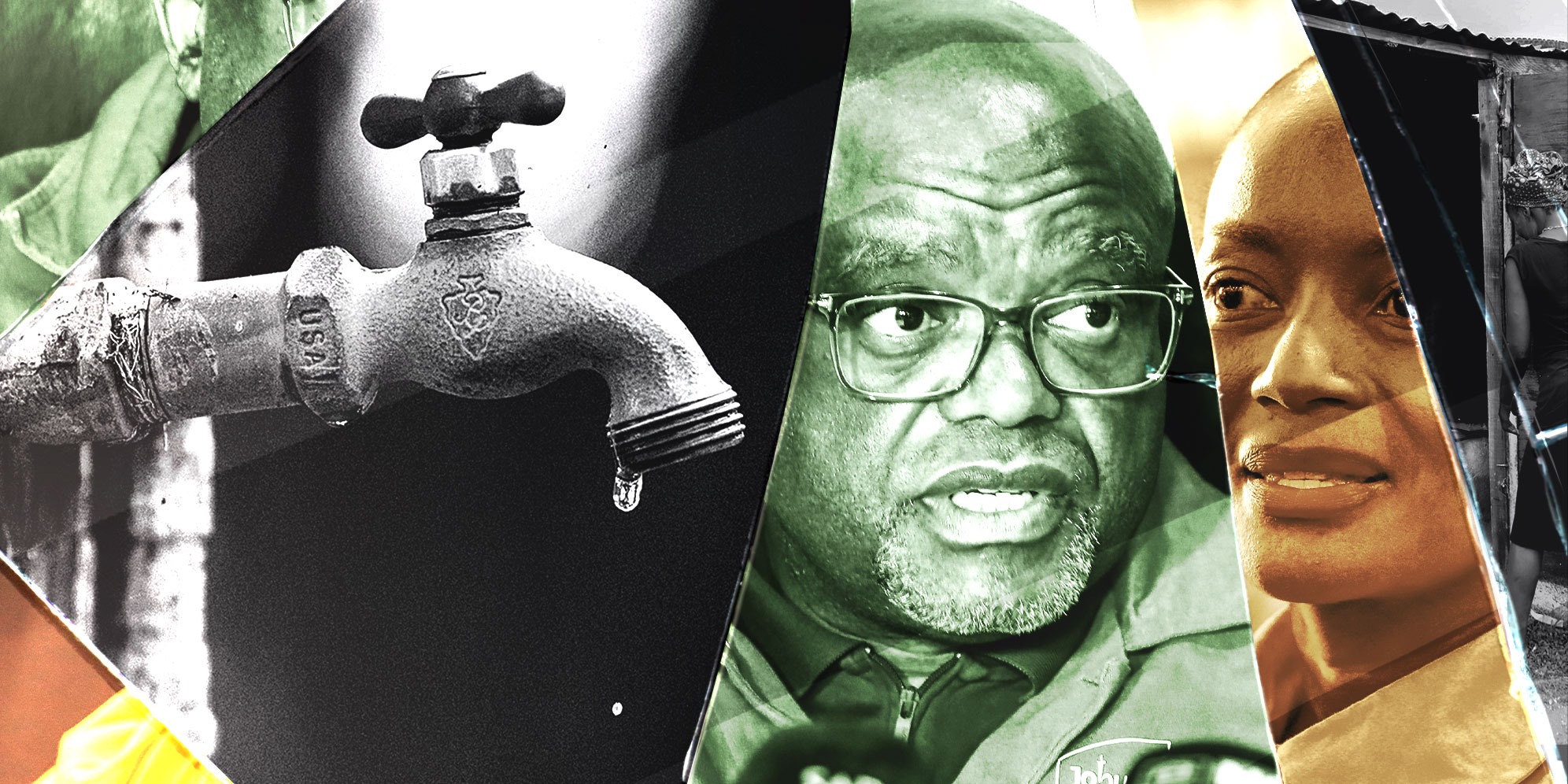
 Illustrative image: Tap. (Image: Unsplash) | Johanneasburg Mayor Dada Morero (Photo: Sharon Seretlo / Gallo Images) | ANC Gauteng leader Loyiso Masuku. (Photo: Sharon Seretlo / Gallo Images) | A pit latrine toilet in Ekurhuleni, South Africa. (Photo: Fani Mahuntsi / Gallo Images) | (By Daniella Lee Ming Yesca)
 There can be no hiding the fact that the bad news is piling up for ANC leaders in Gauteng. Much of this is driven by failing service delivery, rising levels of corruption and what appears to be entrenched factionalism driven by leaders in ANC regions.
On Friday, it emerged that after weeks of anger, frustration and protests over Joburg’s water crisis, Rand Water is now demanding a deposit of R2.4-billion from Johannesburg Water.
The reason is obvious: Johannesburg Water has not been paying what it owes, despite residents paying for the water they consume. Instead, it seems that revenue is still being taken into the “sweeping account” and not returned.
It is not clear what really happens to the money. But residents without water might well have some ideas on where it is really going.
On Thursday, reports emerged that the CEO of City Power, Tshifularo Mashava, has resigned. The Hawks had previously said she should be charged for her alleged role in corruption, following a raid on the City Power headquarters.
Meanwhile, there seems to be no resolution to the “two centres of power” problem in Johannesburg, where Dada Morero is the mayor and Loyiso Masuku the leader of the regional ANC
Ekurhuleni fiasco
In Ekurhuleni last week, Mayor Nkosindiphile Xhakaza removed several EFF councillors from his mayoral committee. The EFF has since promised to stop supporting the ANC in Ekurhuleni and in the Gauteng legislature.
It would make sense for the Gauteng ANC leader, Premier Panyaza Lesufi, to simply order Xhakaza to reinstate those EFF members.
But the tensions between the two parties in that metro have a long history. Even two years ago, it seemed the coalition was going to fail, while the ANC region there has long wanted to remove the EFF from the coalition, or at least weaken it.
/file/dailymaverick/wp-content/uploads/2024/04/ED_247482.jpg "Nkosindiphile Xhakaza, executive mayor of the City of Ekurhuleni. (Photo: Papi Morake / Gallo Images)")
In the reshuffle of his city cabinet, Xhakaza, it seems inexplicably, included ActionSA’s mayoral candidate Xolani Khumalo (who has been criminally charged with assault). ActionSA has said it has already told him it will not accept an offer for this position.
The only explanation for this would be that Xhakaza is trying to tempt Khumalo to break away from ActionSA. But this, for the moment at least, seems unlikely.
In Tshwane, the metro has an ActionSA mayor and an ANC-led majority. For the moment, this appears stable, but corruption claims against the ANC’s Deputy Mayor Eugene Modise appear to be well-grounded.
Horse-trading and extraction
Before all of this, the Gauteng ANC had a very tenuous grip on power.
It refused to work with the DA in the legislature, thus forming a minority administration. This means it is vulnerable to either not having enough votes to pass a budget, or to a no-confidence vote of virtually any kind.
There are many reasons why this has happened, but it would seem that infighting and factionalism form a critical component.
Fifteen years ago, it was apparent that ANC leaders had been able to entrench themselves in provincial power bases. They were able to control those provinces and establish extraction networks. This has led to the ANC losing a huge amount of support nationally.
In Gauteng, it is now obvious that the same thing has happened at the regional level. It seems very difficult for the Gauteng ANC to have any influence over its regions – so the dispute between Masuku and Morero will simply continue, with no end in sight.
The same is probably true in Tshwane. Despite a council report finding that Modise benefited personally from the way in which council money was spent, he has not been removed. And it seems unlikely that he will be.
For Lesufi, then, there is really only one way to remain in power in Gauteng. While it may seem he could do a formal deal with uMkhonto Wesizwe (the MK party) and involve them in governance, it is unlikely this could work. The national ANC would surely draw the line there, while the MK party itself might refuse to work with the ANC for its own strategic reasons.
/file/attachments/2986/ED_589964_221375.jpg "Premier Panyaza Lesufi’s ANC government leads with a minority in Gauteng and is under further pressure after the EFF said it will withdraw its support. (Photo: Fani Mahuntsi / Gallo Images)")
This means the only realistic way to get the support he needs is probably to buy off either the EFF or MK party – to give them enough of what they want in the budget that they decide to vote for it.
This is exactly the kind of horse-trading that voters despise.
It means there are no clear priorities in government, and government decisions are being made for the purposes of extraction (as surely the cynical now believe is the case in the use of Joburg’s “sweeping account”, which now threatens the city’s water supply from Rand Water).
It shows how cities, and possibly the province, are being run only for the benefit of those in power, and not for residents.
For the moment, it seems impossible to imagine a scenario in which the party is able to arrest its decline in Gauteng.
No “new leader” or “new broom” could make major changes. There is no group of people who could be brought in to change all of this.
The problem is structural. It is about the people who have been voted into power as regional leaders by ANC members. As a result, it won’t change, which might well make the election result fairly predictable. DM