




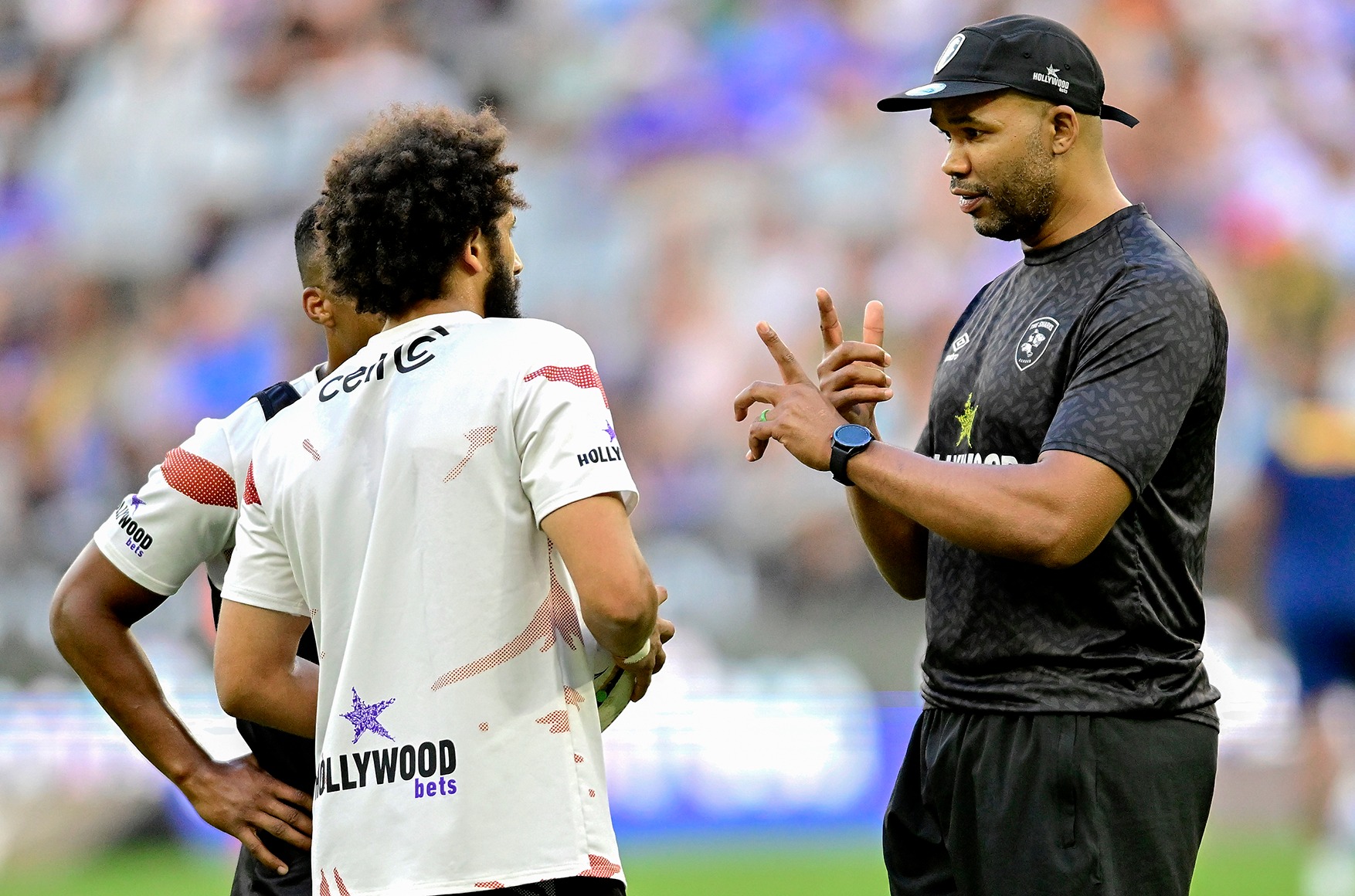
 Newly appointed Sharks head coach, JP Pietersen (right), speaks to Jaden Hendrikse before a United Rugby Championship match against the Stormers. (Photo: Ashley Vlotman / Gallo Images)
 Since taking the reins as Sharks interim head coach in December, JP Pietersen has overseen a significant uptick in results – five wins in seven matches versus one win in seven prior to his elevation.
The natural urge then is to assume all is well, and the only “problem” was the management of previous head coach John Plumtree.
Fortunately, the Sharks hierarchy appear to have resisted that simplistic view and have rather undertaken a comprehensive assessment of their club from top to bottom.
Maybe the change of coaching voice for the senior team has had some influence on improved results. That’s often the case with sports teams when there is a reshuffle mid-season.
It happens frequently in British football. A mid-campaign change focuses minds. Players are shaken and understand that nothing is guaranteed while all levels of staff are given the proverbial “kick in the butt”.
But the rebound is often temporary, which is why the Sharks aren’t reading too much into immediate results as signs of greatness and future success.
/file/dailymaverick/wp-content/uploads/2024/01/TL_2160750.jpg "Former Sharks head coach John Plumtree. (Photo: Steve Haag Sports/Gallo Images)")
Plumtree both asked to step down and suggested Pietersen for the interim role. It’s easy to blame Plumtree, but he took over at a tricky time after Sean Everitt left and by several accounts created more order in the Sharks system during his time there.
Naturally, high-performance sport is a results-driven business and the start to the Sharks’ 2025/26 campaign was poor, but it led to a positive process.
The club appears to have a much more focused plan after a few years of poor results.
“We didn’t view our recent challenges as a head coach issue; rather, we thought we needed to look at the whole rugby department to try and identify the underlying root issues,” Sharks chief executive Shaun Bryans told Daily Maverick.
“We undertook an objective, independent review, bringing in the likes of Alan Zondagh, Stefan Terblanche and Grant Bashford to look at structure and process, as well as culture.
“It’s easy to replace a coach and hope for the best, but we wanted to identify the bottlenecks in our system. JP’s appointment as head coach is a natural progression of that; he’s a ‘Sharks man’ through and through, and his focus on clarity and accountability has already triggered a tangible shift in both culture and on-field results.
“We are very excited for the next phase of Sharks Rugby – noting that the recently announced changes and new structure are a starting point, not the end.”
/file/attachments/orphans/TL_2506252_378613.jpg "JP Pietersen has enjoyed a long association with the Sharks, first as a fine player before turning to coaching. (Photo: Steve Haag Sports / Gallo Images)")
New era
When a US-based consortium led by South African, Manhattan-based lawyer Marco Masotti acquired a controlling equity stake in the Sharks in 2021, there was natural optimism and bullish language.
Masotti spoke of making the Sharks the biggest brand in rugby and becoming the “Liverpool” of the sport.
And the Sharks started out like a Galáctico club, signing marquee Springboks and stockpiling their player roster with big names. It was a bold strategy but didn’t fully account for the staccato nature of the season, which is divided into United Rugby Championship (URC), Currie Cup and for the past three years, European Champions and Challenge Cup rugby.
/file/attachments/orphans/TL_2510527_709472.jpg "Bok skipper Siya Kolisi (left) was one of the Sharks' ‘Galáctico‘ signings. (Photo: Steve Haag Sports / Gallo Images)")
That was on top of the heavy workload for key Springbok players, who were, and are, involved with the national team for about six months of the year in a global rugby calendar that is still not aligned between competitions in the southern and northern hemispheres.
Middling to poor results in some seasons (the Sharks did make the URC semifinals in 2025), given the quality of players, is easy to simply pin on the coaching group.
New model for Sharks
That’s precisely what the Sharks review has tried to avoid doing.
The Sharks are undergoing a fundamental identity shift, moving away from a traditional “director of rugby” model towards a sophisticated, American-style executive structure.
It is clear that the Durban franchise is no longer content with simply outspending its rivals. Instead, they are building a high-performance machine designed to survive the “Springbok tax” and the logistical chaos of the dual-hemisphere calendar.
“There is a significant ‘price’ paid by franchises for the success of the Springboks,” Bryans said.
“With the Boks playing up to 15 Tests a year, our senior players are often unavailable for pre-season and return to us in December completely fatigued.
“It’s not sustainable to ask them to land from a four or five Test November tour and immediately front up for a Champions Cup clash in Toulouse.
“Consequently, we are refining our strategy: while we will always value world-class experience and we are fortunate to have some of South Africa’s most celebrated players represent our Club, our future depends on the bravery to give our talented younger players such as Ethan Hooker and Jaco Williams proper exposure.”
Current Cheetahs CEO Rory Duncan will join the club in June as chief of staff, and Dave Williams has been made general manager. Neil Powell has been moved to head of junior rugby, which is a vital role when the focus has shifted from buying talent to producing it. The Sharks will use data-driven AI tools as part of their emphasis on recruitment.
Bryans admits the various departments had possibly been operating in silos, which led to some of the bottlenecks he referred to earlier.
Despite more titles, the newer structure is “flatter” and more integrated.
“Historically, like many clubs, the Sharks have operated in silos,” Bryans said.
“To fix this, we’ve created a more strategic, proactive recruitment committee that includes the head coach, the head of junior rugby [Powell], and our GM [Williams].
“This ensures that every player we bring in – from junior to senior – fits our specific game model. We want to demonstrate to our Academy players that their pathway to the top is clearer and more professional here than anywhere else in the world.”
Duncan’s role is still not fully defined, but he will be the eyes and ears on the ground, dealing with commercial matters and largely staying out of the rugby department’s way.
/file/attachments/orphans/TL_2433424_155490.jpg "Rory Duncan, currently CEO of the Cheetahs, will become the Sharks' chief of staff in June. (Photo: Charle Lombard / Gallo Images)")
“Rugby is a complex, 24/7 business. I am not based in Durban permanently, and Rory Duncan’s appointment as chief of staff is about securing someone with proven executive experience to drive day-to-day execution on the ground,” Bryans said.
“This more ‘American-style’ model empowers our staff to crack on with daily operations, allowing me to focus on the strategic ‘big picture’ – such as our stadium precinct plans and the next phase of commercial growth.”
World Club Cup implications
In the official restructuring announcement, Masotti highlighted the World Club Cup, which is scheduled (although not confirmed) to start in 2028.
Qualifying for that competition will require a top-eight finish in the Champions Cup the season before, all of which added to the urgency of a clearer plan.
“The lack of a simplified global calendar forces South African teams into constant trade-offs,” Bryans said.
“You are often weighing up whether to jeopardise your URC campaign to go ‘all-in’ on the Champions Cup. A goal of playing in the Club World Cup requires us to be in the top eight of the Champions Cup, which is incredibly difficult under the current schedule.
“[Global calendar] alignment is the single-most important factor that will allow our players to rest and our franchises to compete on a level playing field.”
With "Vision 2028" now firmly established as the club’s guiding principle, the Sharks have moved beyond short-term reactive fixes.
They appear to have instead engineered a modern, globally ambitious organisation ready to compete for silverware on both hemispheres.
As always though, the proof will only be evident in months and years to come. DM