




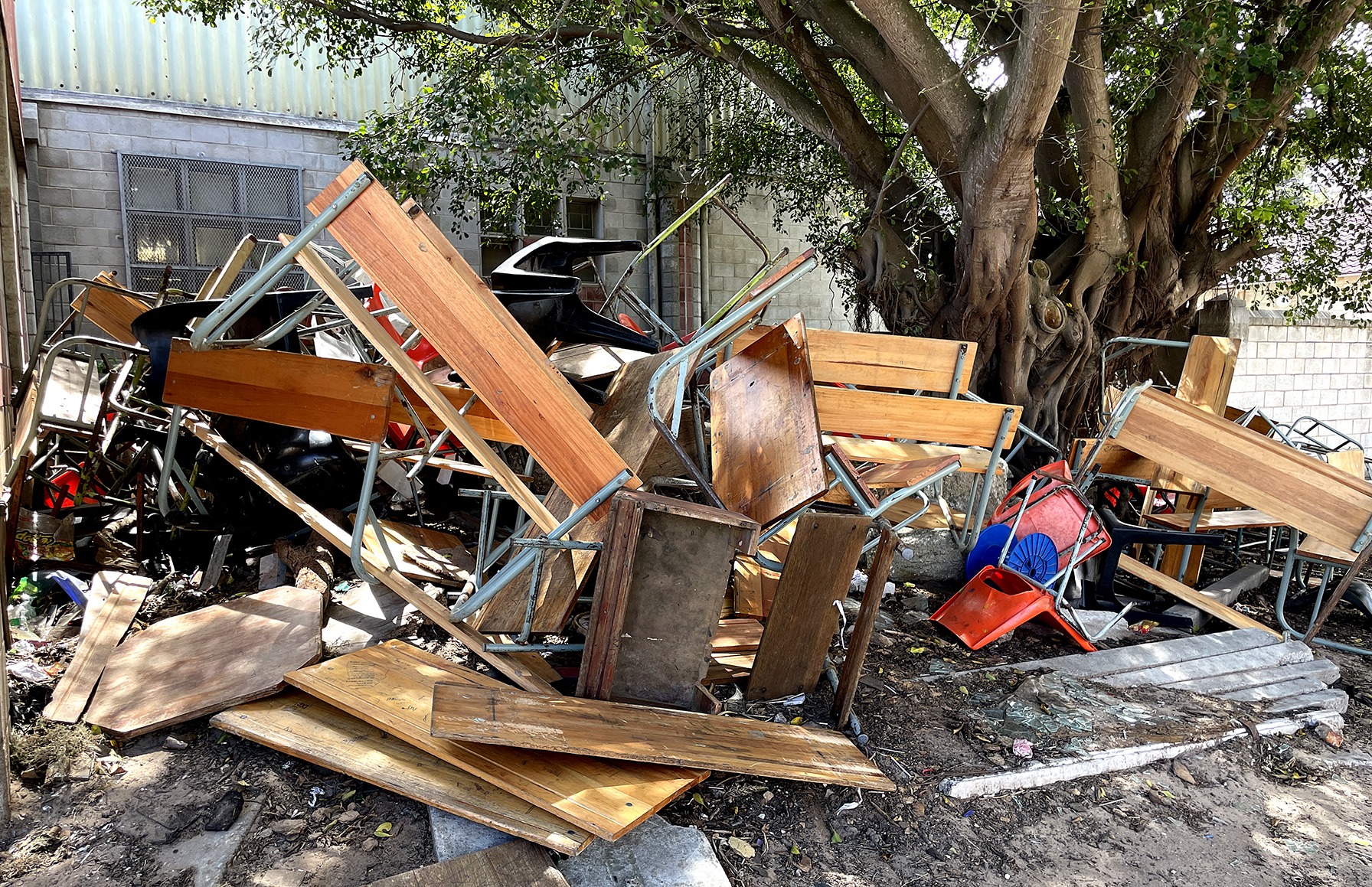
 Broken desks and chairs highlight the dire shortage of furniture at the school. In some classrooms, three learners are forced to share a desk designed for two. (Photo: Kyran Blaauw)
 More than a decade ago, when the current matric class at Walmer High School in Nelson Mandela Bay was still in primary school, concerned parents and community members warned that Walmer township’s only high school was already buckling under rapidly growing learner numbers.
Since then, not a single brick has been laid for a second high school, even though residents and the provincial education department say there is in fact enough in the budget to build the school, and plans have been developed for the new school.
However, the Nelson Mandela Bay Municipality has yet to submit an environmental impact assessment (EIA), a crucial step that could finally clear the way for construction.
But despite growing concerns and the municipality facing a self-imposed deadline this week (starting 16 February) to submit the EIA, the municipality remains mum on the status of the assessment.
After years of mounting frustration among learners and parents, that frustration and desperation for answers spilled onto the streets on 5 February 2026, when they marched to demand that authorities fast-track the long-promised project.
Read more: Overcrowded classes in Gqeberha school expose municipal failure in education
To date the school, initially designed for about 1,050 learners, accommodates 2,400 – more than double.
The South African Human Rights Commission has flagged overcrowded classrooms as a violation of learners’ constitutional rights, calling the problem systemic.
Community leader and chair of the school governing body, Professor Mtyaleka was earlier quoted as saying continued delays to build a second school and improve conditions at Walmer High School amounted to a violation of children’s constitutional rights to basic education. But even his words could not fully capture the conditions in which pupils are expected to learn.
/file/attachments/orphans/Photo6_358575.jpg "Some of the earliest prefab classrooms installed at Walmer High School in Nelson Mandela Bay as a temporary solution to accommodate rising learner numbers are still in use. Despite being fitted with electrical infrastructure, they have never been connected to the electricity supply. (Photo: Kyran Blaauw)")
/file/attachments/orphans/Photo5_815717.jpg "The roofs of several prefab classrooms at Walmer High School have leaks. Years after being installed, the lighting in the classrooms is still not connected to the electricity supply. (Photo: Kyran Blaauw)")
While most of the school is well maintained, it is hard to miss the overcrowded classrooms and the deteriorating prefab structures, installed years ago as a temporary solution.
Several of the prefab classrooms have no electricity supply. There are no lights, no fans and no power points, leaving pupils to endure heat and dim lighting while still trying to concentrate.
“If you come to our school you will be surprised by the lack of things we have, but even with those shortcomings we produce good results.”
Despite the conditions, the school’s academic performance has over the years steadily improved. In 2017, Walmer High recorded a matric pass rate of 73.6%. By 2025, that figure had climbed to well above 90%. Not once has the pass rate slipped.
Read more: Inspirational teaching sees Walmer High School matrics celebrate 100% pass rate in maths
Read more: Walmer High School principal retires after raising matric pass rate to well above 90%
Those results come at a cost, learners told Daily Maverick.
Eighteen-year-old matric learner Blessing Nyatsanza said the school’s ability to perform academically despite limited resources is the reason many pupils from surrounding township schools choose to enrol there.
“What makes Walmer High School special is that even with the lack of resources, we make something out of it,” he said. “If you come to our school you will be surprised by the lack of things we have, but even with those shortcomings we produce good results.”
However, Blessing said those results come at a cost, pointing out that classrooms often hold more than 60 learners at a time, far exceeding the standard number of children in a class.
“That is why it was important for learners to participate in the protest, to make sure every child is on equal footing,” he said. “How can a teacher focus with a class full of 60 children? There are disruptive learners, and there are also learners who need extra attention. The teacher simply cannot give that individual support.”
/file/attachments/orphans/Photo2_881007.jpg "A door to a prefab classroom at Walmer High School has come off its hinges and has not been repaired, leaving the classroom exposed day and night. At the end of the school day, the teacher locks the security gate in the hope that the classroom will not be vandalised. (Photo: Kyran Blaauw)")
He added that overcrowding has been an issue since his first year at the school. “When I was in Grade 8, we already had 48 children in one class. This is not new.”
Aphelele Ndongeni (17) shares these concerns, saying that while the school is often celebrated for its results, the daily realities of learners – and the dedicated staff – are far too often overlooked.
“Classes are often three times the size they are supposed to be, and that makes learning very hard. There are times when children get left behind.”
“Despite all the challenges and shortcomings, the children who leave this school go on to do great things,” she said. “We have learnt to make the best of our situation. But there are other issues that need addressing, and it feels like nothing is working.”
She said the protest was organised after repeated attempts to raise concerns failed to bring change. “It is difficult to be heard,” Aphelele said. “Classes are often three times the size they are supposed to be, and that makes learning very hard. There are times when children get left behind.”
Aphelele believes the long-term solution lies in expanding infrastructure in the area.
“We desperately need more classrooms. That means building a second school for this community,” she said.
Aphelele said at times overcrowding forced learners to attend classes in the school hall.
“There would be chaos. Children would start fighting and teaching would be disrupted,” she said.
Beyond classroom space, Aphelele pointed to shortages of teachers, desks and chairs. “The desks are old. Sometimes three learners have to sit at a desk meant for two. It’s hard to write, and there are not enough chairs.”
Another matric learner, Sinalo Momo (17), said the role of teachers in sustaining the school’s performance despite these challenges was phenomenal.
“Our teachers are very dedicated,” Sinalo said. “Even on weekends they sacrifice their time to make sure we pass with good results. Even with a lack of infrastructure, desks and textbooks, they make sure we get the best.”
Sinalo said academic results at the school have steadily improved since 2017, despite ongoing shortages. But he described the lack of textbooks as particularly damaging to learning.
“There can be 36 learners in a class and only 12 textbooks,” he said. “If there is homework, only one person can do it properly while others cannot because they don’t have a textbook.”
Like his peers, Sinalo said the protest was aimed at drawing attention to overcrowding and the urgent need for another school in the area.
“We protested because we wanted the right people to notice us,” he said. “Our school is overcrowded, and this community needs a second school.”
Second school stalled
But how exactly did this situation happen? Mtyaleka said the proposal to build a second high school was raised more than 10 years ago, and a site was identified and allocated a site number. It was assigned Erf 11305.
However, the project stalled amid regulatory and administrative delays, largely linked to the municipality.
An environmental impact assessment (EIA) was approved in 2017, raising hopes that construction would begin soon after. That never happened.
When community members followed up in 2021, they were apparently told the EIA had lapsed and the process would have to start from scratch.
Residents were later assured that a new EIA would be finalised by early 2025, but by the time of the protest of 5 February nothing had materialised.
The municipality however was quick issue a statement to say it planned to submit an EIA application to the Department of Economic Development, Environmental Affairs and Tourism during the week of 16 February.
The process the municipality said is expected to take approximately six to 10 months.
/file/attachments/orphans/Photo4_350939.jpg "The walkway in front of the Walmer High prefab classrooms is damaged and uneven, posing a safety hazard to learners and staff. (Photo: Kyran Blaauw)")
Municipal spokesperson Sithembiso Soyaya said the environmental impact assessment (EIA) application for the proposed second school in Walmer Township, on erf 11305, is progressing as planned.
According to Soyaya the municipality was on track to submit the EIA application to the Department of Economic Development, Environmental Affairs and Tourism by the end of the week (20 February).
“This submission reflects the municipality’s commitment to the Walmer community and its determination to follow due process while fast-tracking the project within the applicable legislative and regulatory framework,” he said.
Soyaya added: “At this stage, the application has not yet been formally lodged, as final internal checks and consolidations are being concluded to ensure compliance and completeness.
“Once the submission has been effected, the municipality will be in a position to formally confirm receipt by the relevant provincial department and provide further details on the next steps in the statutory process.”
Serious overcrowding at Eastern Cape schools
Meanwhile, Equal Education’s Eastern Cape manager, Ona Matshaya, says previous visits to schools across the province, including Qonce, have revealed serious overcrowding issues. Teachers have raised concerns that they are unable to work effectively, and learners are also suffering.
/file/attachments/orphans/Photo7_415306.jpg "Several windows at Walmer High School are broken, exposing classrooms to the elements. (Photo: Kyran Blaauw)")
“Some of the reasons we see overcrowding are infrastructure-related, where the department refuses to build more classrooms,” Matshaya said.
“This obviously takes a toll on teachers and their mental health, because they are not in a space where they can properly teach. The environment is simply not conducive for teaching and learning.”
Matshaya says overcrowding prevents teachers from giving learners the individual attention they need, which can contribute to school dropouts.
While temporary structures are often provided, she says these are not ideal, as they can become extremely hot or cold.
“Teachers can usually identify early on which learners need additional support, but overcrowded conditions make this much harder,” Matshaya explained.
She warns that if overcrowding is not addressed, learner dropout rates will continue to rise. To prevent this, Matshaya says the education department must listen to schools, address their needs, and ensure allocated budgets are properly spent. DM
This article has been updated to include comments received after publication from municipal spokesperson Sithembiso Soyaya. His response was received on 19 February.