



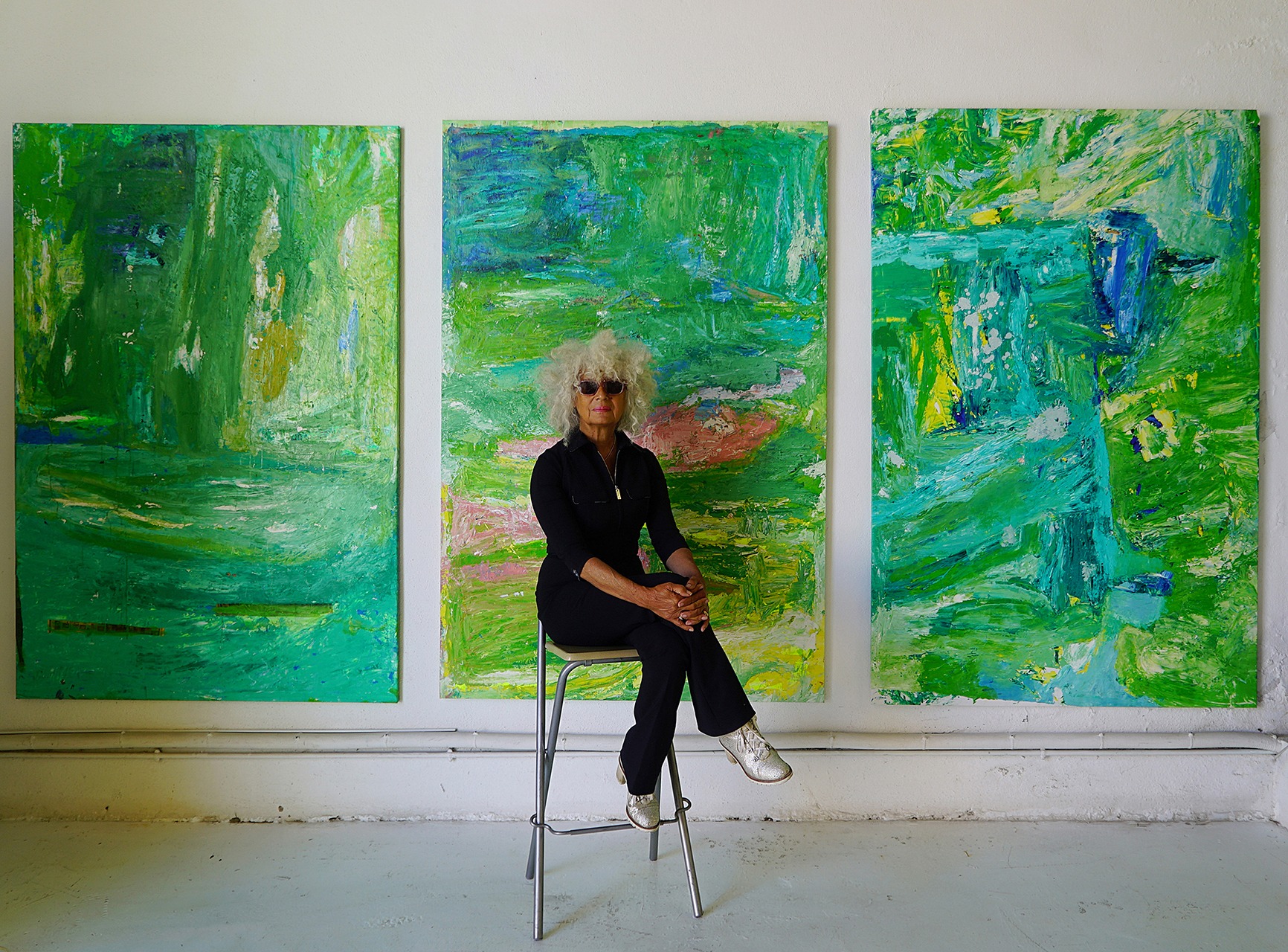
 Multi-disciplinary artist Owanto in her studio. With her upcoming solo exhibition, Traces of the Timeless, Owanto is turning her gaze inwards – bringing into material existence the invisible impulse of unfolding time.(Photo: Courtesy of Owanto Studio)
 At the opening exhibition of Cape Town’s Zeitz MOCAA in 2017, the multi-disciplinary artist Owanto presented her project called Flowers, a series of black and white photographs adorned with large, bright flowers. It served as a reclamation of women’s ownership of their bodies by calling attention to female genital mutilation.
Daily Maverick spoke to Owanto about Flowers in 2020 and has now had the opportunity to reconnect with the artist about her upcoming solo exhibition at the 2026 Investec Cape Town Art Fair.
With Traces of the Timeless, Owanto is turning her gaze inwards – bringing into material existence the invisible impulse of unfolding time. The works are eye-catching palettes of blues and greens that move among one another in a way that evokes enlivened energy while also inviting steady pondering, grounding viewers in their interconnectedness with the seen and unseen worlds beyond the self.
/file/attachments/orphans/SoundoftheOcean202538x46cmmixedmediaoncanvas_CourtesyofOwantoStudio_772079.jpg "Sound of the Ocean (2025), 38 x 46cm, mixed media on canvas. (Image: Courtesy of Owanto Studio)")
You’ve described your return to painting as a return to your first language. Could you share more about your connection with the medium of paint and how that connection differs for you compared to photography?
Painting is my first language because it is immediate, bodily and instinctive. Before concepts, before framing, there is gesture, pigment, rhythm. With paint, I am inside the act. Time slows, sometimes melts, and something aligns. Painting is not about describing the world but about entering a state of listening, where the hand follows something older than intention.
In contrast, photography can capture an instant, but my work has never been only about that. In The Flowers Project, I enlarged small, forgotten photographs found in a drawer, archival images, to reclaim the right of women over their own bodies. The act of enlargement became a form of transformation, allowing these images to move from the intimate to the public, from silence to presence. This work has been shown in eight museums across three continents, and it continues to inform how I think about time, memory and responsibility.
With painting, I accept slowness as a form of alignment. There is rawness and a quiet urgency, but also waiting, listening, and return. Through layering, erasure and repetition, the painting finds its own rhythm and carries its own time. Unlike photography, which fixes an image, painting accumulates duration. Not an instant, but a state of becoming.
Traces of the Timeless represents a closeness to nature and ancestry. How did that inspire your use of colours and textures?
Colour, for me, is never decorative. It is matter, temperature, breath. The pigments I use feel close to earth, to minerals, to the ocean. They are not chosen to please the eye but to resonate with something deeper, something remembered rather than seen.
Texture plays an essential role. The marks, the scratches, the raw gestures are traces of presence. They echo erosion, tides, weathering. Ancestry is not represented symbolically. It is embedded in the way the surface is worked, in the patience of layering, in the acceptance of imperfection as a blessing. Nature is not a motif here. It is a rhythm, a way of moving through the work.
/file/attachments/orphans/DoyouseemeDoyoufeelme2025200x130cmmixedmediaoncanvas_CourtesyofOwantoStudio_191704.jpg "Do you see me? Do you feel me? (2025), 200 x 130cm, mixed media on canvas. (Image: Courtesy of Owanto Studio)")
/file/attachments/orphans/Doyouhaveaname202515x150cmglassneonlight_CourtesyofOwantoStudio_450706.jpg "Do you have a name? (2025), 15 x 150cm, glass neon light. (Image: Courtesy of Owanto Studio)")
What kind of impact or feeling do you hope will linger for viewers after they’ve seen the artworks in Traces of the Timeless?
I hope what lingers is not only an image, but a sensation, something felt in the body before it is named. A quiet resonance that remains after leaving the room. A slowing down, a grounding, a return. These works are not asking to be understood. They are asking to be felt.
If there is a message, it is simple and essential. We are salt and water. We come from the ocean. This knowledge keeps us humble. It reminds us that we are part of a larger community, human and non-human, moving together within the same rhythms. In a world saturated with noise, power and urgency, I hope the paintings offer a pause, a space where beauty becomes an answer rather than a distraction.
We are all children of the world. Remembering this changes how we stand, how we look, how we care.
Has working on Traces of the Timeless shaped or changed you as an artist in any way? If so, how?
I began painting in the 1980s. In the 1990s, an out-of-body experience profoundly transformed my way of seeing, or perhaps my way of not knowing. From that moment, abstraction became my way of maintaining a certain frequency, a subtle space I had discovered. A way of staying in contact with the unknown, of approaching what cannot be named. Ozangé emerged from that place.
There are moments in the studio when I experience what I call an absolute communication. Not communication with the Absolute, but a moment of complete attunement. Time dissolves. If time exists, it melts. These moments cannot be summoned. They are gifts. Traces of the Timeless is built around the humility of receiving rather than controlling.
I see my practice now as part of a continuous becoming. We do not subtract. We add, slowly. Like the ocean, from which we come.
(Note from the writer: Ozangé means light in Omyènè, Owanto’s maternal language from Gabon.)
/file/attachments/orphans/IAM201460x30cmglassneonlightonfoundbuoydetail_CourtesyofOwantoStudio_184968.jpg "I AM (2014), 60 x 30cm, glass neon light on found buoy (detail). (Image: Courtesy of Owanto Studio)")
What is exciting you the most about the world of contemporary art at the moment?
I am drawn to artists who are returning to depth, not as a trend, but as a necessity. There is a renewed interest in the sacred, the invisible, the metaphysical. Not in a religious sense, but as a way to reconnect art with meaning.
I am less excited by spectacle and more by sincerity, by practices that embrace immediacy, rawness and presence. Work that is unfinished, unlearned and indelicate can carry a truth that polished perfection never reaches. Art does not need to explain the world. It needs to open spaces where complexity can exist.
Is there an artwork by another artist that you wish you owned?
There are many works I admire, but ownership is not the point. Some artworks are meant to accompany you, others to guide you from a distance. I am deeply moved by works that carry humility, that feel inevitable rather than ambitious. Those are the works that stay with me.
Outside of your work as an artist, what have you been enjoying spending time doing recently?
I spend time near water whenever I can. Walking, listening, observing. I read slowly. I enjoy silence. These moments are not separate from my work; they are its foundation. Creation does not only happen in the studio. It happens in attention. DM
Owanto’s Traces of Timeless will be on exhibition at Investec Cape Town Art Fair 2026 from 20 to 22 February.