




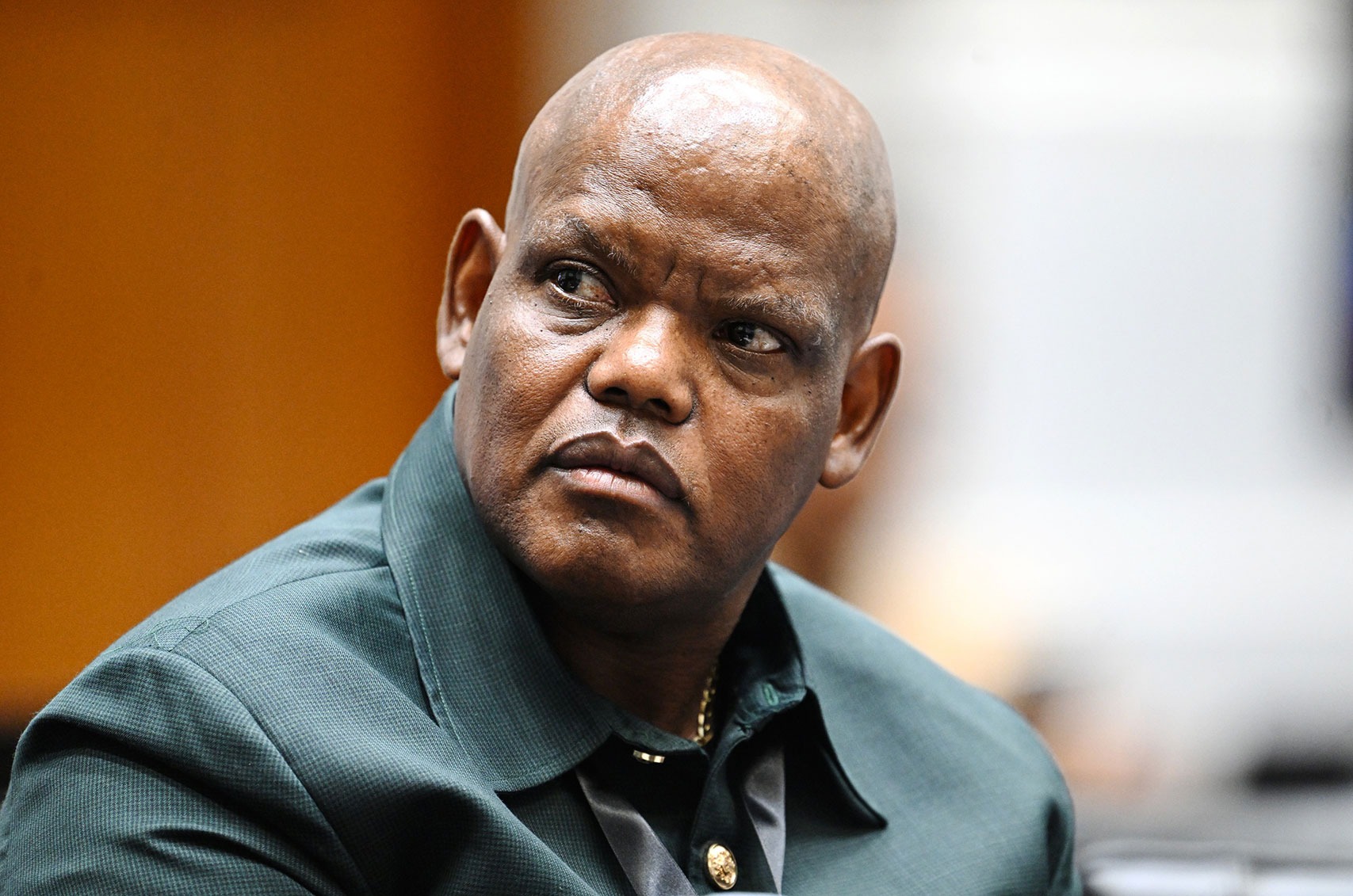
 Former national police commissioner Lieutenant-General Khomotso Phahlane appears before Parliament’s ad hoc committee that is investigating the allegations made by Lieutenant -General Nhlanhla Mkhwanazi. (Photo: Phando Jikelo / RSA Parliament)
 Things have gone downhill for former Lieutenant General Khomotso Phahlane since his appearance at Parliament’s Ad Hoc Committee into police corruption mid-January.
There, he protested his innocence and argued for hours that he was being victimised by the likes of former Independent Police Investigative Directorate (IPID) head, Robert McBride.
However, on Friday, at the Madlanga Commission of Inquiry, former SAPS section head for quality management, Brigadier Rachel Matjeng, who testified that she was Matlala’s mistress, let it slip that Phahlane and Matlala knew each other.
Own meetings
Matjeng, who is accused of assisting Matlala to secure a R360-million police health care contract, told commissioners that Phahlane – referred to as “JK” in WhatsApps sent in March 2025 – had contacted her when he had had difficulty getting hold of Matlala.
“They met several times but arranged their own meetings without me being involved,” she told the panel.
She had forwarded messages between the former acting National Commissioner and Matlala with regard to a proposed meeting. Matjeng claimed to have been in a romantic on-again-off-again relationship with Matlala since 2017.
/file/attachments/orphans/ED_594827_788020.jpg "Brigadier Rachel Matjeng testifies at the Madlanga Commission of Inquiry in Pretoria. (Photo: Gallo Images/Frennie Shivambu)")
She admitted that she had received about R400,000 from Matlala, paid into her account, but denied that these gifts influenced the awarding of a R360-million health contract to Matlala’s company. She told the commission she was aware that “JK” and Matlala knew each other.
Phahlane was dismissed from the SAPS in 2020.
The camera trick
In 2013, Phahlane was the Divisional Commissioner: Forensic Services when a need was identified for a 360 x 180 panoramic image-capturing system to assist in the visual presentation of crime scenes.
Following a bidding process, the contract – valued at over R92-million – was awarded to Ethemba Forensic Group (Pty) Ltd in July 2014.
However, after a losing bidder Forensic Data Analysts (FDA), owned by Keith Keating, complained about the award, Phalane began actively opposing the contract, claiming that the Ethemba equipment was non-compliant.
This, despite independent committees and the camera’s inventor providing evidence to the contrary.
Read more: Scopa hears how SAPS illegally siphoned off R100m from Criminal Justice System budget
Out in the cold
Meanwhile, on 5 February, the Labour Appeal Court (LAC) ruled that it would not overturn the findings of an arbitrator or a subsequent Labour Court judgment that Phahlane’s dismissal had been procedurally fair.
Phahlane had attempted to argue that once he had been appointed as the Acting National Commissioner by President Jacob Zuma in 2015, any negligence or misconduct within the Forensic Services Department he formerly headed could no longer be attributed to him.
/file/attachments/orphans/pic_342750.jpeg "Former national police commissioner Lieutenant-General Khomotso Phahlane appearing before Parliament’s Ad Hoc Committee investigating the allegations that were made by Lieutenant-General Nhlanhla Mkhwanazi, on 14 January 2025, in Cape Town. (Photo: Phando Jikelo / RSA Parliament)")
The court found this argument “nonsensical”, stating that it was incorrect to infer an official lost accountability for actions performed in a previous role simply because they moved to a higher position.
The court found that Phahlane “intentionally or negligently caused the SAPS to repudiate a valid contract with a provider (Ethemba), resulting in fruitless and wasteful expenditure of approximately R24.5-million”.
The arbitrator originally found that Phahlane had “intentionally” caused the non-compliance. While the majority of the LAC disagreed that the evidence established a “preconceived plan”, they found that the senior policeman acted with “reckless indifference” and negligence.
His failure to place orders or seek a judicial review of the contract – despite legal advice that it was binding – was a breach of the SAPS Code of Conduct.
The court found that the sanction of dismissal was appropriate given the gravity of the misconduct and the tarnishing of the public service organisation’s image.
Aggravating circumstances
The arbitrator in the long-running matter had in fact found that Phahlane’s promotion to acting national commissioner had served as an aggravating factor because, as the accounting officer for SAPS, he had a greater responsibility.
He also had a duty to protect the finances of the state, which he had failed to do by allowing “reckless” inaction regarding the camera contract.
The arbitrator had specifically noted the former top cop’s attitude of “seeking to apportion blame to everyone else but himself” and failing to “show any remorse for his actions”.
The court characterised him as the “catalyst” in the refusal to place orders, noting that as a senior ranking officer, his stance was one of non-compliance with a valid binding contract despite the threat of litigation.
His “reckless indifference” and “supine approach” were found to be personal failures in his fiduciary duties as a senior public official.
Disgruntled litigant
Phahlane has told the commission, and has consistently argued that the use of an “expeditious process” under Regulation 9 of the Discipline Regulations rather than a full inquiry under Regulation 8, is unfair.
The court found that the choice of process was the employers’ and that Phahlane had been afforded a “full opportunity” to present his case before an independent and impartial chairperson.
His allegations of bias against the presiding officer were found to be without substance and merely the complaints of a “disgruntled litigant”. DM