




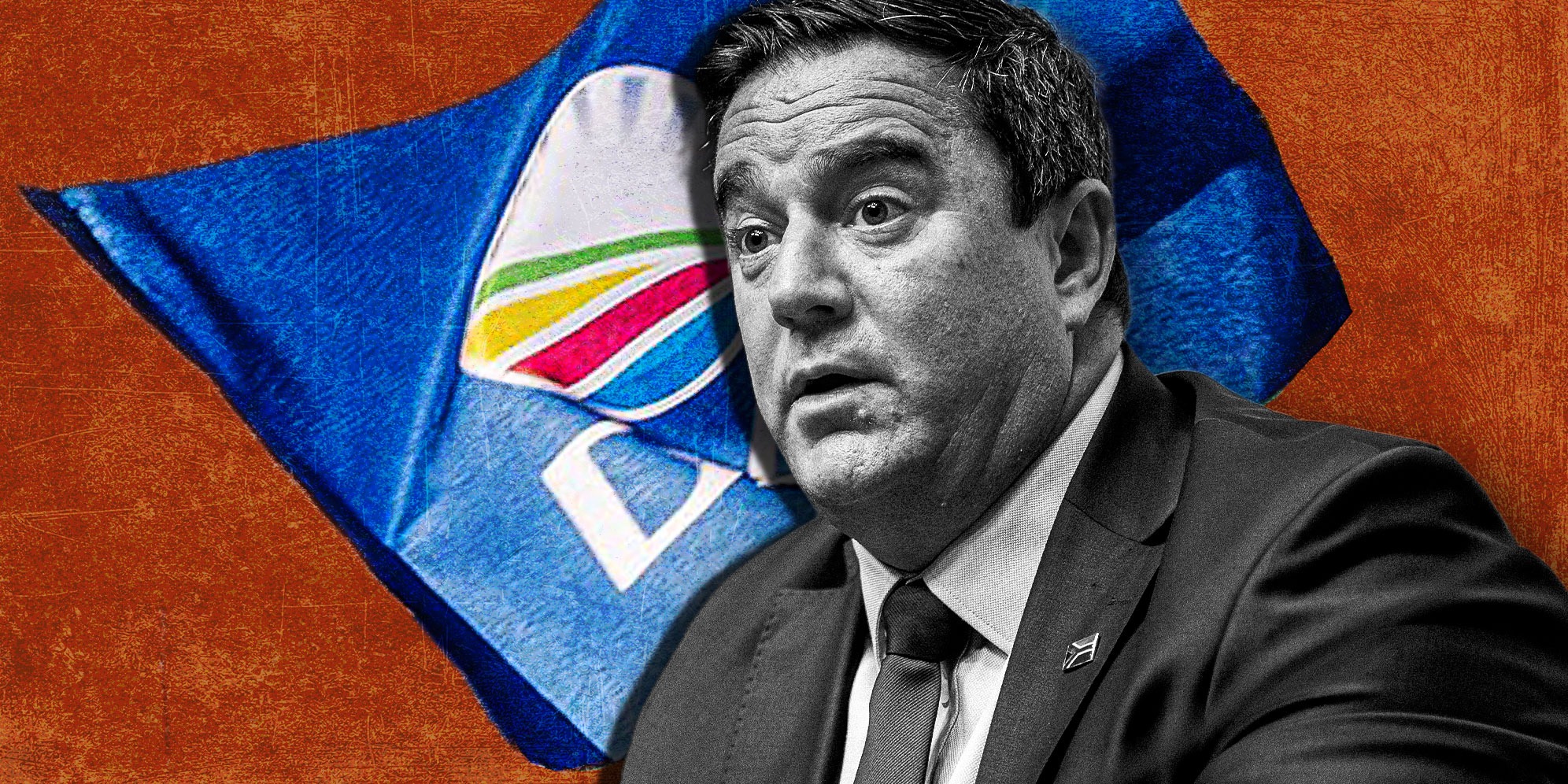
 Illustrative image: John Steenhuisen. (Photo: Gallo Images / ER Lombard) | DA flag. (Photo: OJ Koloti / Gallo Images) | (By Daniella Lee Ming Yesca)
 There are different interpretations of John Steenhuisen’s decision not to seek another term as Democratic Alliance (DA) leader, but the most likely reason revolves around his personal finances.
It is true that the foot-and-mouth outbreak, Steenhuisen’s justification for not vying for DA re-election, may be causing political problems in some parts of the DA’s constituency.
But it’s strange that he no longer wanted to be leader of the DA, a job he has held for six years, because of something that happened while he was in the Cabinet, where he has been for less than two years.
Instead, the revelation, first published by Daily Maverick’s Rebecca Davis, that he had suffered a default judgment of R150,000 for credit card debt is the key reason that triggered Steenhuisen’s announcement on Wednesday, 4 February.
Read more: ‘I have loved leading the DA,’ says Steenhuisen, exiting leadership race under party pressure
The fact Steenhuisen had used the DA credit card for personal expenses led to Dion George, as DA federal finance chair, to revoke the card.
Perhaps Steenhuisen might have survived that. Especially in light of the DA’s Federal Legal Commission finding that he had done nothing wrong (despite the obvious fact that very few corporations will tolerate someone, even a CEO, using the company credit card for personal expenses).
But his decision to ask President Cyril Ramaphosa to then remove George as environment minister, for reasons still not fully explained, gave this much more power.
DA’s broken rule
To be blunt, each of our political parties has certain rules by which it must live for its constituency.
The Inkatha Freedom Party cannot survive weakening the role of the Zulu king. The African National Congress (ANC) cannot turn its back on BEE, affirmative action or the Struggle. The Freedom Front Plus must always support farmers and fight land expropriation.
Perhaps one of the rules for the DA is that its leader cannot be accused of financial impropriety.
The DA’s unique selling point to voters is that it is different from most other parties, which it so often accuses of being corrupt. If that selling point is damaged, it could be fatal to the party in the longer term.
/file/attachments/orphans/260204_ARD1756_336663.jpg "DA leader John Steenhiusen speaks at a press conference at the Riverside Hotel in Durban, on 4 February, where he announced he will not seek re-election for the post. (Photo: Rogan Ward)")
Steenhuisen’s actions do not, as far as can be known, constitute criminal conduct in any way. But, as so many American and British politicians are re-learning in the aftermath of the Jeffrey Epstein scandal, politics is about perception.
Read more: Behind the scenes of Steenhuisen’s dealmaking with the DA
To put this another way, six months ago Steenhuisen looked very established as the leader of the DA. It was difficult to imagine anyone contesting him at the party’s next conference.
It was not the foot-and-mouth outbreak that shook that. It must have been the personal finances and his actions over George.
Next moves
More fundamental questions may now lie ahead for the DA.
Steenhuisen was correct to say in his address on Wednesday (after which he answered no questions and gave no interviews) that his era of leadership will be remembered for the DA’s entry into national government for the first time.
This was a step-change. Both for the DA and our politics.
The next leader will have several important issues to deal with, both short- and long-term.
Virtually immediately after the leadership election (should Cape Town Mayor Geordin Hill-Lewis face a contender), campaigning will intensify ahead of the local government election.
No matter who the next leader is, they might find themselves almost eclipsed by the impressive and powerful personality that is Helen Zille on the campaign trail.
The person will have to work closely with her (Hill-Lewis was Zille’s chief of staff), particularly if the DA is successful in making the local elections about the state of Johannesburg.
/file/dailymaverick/wp-content/uploads/2025/11/P12-Impact-Tracker6.jpg "Cape Town Mayor Geordin Hill-Lewis is being touted as a possible successor to John Steenhuisen as DA leader. (Photo: Brenton Geach)")
The way in which the DA approaches this election will also play a role in its longer-term strategy.
One of the hallmarks of the Steenhuisen era has been the apparent decision to move away from trying to win the votes of a broader section of our society and focus on its core constituency.
It has appeared the DA has been focusing on winning perhaps 25% of the vote, as the ANC and other bigger parties lose votes. As Zille has said, she believes no party will ever again win a majority (this is almost certainly true), which would allow the DA to either always be the second-biggest party, or perhaps the biggest party in our politics.
A new leader will have to decide whether they want to continue in this direction, or to go back to what might be called the Mmusi Maimane era, when the party tried to reach a more diverse constituency.
Key to this is their understanding of race.
No one can hope to win votes in South Africa without being able to articulate a clear vision of their views on race, and how it still defines the political identity of so many people.
This also means being able to defend your view without losing votes.
It is one of the strange situations in our politics that Hill-Lewis has risen to the point of being seen as the most likely next leader of our second-biggest party, and yet has hardly spoken about race in explicit terms.
But if Hill-Lewis becomes leader, he can expect to face questions about whether he believes race is a proxy for disadvantage in South Africa, whether he believes apartheid still defines lives now and how best to deal with our racialised inequality.
One of his few comments on this subject, when he told Daily Maverick’s Kevin Bloom last year that referring to things like “spatial apartheid […] I think that’s just kind of propaganda language that is no longer rooted in reality” is unlikely to win him the votes of the majority of the population.
It suggests a lack of understanding of the lived experience of many millions of South Africans.
The ANC question
The next leader of the DA is also going to have to manage their relationship with President Cyril Ramaphosa, and whomever follows him.
One of the difficult questions the next leader might have to deal with is whether to remain in the national coalition with Ramaphosa’s successor.
If it is current Deputy President Paul Mashatile, that could be an almost impossible decision (does the DA stay in government with him, or open the door to the ANC working with the uMkhonto Wesizwe party or the Economic Freedom Fighters?).
Leading a party like the DA in a country as complicated as South Africa must be one of the tougher jobs in world politics.
You have to appeal to hugely diverse constituencies, deal with a sometimes hostile media, social media disinformation and a party that can sometimes disagree on fundamental issues.
But it should not be forgotten how important the DA is to South Africa.
It is the most diverse party in the country; to its eternal credit, it has never tolerated corruption; and many areas where it governs appear to be better managed than other parts of the country.
It is also well-organised and can be both effective in government and effective in opposition.
South Africa without the DA (or something like it) would be a much weaker democracy. DM