



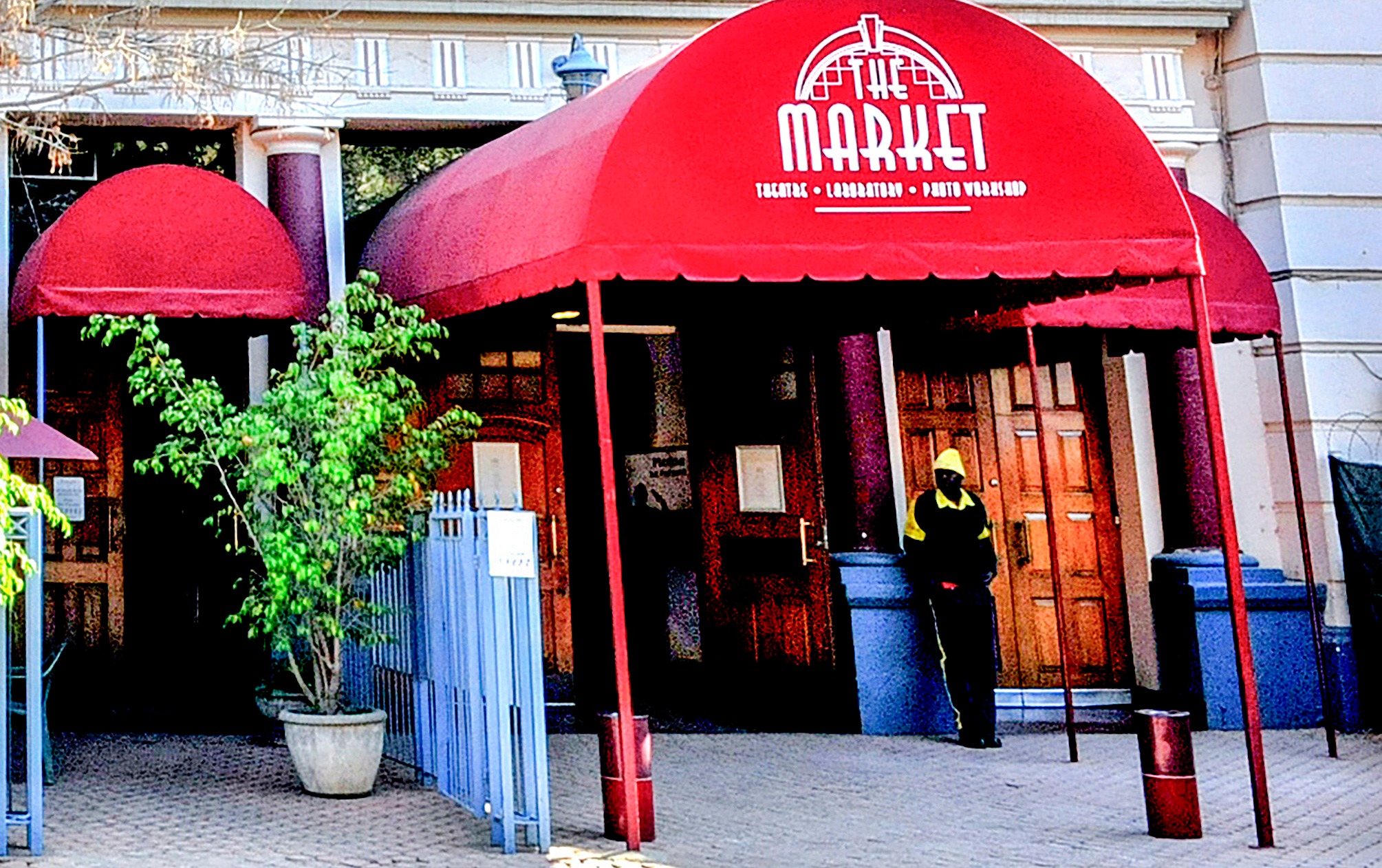
 The Market Theatre in 2013. (Photo: Lucky Maibi / Gallo Images / Foto24)
 Johannesburg’s Market Theatre is celebrating its 50th anniversary. This year’s anniversary season began with Marabi, an early work by the Junction Avenue Theatre Company, set in the 1930s slum communities of Doornfontein, Johannesburg. (It runs from 19 January to 15 February). This was followed by the Tony-nominated musical Blues in the Night, produced by the Memphis, Tennessee-based Hattiloo theatre group, which runs from 5 to 22 February.
Thereafter, said the theatre’s artistic director, Greg Homann, other activities will include a June birthday-month celebration featuring a sampling of big moments from significant plays in the theatre’s history. There will also be a group of new plays focusing on today’s circumstances, including a work by the renowned Empatheatre group, based on Henrik Ibsen’s An Enemy of the People, but set in KwaZulu-Natal and focusing on climate change.
Read more: Market Theatre celebrates 50 years with iconic musical Marabi
Homann promises that this year the Market Theatre will offer exciting, diverse, new, contemporary theatre, in addition to festivals for younger playwrights and theatre groups. He explains that, yes, the works will lean into the theatre’s legacy of being on the right side of history, but insists that what is on stage must entertain and engage its audiences as well.
Listen to the full interview here.
/file/attachments/orphans/MarketTheatre-HeritagePortal-2014-2_711174.jpg "The Market Theatre in 2014. (Photo: Wikipedia)")
Home of liberation theatre
During the Market Theatre’s half-century, it became synonymous with its opposition to apartheid as the spiritual home of South Africa’s protest or liberation theatre. The theatre was the brainchild of the late Barney Simon and Mannie Manim. Simon had been the leader of a collective of theatre-makers, The Company, which had no permanent home, while Manim had become increasingly disillusioned with mainstream theatre management, such as the bureaucratic, state-funded Performing Arts Council of the Transvaal (Pact).
Recalling how it all started for him, Manim described the moment he was confronted by community organisers at a meeting in Lenasia who had gathered to hear his upcoming theatre plans. They asked why he was not working to make Pact dramas open to all audiences at its professional facilities, rather than sending out second-tier work to makeshift venues.
Writing about it, he explained: “These guys tore into me … [saying that] under these circumstances they didn’t want to have any part of this [the second-class performances] any more.” After an hour of unsatisfactory discussion, he said he “spilt his guts”.
“I told them the things I had been doing over the years, what my plan was, how I was hoping to be able to take all the plays into the townships and really enable everybody to see everything.
“I told Barney [Simon], and we got some of the actors that we thought might like this idea, and we had a meeting at Barney’s house… We all didn’t know what the blazes we were going to do — but we were going to go off and be independent.”
/file/attachments/orphans/ED_551308_966399.jpg "Mannie Manim speaks at a memorial service for Athol Fugard at the Adam Small Theatre in Stellenbosch on 21 March 2025. (Photo: Theo Jeptha / Gallo Images / Die Burger)")
Then Johannesburg City engineer Maurice Norton phoned Manim to say the Johannesburg market in Newtown was moving to bigger premises. Taking a great leap of faith, the two men put together a proposal to the City of Johannesburg to take over the building that had housed the city’s Indian Fruit Market, built in 1913. Simon and Manim were astonished when the city agreed to their proposal (over those from other competitors), and they set about raising funds to turn their dream into a solid reality.
They planned to open the venue as a non-racial, unrestricted space, an idea inspired by the brief tenure of the Space Theatre in Cape Town, back when virtually every performance venue in South Africa was racially restricted.
As fate had it, the Market Theatre opened its doors just three days after the start of the June 16 Soweto uprising. The first performance in one of the theatre’s venues, later named in Barney Simon’s memory, was a production directed by Simon of Anton Chekhov’s The Seagull. This was followed by Arthur Miller’s The Crucible, directed by Janice Honeyman. In October, the Main Stage, in recent years renamed in honour of actor/playwright John Kani, was opened with Peter Weiss’s Marat/Sade, directed by Simon.
/file/attachments/orphans/ED_534353_388203.jpg "Actor/playwright Dr John Kani, in honour of whom the Market Theatre’s Main Stage was renamed in 2014. (Photo: Frennie Shivambu / Gallo Images)")
British author Mary Benson wrote, “‘It was the time of the Children’s Uprising in Soweto in June 1976,’ Barney later recalled. ‘Terrifying — actors were climbing trees looking for branches to create curtain poles for ‘The Seagull’s’ stage and helicopters were flying over on their way to the townships, and I remember feeling quite insane, up a tree, just wanted to jump because the agony of doing Chekhov in such circumstances was more than I could bear.’”
Within its second year of operations, the Market Theatre was already on the way to becoming an artistic and political force to be reckoned with internationally. Soon enough, some of its productions were touring nationally and internationally, especially works delivering powerful artistic critiques of the iniquities of the apartheid system.
Fortuitously, the plan to run a non-racial entity in South Africa’s apartheid universe was aided because the theatre was on land that had been zoned many years before for light industrial use, rather than for any specific race. Thus, the theatre could operate just beyond the reach of the Group Areas Act, which defined who could live or work where, based on a person’s racial identity as defined by the Population Registration Act.
Through quiet contacts with a sympathetic city employee (the city was the theatre’s landlord), for years the theatre was also able to secure a yearly liquor licence for its bar, despite the legal prohibition on selling spirits to Africans, let alone in a bar serving its patrons on a non-racial basis. But after all, what is a theatre without a bar for pre- and post-performance drinks?
Cultural hub
Over time, the Market Theatre became a magnet for other cultural venues and arts education projects in addition to its own theatres: the Market Lab drama school, the Photo Workshop — a professional-level photography training school — and the theatre’s restaurant.
The restaurant initially was the Market Cafe (hosting live entertainment, where this writer first heard Johnny Clegg’s original group Juluka). Then it was Harridan’s (an eclectic nouvelle cuisine spot that attracted tourists, actors, musicians and stockbrokers). This eventually became Gramadoelas, a real theatre-district-style restaurant offering an Africa-centric menu — from bobotie to grilled crocodile and wonderful curries, along with a great wine list, which became a favoured gathering spot for theatregoers. We miss all these venues.
Beyond the Market Theatre’s dramatic oeuvre, the Federated Union of Black Artists’ cultural centre and school was established in 1978, opposite the Market Theatre (in the building now used by the National Arts Council), as well as Kippies, the popular jazz club. Then there was the Yard of Ale, a pub that became a legendary meeting point for actors, would-be revolutionaries, diplomats and, inevitably, a Special Branch observer or two, trying to keep tabs. The latter was not that surprising, given that the John Vorster Square police headquarters was a short walk from the theatre.
By the mid-1980s, the Market Theatre was also hosting an art gallery and the weekend flea market on Mary Fitzgerald Square, across the street from the theatre. Newtown had become Johannesburg’s artistic and cultural hub, and the flea market was a shoppers’ paradise for everything from tourist souvenirs to antiques and fine malachite jewellery.
The Market Theatre’s theatrical output was strongly focused on locally originated productions, but also included biting satirical humour from performers like Pieter-Dirk Uys, and extraordinary music performances by Sakhile and Busi Mhlongo, among others.
As for dramas, there were major new works as well as classic ones — from the Greeks and Shakespeare through to major moderns. Original South African works, including Woza Albert, Sizwe Banzi is Dead, Sarafina!, You Strike a Woman, You Strike a Rock, The Island, Master Harold and the Boys, Sezar (a retelling of Julius Caesar in Sesotho), Nothing But the Truth, Green Man Flashing, Itsoseng, Sophiatown and Marabi were either first performed at the Market or gained major audiences there.
Some of those works originated at the Market (often with Simon helping to shape the creators’ ideas into gripping dramas through intense workshopping), while others were developed and performed in cooperation with other groups such as the Sibikwa Theatre Workshop, the Junction Avenue Theatre Company, or independent dramatists such as Athol Fugard, John Kani, Winston Ntshona and Mike van Graan.
Read more: John Kani: Still challenging our conspiracies of silence
/file/dailymaverick/wp-content/uploads/2025/03/000073056.jpg "Paywright, novelist and actor Athol Fugard, a week before the opening of Master Harold and the Boys on 22 August 1983 at the Market Theatre. (Photo: City Press)")
/file/dailymaverick/wp-content/uploads/2025/03/AV_00007692.jpg "Legendary playwright Athol Fugard during an interview in Cape Town on 19 April 2011. (Photo: Esa Alexander / Gallo Images / Sunday Times)")
Surviving Joburg’s changes
By 1992, the Market Theatre’s international reputation was such that it was the only possible South African sponsor for the cultural boycott-ending, month-long tour by the Dance Theatre of Harlem in September 1992 (even if the staging requirements demanded the bigger stage of the newly rebuilt Joburg Theatre).
Unfortunately, by the late 1990s and into the 2000s, the viability of the Market Theatre and its activities was threatened as downtown Johannesburg (including Newtown) went into a decline that severely hurt ticket sales, bringing the theatre close to financial crisis. Moreover, corporate supporters began shifting their earlier support for culture as a way of responding to the apartheid regime over to basic human needs concerns increasingly favoured by the government.
In the nick of time, an emergency infusion of government funding helped stave off disaster, and as part of that shift, the theatre ceded its independent status and became a cultural institution under the Department of Arts and Culture (no sports there, yet) — making it eligible for an annual support grant.
With further funding then available, the Market Theatre was asked to take over the foundering Windybrow Theatre, and it was also able to begin a major refurbishing and construction programme, rebuilding its three theatre venues, and constructing a new administrative building with dedicated spaces for its two teaching wings.
More recently, under the guidance of Malcolm Purkey, James Ngcobo and now Greg Homann, as successive artistic directors, the Market Theatre has been building on its historic legacy and is now setting out ambitious plans for its 50th anniversary with a season of works to commemorate its continued existence, despite all the pressures and difficulties it has faced over those years.
Go see them all. DM
J Brooks Spector was on the Market Theatre’s council from 2004 to 2018 and served as interim CEO for a year.