
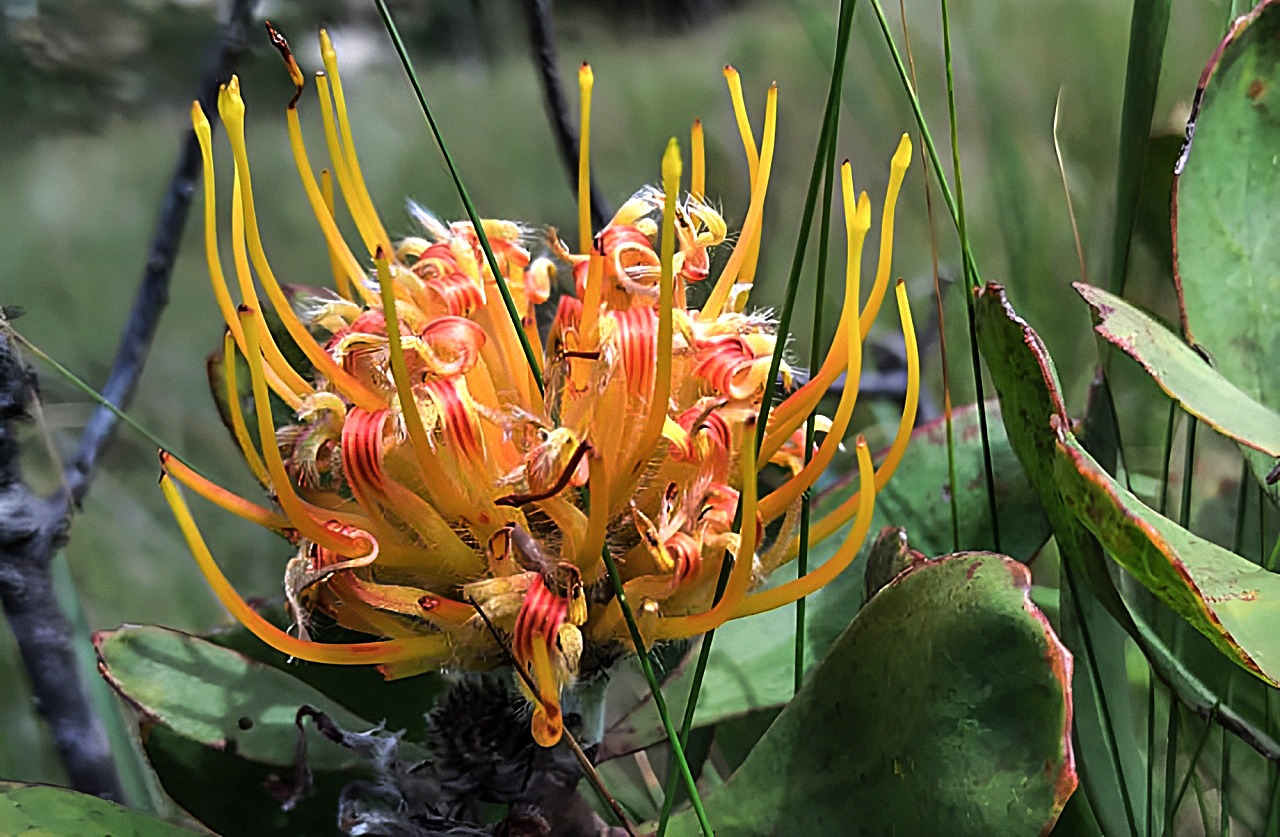
 The highly endangered Pondoland Pincushion is found along the Eastern Cape’s Wild Coast. (Photo: Sinegugu Zukulu)
 Last week, local tourist guide and award-winning environmentalist in the Amadiba area along the Eastern Cape’s Wild Coast, Sinegugu Zukulu, discovered that the contractor hired to cut down alien plants in the Amadiba area had destroyed a colony of Pondoland Pincushions, a highly endangered plant.
/file/dailymaverick/wp-content/uploads/2024/12/Tony-green-heroes-1-Sinegugu-Zukulu-Credit-Goldman-Environmental-Prize-1.jpg "Environmentalist Sinegugu Zukulu takes a break on a Wild Coast beach. (Photo: Goldman Environmental Prize)")
The work was part of the R4-billion Mtentu Bridge N2 Sanral project to build one of Africa’s highest and longest cantilever bridges over the Mtentu River. The plan is to reduce travel time on the N2 between Durban and East London and boost the Eastern Cape economy.
However, there has been an ongoing dispute with the Amadiba community, who are fighting the decision to have the road run through their pristine coastal area.
The Amadiba Crisis Committee has been fighting for the planned N2 Coastal Route to be moved from the environmentally sensitive coastline since 2010, when its former, late chairperson, Sikhosiphi “Bazooka” Radebe, first raised the issue. He was gunned down at his house in 2016 by unknown people. The Amadiba objection has now reached Parliament in the form of a petition that also proposes an alternative route and a midterm review of the project.
Read more: Sanral’s need for speed rides roughshod over Xolobeni/Amadiba community’s land
Besides the Pondoland Pincushion, Zukulu pointed out, among the carnage he also found two other Red List species. The Spearleaf Conebush (Leucadendron spissifolium) is on the list due to continuing threats to its habitat but is not yet in danger of being extinct. The other plant, the Lance-leaved waxberry (Morella serrata), is on the red list but the full extent of the threats against it must still be assessed.
/file/attachments/orphans/DeadPlants4_143981.jpeg "Piles of dead Pondoland Pincushions were discovered on Amadiba land, where the contractor working on the N2 had been. (Photo: Sinegugu Zukulu)")
“All three of these species are highly vulnerable and under threat to become extinct,” he said. Several of the same plants had been “mowed down” in the area six months ago by uninformed contractors.
Zukulu said the plants grow in the Pondoland Centre of Endemism. Among the Amadiba community’s arguments to have the proposed N2 highway moved inland is that it will save this area.
/file/attachments/orphans/YOungBush_146675.jpeg "A young bush of Pondoland Pincushions pictured along the Mnyameni River on the Eastern Cape Wild Coast. 29 January 2026 (Photo: Sinegugu Zukulu)")
“It is hugely important and very popular among tourists,” Zukulu said, especially the pincushion. In its statement, the Amadiba Crisis Committee said it was impossible to mitigate huge environmental damage on the coast. Zukulu said the absolute protection of the plants was also very necessary to provide for bees.
“But I think firstly we need an acknowledgement that what happened here was very serious. There is a need for an undertaking to do rehabilitation.” Zukulu said the workers also needed to be informed to understand why the plants were crucial to the area.
He said that after the Amadiba Crisis Committee filed its complaints he heard that workers’ wages were not paid “as a punishment”.
“This is unfair towards the workers, who are poor, and it has sown seeds of division in the community,” he said.
“The workers who were employed by the service provider were not aware that these were endangered plants. It happened before, and then they were made aware. But this time, they were also in an area where they were not supposed to be. This does call into question the monitoring by the Eastern Cape Parks and Tourism Agency. It also calls into question the supervision by the implementing agent,” Zukulu said.
“I also want to make a point that this damage is caused by Sanral,” he said.
“It was this community that said from the start that these sites must be protected. That is what we want.”
This is the third incident since May and June 2025 in which these plants were destroyed by contractors working on the N2.
According to the Amadiba Crisis Committee, the incidents are occurring within the “Biodiversity Offset” programme for the N2 Wild Coast Highway project.
“The programme is supposed to save some of the environment from the destruction expected in building the N2 Wild Coast Toll Highway in Pondoland,” it said.
“This contractor is supposed to hire an ecological expert to guide the work. Where is this person? Eastern Cape Parks and Tourism Agency is the closest responsible for managing contractors paid to work in biodiversity offset areas,” said well-known environmental activist Nonhle Mbuthuma.
“Sanral, agencies and N2 project outfits like the Environmental Monitoring Committee are supposed to defend the rules and directives in the Environmental Authorisation (EA). The EA is a law in the N2 project. Obviously, they cannot, and they don’t. They, for example, have no way to control contractors, or they don’t want to,” Mbuthuma said.
‘Serious noncompliance’
On 11 December 2025, the Amadiba Crisis Committee received a letter from the Green Scorpions of the Department of Forestry, Fishing and the Environment, confirming that its investigation in the area from 21 to 22 October uncovered “serious noncompliance” with environmental legislation and authorisation, including the destruction of wetlands and the pollution of water resources.
Human Rights Commission complaint
The crisis committee also turned to the South African Human Rights Commission to complain about the related pollution and destruction of water sources in the area. The Khanyayo community has complained to Sanral since January 2025 that their fresh water had disappeared when construction over wetlands and springs began.
Residents and nurses also complained about pollution close to the Khanyayo Clinic that came from a conservation tank used by workers in the N2 project.
Sanral said it has not yet received correspondence warning of these issues.
“Sanral wishes to put it on record that it undertook a site visit together with the Department of Forestry, Fishing and the Environment in June and October last year to assess biodiversity and general environmental challenges that may affect the N2 Wild Coast Road Project.
“While no material issues were raised with Sanral during the visit, Sanral awaits official correspondence from the department on steps that need to be taken, if any, to ameliorate any environmental challenges that pertain to the project,” the roads agency said in a written answer to a request for comment. DM