




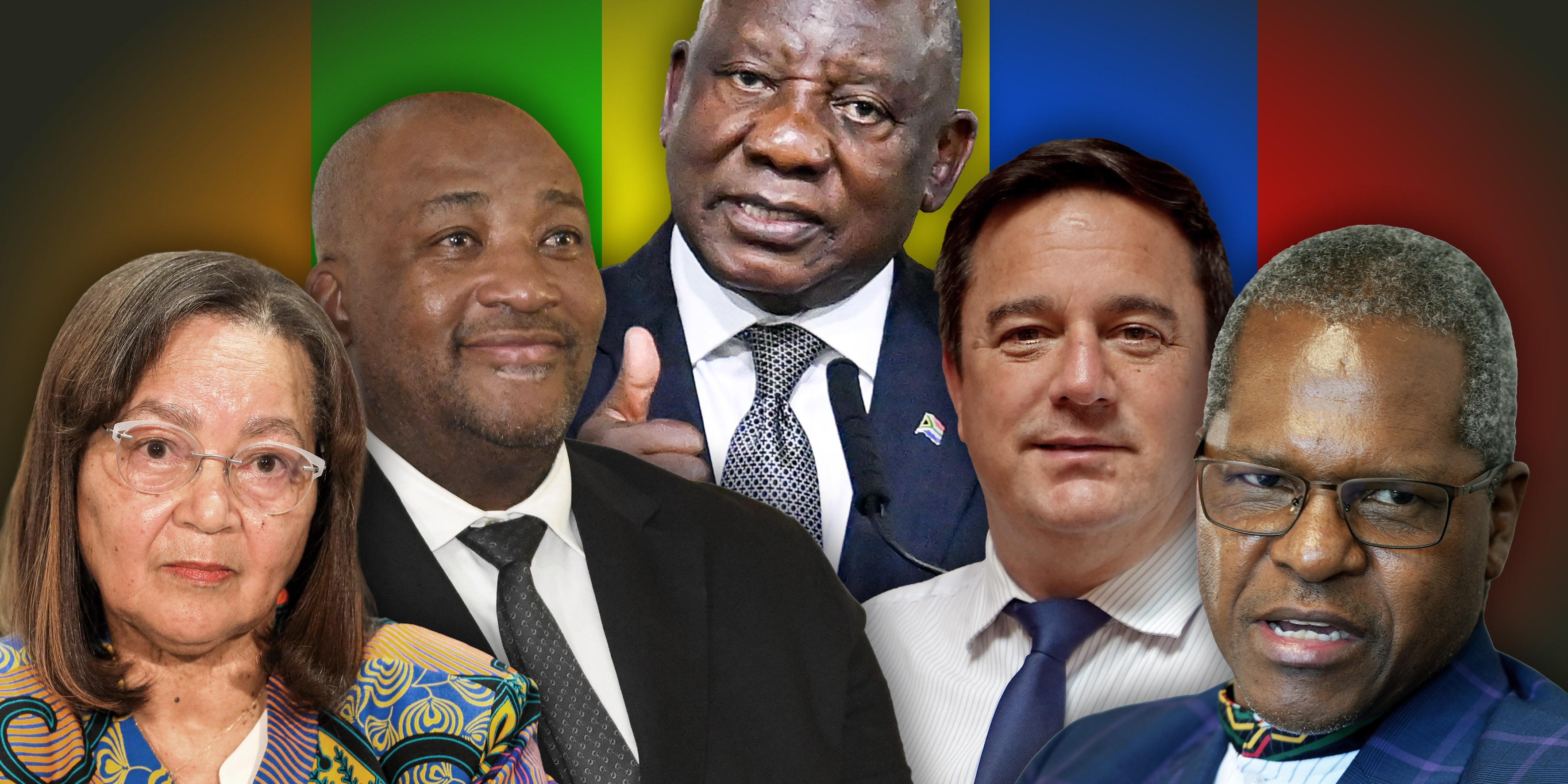
 From left: Good party leader Patricia de Lille. (Photo: OJ Koloti / Gallo Images); Patriotic Alliance leader Gayton McKenzie. (Photo: Frennie Shivambu / Gallo Images); President Cyril Ramaphosa. (photo: Jeffrey Abrahams / Gallo Images); DA leader John Steenhuisen. (Photo: Tebogo Letsie / City Press / Gallo Images);
IFP leader Velenkosini Hlabisa. (Photo: Tebogo Letsie / City Press / Gallo Images)
From left: Good party leader Patricia de Lille. (Photo: OJ Koloti / Gallo Images); Patriotic Alliance leader Gayton McKenzie. (Photo: Frennie Shivambu / Gallo Images); President Cyril Ramaphosa. (photo: Jeffrey Abrahams / Gallo Images); DA leader John Steenhuisen. (Photo: Tebogo Letsie / City Press / Gallo Images);
IFP leader Velenkosini Hlabisa. (Photo: Tebogo Letsie / City Press / Gallo Images) South Africa’s 18-month-old Government of National Unity (GNU) has hobbled from one crisis to the next since it was established on 14 June 2024. But as preparations for another State of the Nation Address (Sona) and Budget begin, the big question is whether the GNU has matured enough to survive the terrible twos.
Since its inception, the 10-party coalition has bickered about everything from the Budget to National Health Insurance, affirmative action policies, education and foreign policy.
Its biggest test, perhaps, was in February and March 2025, when the GNU failed to pass the Budget on two occasions, a first for the country. The first attempt at a Budget didn’t even make it to the National Assembly after last-minute talks in the GNU Cabinet collapsed because of opposition to its proposed VAT increase from 15% to 17%.
Meanwhile, ideological and policy differences among the GNU parties, particularly the ANC and the DA, have continued to put added pressure on the power-sharing arrangement.
Read more: South Africa’s GNU turns one – a year of unity, friction and some green shoots
However, the feeling among most parties in the GNU is that it is starting to experience a measure of stability. ANC spokesperson Mahlengi Bhengu told Daily Maverick that one of the GNU’s core strengths has been its “institutional stability”.
“Despite early tensions, the GNU has maintained policy continuity, protected fiscal credibility and ensured government does not grind to a halt. There has also been a maturing culture of negotiation, where differences are resolved through structured processes rather than confrontation,” Bhengu said.
DA leader John Steenhuisen seemed to agree. “The GNU has shown institutional resilience, maintaining continuity despite disagreements,” he said. “Decision-making has become more consultative. Importantly, it has demonstrated that political competition and cooperation can coexist, marking a meaningful shift in governance culture.”
According to Steenhuisen, the 2025 Budget bust-up marked a defining moment for the GNU. The DA was one of the parties that took the VAT hike to court.
“It illustrated that the DA was not simply going to rubber-stamp government decisions where they were misaligned with our values and what is in the best interests of South Africans. This brought about a more ‘consultative’ approach, which is welcomed.”
After the Medium-Term Budget Policy Statement was tabled in Parliament in November 2025, DA finance spokesperson Dr Mark Burke told Daily Maverick it seemed that Finance Minister Enoch Godongwana had listened to the party’s concerns – a sign that the GNU may hopefully avoid another Budget crisis this year.
Other parties, including the UDM and Good, also pointed to the rejection of the Budget as having been a turning point in internal GNU dynamics.
/file/attachments/2987/ED_549952_967840.jpg "Finance Minister Enoch Godongwana (centre) at the media briefing before the Budget speech in Cape Town on 12 March 2025. (Photo: Brenton Geach / Gallo Images)")
“[It] served as a clear reminder that the old way of doing things is no longer applicable,” UDM leader Bantu Holomisa said. “The era of individualism has ended; governance under the GNU requires collective responsibility, alignment and adherence to agreed processes.”
Now, the GNU is in full swing with final preparations for President Cyril Ramaphosa’s Sona, which will take place on 12 February. Presidential spokesperson Vincent Magwenya told Daily Maverick that Ramaphosa had witnessed “a great deal of more focused and better working relationships” among the GNU members.
Magwenya said this was evident during the two-day Cabinet lekgotla currently underway in Pretoria, in which the “spirit” of the discussions was very different from the first lekgotla under the GNU.
“There’s more cohesiveness, alignment and collaboration in ensuring that the GNU delivers to its priorities. This is certainly a positive development for the country,” he said.
But not all parties believe that the dynamics in the GNU have changed for the better.
“The GNU was a chance – the first in 30 years – to make a new beginning based on collective decision-making,” said Freedom Front Plus leader Dr Corné Mulder. “Unfortunately, I believe that a few months after the start [of the GNU] the ANC changed its stance.”
This was a “negative” change, he said.
Read more: GNU lease of life? Ramaphosa might just have finally taken charge of SA’s governing coalition
Mulder added that the two-day lekgotla convened by Ramaphosa with the leaders of political parties in the GNU in November 2025 had been a chance for a “reset”. “But I have not seen the fruits thereof,” he said.
Looming local elections
The forthcoming local government elections have the power to potentially upset the somewhat stable GNU relations. Magwenya said the elections would “test” the GNU.
“When campaigning gets heated, one can expect some individuals will feel different or be sensitive to robust political rhetoric. But be that as it may, it will not collapse the GNU. Every party is equally vested and committed to the success of the GNU and ongoing stability of government,” he said.
In response to questions, most coalition members said the elections had the potential to further drive a wedge between parties who are competing for councils.
“The main risks lie in ideological differences, uneven political discipline and the pressures of electoral competition,” Bhengu said. “If short-term positioning overrides collective responsibility, tensions can re-emerge.”
Similarly, PA spokesperson Steve Motale said the “main vulnerability” was that the GNU brought together political parties that have “genuinely different ideological traditions and constituencies”. “When political incentives shift, for example, ahead of elections or during moments of public pressure, those differences can resurface sharply.”
Steenhuisen also acknowledged that the elections have the potential to create “internal tensions”. He said parties had to figure out how to “balance governing together while campaigning against one another”.
/file/attachments/2987/ED_584896_278405.jpg "Kenny Kunene, the Patriotic Alliance’s mayoral candidate for Johannesburg, at the Metrobus Centre of Excellence in Randburg on 31 October 2025. (Photo: Luba Lesolle / Gallo Images")
It’s not hard to see why political parties have flagged this as an issue. There’s a big battle looming between the ANC and the DA in the City of Johannesburg. DA stalwart Helen Zille has been announced as the party’s mayoral candidate. The PA is also making inroads in Johannesburg and has announced its deputy president, Kenny Kunene, as its mayoral candidate. This means three parties in the GNU will be fighting for control of the country’s biggest metro.
Read more: Helen Zille moves to Joburg next week
In the Western Cape, the DA and PA, which have previously been coalition partners at a local level, have been at odds over control of the George Municipality, where three tightly contested by-elections are being held between January and February. So far, the PA has defeated the DA twice.
In the run-up to the municipal polls, tensions over voter support are likely to become a headache for the GNU as parties vie for control of the country’s 257 municipalities.
Ideological clashes persist
Aside from the coming polls, there’s another pressing issue: the differences in political ideologies among the 10 parties.
“Like any coalition arrangement, the GNU faces inherent challenges arising from differing ideological positions, policy approaches and constituencies,” Holomisa said.
“These differences tend to surface most sharply around high-stakes matters such as budgets, resource allocation and legislative priorities.
PAC secretary-general Apa Pooe said the most serious weakness was that the GNU lacked a unifying ideological vision.
“It is an arrangement of convenience, not conviction. Power-sharing without clear accountability creates fertile ground for paralysis, policy incoherence and political brinkmanship,” he said.
On the other hand, IFP chief whip Nhlanhla Hadebe said there could be “strength in unity through diversity”. “However, this unity is contingent upon equitable power-sharing arrangements, strong accountability mechanisms and unwavering respect for constitutional governance,” he said.
/file/attachments/2987/ED_555560_769980.jpg "Al Jama-ah leader Ganief Hendricks during the Week 4 Palestine media briefing at Constitutional Hill in Johannesburg on 30 April 2025. (Photo: Sharon Seretlo / Gallo Images)")
Other parties raised potential weaknesses in the lack of an agreed, detailed policy platform. An issue raised by Al Jama-ah leader Ganief Hendricks was that leaders seldom met and engaged. He also said the secret nature of Cabinet meetings hampered feedback to party leadership and members.
In response to Daily Maverick, some political parties said certain mechanisms that had been introduced had improved the workings of the GNU. For example, in October 2025, Deputy President Paul Mashatile announced that the terms of reference of the GNU’s clearing house mechanism to resolve disputes had, at long last, been adopted.
“The internal dynamics of the GNU have evolved meaningfully over the past 18 months,” Holomisa said. “A key development has been the establishment of formal coordination mechanisms, including regular cluster meetings involving ministers, deputy ministers and departmental heads.
“In addition, a coordination forum exists comprising at least two representatives from each GNU partner, with all parties participating on an equal footing. This platform exists to surface concerns early, ventilate differences candidly across the table and resolve matters collectively before they escalate into public disputes.”
Holomisa said these mechanisms have strengthened discipline, improved communication and developed a culture of problem-solving.
/file/attachments/2987/P4SuneToriGNUtimeline_604159.jpg)
Public perception of the GNU
South Africans have not yet given up on the GNU. A Social Research Foundation poll done in late 2025, of which some findings were released this week, showed that 49% of respondents thought it was working well. By comparison, 34% thought the GNU was working poorly, 17% said it was working quite poorly and 17% said it was working very poorly.
Interestingly, the same poll seemed to show that more DA voters (33%) were opposed to the GNU than ANC voters (23%). Among the ANC voters surveyed, 50% thought the GNU was working well, 16% said it was working very well and 34% said it was working quite well. By contrast, among the DA voters surveyed, 56% thought the GNU was working well, only 5% said it was working very well and 51% said quite well.
Magwenya said Ramaphosa and Mashatile were doing performance reviews with ministers and deputy ministers. “It’s a detailed process that looks at the overall past and future performance of departments in implementing the priorities of the GNU,” he said.
In the absence of ministerial performance contracts, it’s difficult to judge the GNU’s progress. Its statement of intent had pledged, among other things, rapid and inclusive economic growth, spatial redress and land reform, corruption-free government, strengthened law enforcement, foreign policy based on human rights and job creation.
Investor confidence in the GNU seems to have firmed up, and South Africa exited the Financial Action Task Force’s grey list in 2025. According to the International Monetary Fund, real GDP growth – the economy’s output adjusted for inflation – was 1.1% in 2025, an increase from 0.7% in 2023. Unemployment has also improved, falling slightly in the third quarter of last year to 31.9%.
Read more: Economic growth in 2026 is key to survival of the coalition government
Corruption, however, continues to persist as two simultaneous inquiries – the Madlanga Commission and Parliament’s ad hoc committee – are probing accusations of criminal cartel involvement, interference and corruption in South Africa’s police and criminal justice system.
South Africa’s foreign policy also continues to be a sticking point in the GNU, with several coalition partners wanting a larger say in the country’s policies on international relations. The recent fiasco regarding Iran’s seemingly unauthorised participation in the joint Will for Peace naval exercise has caused concern among the DA and FF Plus in particular. DM
This story first appeared in our weekly DM168 newspaper, available countrywide for R35.
/file/attachments/2987/DM-30012026-001_985740.jpg)