
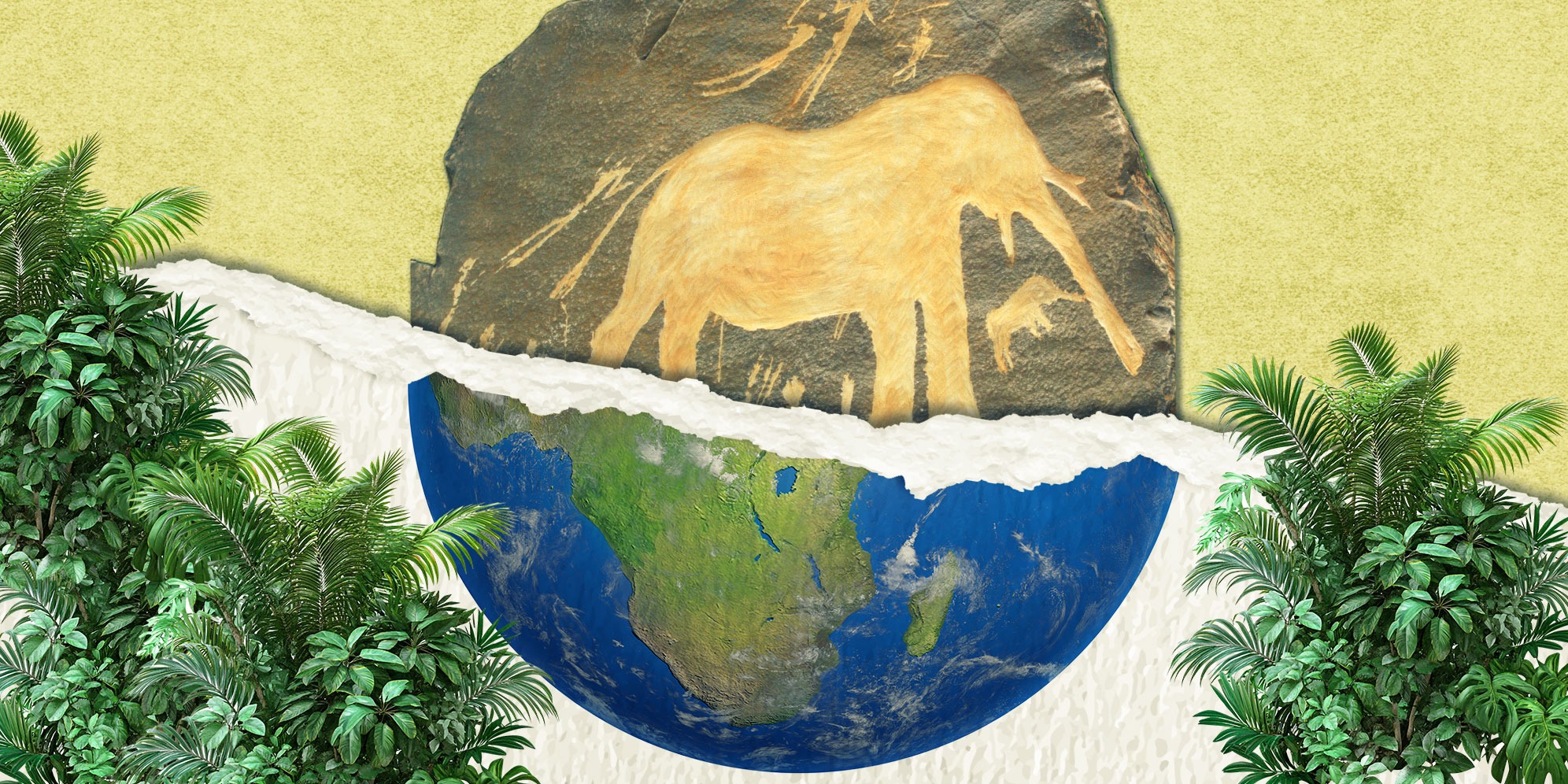
 Illustrative Image: Prehistoric Neolithic African rock art. (Istock) | Plants. (Image: Freepik) | Earth. (Image: Freepik) | Torn paper. (Image: Freepik) | (By Daniella Lee Ming Yesca)
 This is Part 3 of a three-part series. Read Part 1 here and Part 2 here.
The first wave of the “Sixth Extinction” outlined in the previous two parts of this trilogy – the elimination of many species of megafauna by ancient human hunters – would unravel the global web of life in profound ways.
This ecological aftershock, plausibly triggered in part by human/wildlife conflict, must have also affected the subsequent course of history in its broadest sense, both human and animal.
This unfolding environmental drama has given rise to a relatively new branch of scientific scrutiny that is yielding fresh insights into the Anthropocene. But their historical consequences have received virtually no attention.
One useful vantage point to scour this terrain from is through the prism of the “longue duree”. This refers to an approach pioneered by the Annales school of history which looks at history over a long duration to connect the dots in a way that is not apparent over shorter periods of time.
This also serves to blend “pre-history” and “history” onto the same broad canvas. The result is a more compelling portrait of our past that brings our present into sharper focus, helping to frame potential visions of the future.
“I see no value in the artificial separation of our human story into something called ‘history’ and something else called ‘pre-history’,” notes the historian of ancient Africa Christopher Ehret. “Whatever human beings have done in the past is history.”
To that observation one might add that whatever animals have done in the past is also part of our shared history, and its ancient roots include inter-species conflict, the megafaunal extinctions, and the way these ultimately helped shape the world as we know it today.
I am just scratching the surface here, but there are at least two major historical trends – and no doubt many more – that emerged from the megafaunal extinctions at the hands of our ancestors.
The first is that they left an unnatural abundance of forest cover over the Americas and Europe that must have blazed historical trails beneath the boughs that branched out in ways we would not recognise today.
It is simply inconceivable that the history of these regions – and by extension, others – would have proceeded in the way they did if the landscape had continued to be shaped by the presence of elephants and other megafaunal species.
The second is how Africa remained – from a human perspective – burdened by beasts, which helps explain its relative underdevelopment over the arc of the longue duree.
Keystone species
Megafauna are keystone species – like the keystone of an arch, things fall apart when they are removed. And ecological arches across the world collapsed in the wake of their extermination by ancient human hunters.
A key scientific concept at play here is “trophic cascades”, which applies to the top consumers in an ecosystem, both predators and herbivores. Trophic refers to food and nutrition, and the elimination of keystone species unleashes cascades through the food chain, changing the composition of plant life and the entire ecosystem.
Christopher Johnson of the University of Tasmania is one of the trailblazers who has applied his mind to this subject in relation to the megafauna extinctions. In 2009, he published an article in the Proceedings of the Royal Society entitled Ecological consequences of Late Quaternary extinctions of megafauna.
“North America... had a Pleistocene mega-herbivore assemblage considerably richer than that of present-day Africa. Given what we know of the impact of the African elephant alone as a habitat engineer, continental North America’s four (or more) species of proboscideans must have had even greater ecological effects over a wider range of environments; ground sloths might have been just as powerful again. The ecological consequences of their mass extinction, along with large bovids, cervids, camels, horses, glyptodonts, peccaries and so on, should have been immense,” Johnson wrote.
He suggested that megafaunal extinctions could have triggered a trifecta of major vegetation changes: the loss of relatively open landscapes and their replacement with denser formations such as forests, increased fires sparked by this combustible density, and the decline of plant species that had co-evolved with megafauna.
In 2009 when his article was published, there was little in the way of scientific literature exploring the ecological aftermath of the Pleistocene/Holocene megafaunal extinctions. But Johnson was seeing the forest for the trees, and much research has followed his insights.
This has enriched our understanding of the three changes Johnson identified. The first – the replacement of open landscapes with denser, more wooded and in some cases less productive ones – is possibly the most important and far-reaching.
A number of studies over the past decade have shown that Europe, including the UK, and North and South America effectively became more forested because of the disappearance of the mega-herbivores.
For example, one study found that savanna woody cover in South America would be almost 30% smaller if the continent’s megafauna had not died out, and that much of the region’s landscape would be more open like an African savanna landscape.
/file/attachments/orphans/GettyImages-2216592500_620119.jpg "A savanna elephant walking through forested areas in Ankoro, Democratic Republic of Congo. (Photo: Hugh Kinsella Cunningham / Getty Images)")
Scientists refer to elephants as “physical habitat engineers”. In simple terms, they open habitat up – effectively “engineering” it – by the removal of trees.
Big herbivores such as elephants also engineer habitat in other ways. Their dung, for example, disperses nutrients and seeds across a wide area.
Indeed, dung provides some of the clues to the ecological changes linked to the megafaunal extinctions. Several beetle species have an affinity for dung. A decade ago a team of Aarhus University researchers examined the fossil record of dung-loving beetles in Great Britain, comparing it with what the data showed from 132,000 to 110,000 years ago – before modern humans arrived on British shores – and what it revealed about the British environment 10,000 to 5,000 years ago.
“... abundant and diverse large herbivores appear to have been associated with high structural diversity of vegetation before the megafauna extinctions at the end of the Pleistocene. After these losses and in the presence of modern humans, large herbivores generally were less abundant, and closed woodland was more prevalent,” they wrote in the Proceedings of the National Academy of Sciences of the United States of America.
This is rich terrain for historians seeking to untangle the brush of how forests and their key product wood carved the course of history.
The myth of the forest primeval
“This is the forest primeval,” is how the American poet Henry Longfellow begins his classic mid-19th century epic poem Evangeline: A Tale of Acadie.
The murmuring pines and the hemlocks,
Bearded with moss, and in garments green, indistinct in the twilight,
Stand like Druids of eld, with voices sad and prophetic.
The poem revolves around the mid-18th century expulsion by the British of the French-speaking Acadians from my Canadian home province of Nova Scotia. The “forest primeval” is a metaphor of purity that reflects an idyllic rural image of Acadian culture.
The “forest primeval” is is now commonly applied to the concept of an “old-growth forest” – one that has developed free of human encroachment, a natural outcrop with ancient trees sheltered from the surrounding wasteland of the Anthropocene.
The implication is that the “forest primeval” grew out of an antediluvian past untouched by humans, and has remained so.
But the “old-growth” forests of Nova Scotia – where the fossil record clearly shows the presence of mastodons in the Pleistocene – and many others are not “natural” in the sense that they evolved largely outside the influence of humans.
/file/attachments/orphans/GettyImages-1232155135_553405.jpg "A forest protector near Port Renfrew, British Columbia, Canada. (Photo: James MacDonald / Bloomberg via Getty Images)")
They are an outgrowth of the Sixth Extinction’s first wave – forests that sprouted after humans cut down the megafauna that constrained their growth.
Pre-historic hunters, in this sense, were inadvertent “physical habitat engineers”. Indirectly, their actions gave rise to the “forest primeval” and many other features of biogeography that influenced the history of global commerce and trade as well as the climate.
Africa burdened by beasts
Another major trend that rose from this state of affairs was how Africa – from a human perspective – would have to carry a beastly burden that had largely been eliminated elsewhere.
Jared Diamond in his seminal 1997 book Guns, Germs and Steel has drawn our attention to Africa’s dearth of wild species suitable for domestication, which ultimately gave non-African societies – notably Eurasian – a massive head start on the road to economic development.
But there are many other ways in which this unequal distribution of dangerous wildlife laid the foundations for current regional inequalities, with Africa at the bottom.
Think, for example, of the role that rivers have played in the history of trade. It is no coincidence that every major European city is perched on either the banks of a river or a port.
/file/attachments/orphans/GettyImages-94171154_974996.jpg "African rivers contain wildlife that European rivers lack, notably hippos and crocodiles. (Photo: Warren Little / Getty Images)")
Africa’s relative dearth of navigable rivers has been cited as one of the development challenges the continent has faced. But its rivers also contain wildlife that European rivers lack – notably hippos and crocodiles. And the presence of such megafauna has surely been an historical obstacle to the fostering of African trade routes that is as daunting as rapids.
/file/attachments/orphans/GettyImages-107542697_971519.jpg "A Nile crocodile. (Photo: Warren Little / Getty Images)")
Agriculture also comes to mind, and again, the contrast with Europe is stark. Contending with wolves or bears preying on livestock, or deer raiding crops, is one thing. And in Europe, rural communities effectively wiped out almost all of their wolves and bears, which only in recent decades have been making a comeback thanks to conservation efforts.
Elephants raiding crops or the predation of cattle by lions is in a different league altogether. Historically, farming in much of Africa has not only been difficult, but also dangerous as a result.
Cattle are another arresting example on this front. Many African cultures venerate cattle, which are a key source of household wealth. This makes historical sense. Among Africa’s fearsome faunal environment here is an animal that stands out: a critter that is large but also relatively docile and hence useful.
This often romanticised connection to cattle can also be impoverishing. Drought can transform this asset into a liability, exposing rural households to literal wealth destruction.
And many African cattle cultures are deeply patriarchal and historically prone to conflict, be it the raiding of other people’s cattle – property that can be seized – or skirmishing with crop farmers over scarce land and resources.
The Rwandan genocide, reflecting enmity between Tutsi pastoralists and agrarian Hutus that is often likened to the Biblical tale of Cain and Abel, is grim testimony to the killing fields that cattle can reap.
Finally – and this list is by no means exhaustive – there is the blood-stained history of the trade in ivory. The elimination of proboscideans outside of Africa on a global scale – excluding some pockets in Asia – left Africa the world’s final significant source of the commodity.
This in turn gave rise to the colonial predation of Africa by Europe and Arab nations, paying and paving the way for the plunder of the region. And the ubiquity of the elephant in Africa made the ivory trade a continent-wide endeavour while providing the template for what development economists now dub the “resource curse”.
Read more: An old curse and addiction are at play in new debates around ivory
Much of Africa’s megafauna has, over the past couple of centuries, been eliminated. But poor rural Africans who still have to share space with such wildlife live below what I have termed “the faunal poverty line” – a terrifying realm that evokes a Pleistocene existence where poverty makes you prey.
Read more: Africa’s beastly burden – the case for shrinking the faunal poverty line
Many other regions of the world did not share this beastly burden, and when one stands back to regard the broad sweep of history on this canvas, the Anthropocene is seen in a new light. Having eliminated the monsters in their midst outside of Africa, what we broadly define as “economic development” could take off at an accelerating pace.
This portrait of history also explains why many in the affluent West currently view Africa’s megafauna as a blessing while simultaneously not entertaining the notion of living alongside such wildlife themselves. But many Africans understandably regard megafauna as a curse.
We can use this history as a guide to chart a better future – for people and animals alike – as we navigate the perils of the Anthropocene. DM