




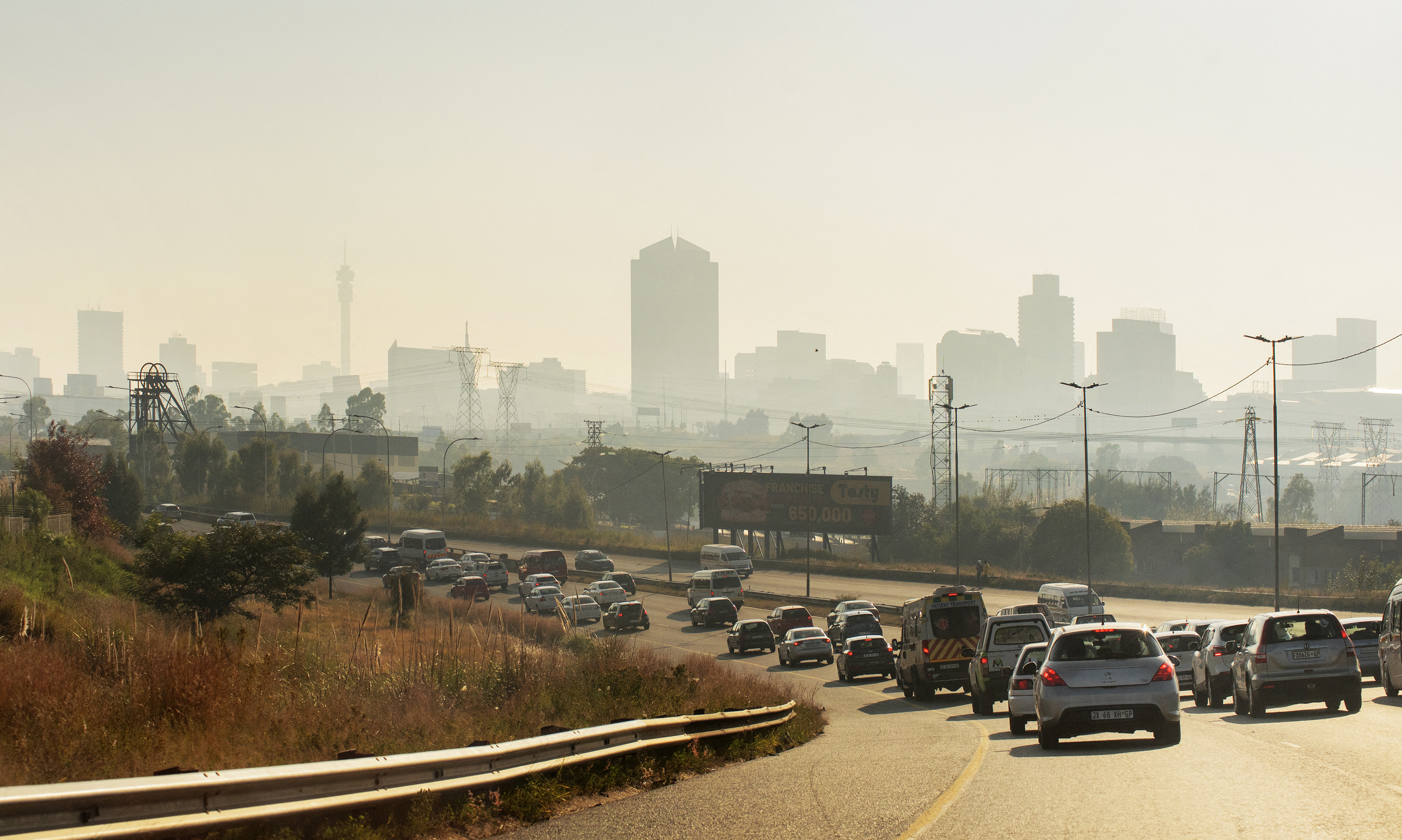
 The ‘rotten egg’ smell over Johannesburg comes from Mpumalanga, says the city. (Photo: Luca Sola / AFP)
 Environmental organisations warn that the “rotten egg” smell recorded over parts of Johannesburg last weekend is a symptom of a larger, ongoing problem with Johannesburg’s poor air quality.
The City of Johannesburg confirmed on 19 January that there were widely reported claims of a rotten egg smell over parts of the city, including Sandton, Randburg, Roodeport, Fourways and Parktown.
In a statement, the city said that an investigation conducted by the Environmental and Infrastructure Department found that the smell was probably linked to hydrogen sulphide pollution. The geographic spread of the odour ruled out a localised source.
“It is likely that the city was impacted by a transboundary pollution source,” the statement reads.
“Current weather patterns are conducive to the long-range transport of air pollutants from the Highveld Priority Area and industrial complexes in Mpumalanga province, which include power generation and petrochemical operations. The characteristics of the reported odour are consistent with emissions typically associated with such activities.”
The Highveld Priority Area is a region in Mpumalanga and Gauteng that includes Secunda, which hosts a synthetic fuel plant owned by Sasol. Sasol denied responsibility for the smell in a press statement released on 16 January.
“We confirm that Secunda Operations is stable, with no operational incidents or abnormal process conditions that could have resulted in increased emissions or off‑site impacts,” it read.
Similar episodes have been reported over the years, with an incident in June 2022 attracting widespread media coverage.
Read more: Something rotten this way comes — sulphur stench in Gauteng and North West investigated
Dirty air
Environmental watchdog Greenpeace Africa and global philanthropic organisation Clean Air Fund warned that these episodes indicate that existing regulations, such as the 2005 Air Quality Act, are not being enforced.
Vumile Senene, Clean Air Fund’s country lead for South Africa, told Daily Maverick that compounding the issue were certain pollutants, such as the one responsible for the rotten egg smell, not being adequately monitored.
“We monitor certain pollutants. So, for example, sulphur, nitrogen dioxide, particulate matter, but these particular events, these regional pollution events, are different chemicals which we are not monitoring in their entirety,” he explained.
“Hydrogen sulphide, for example, which is the rotten egg smell that people complain about, is not monitored extensively. You may have one or two analysers here and there. And so when there’s an incident, you would not be able to sort of pinpoint immediately when it happens and be able to undertake investigations as to where it's coming from.”
Senene said the country lacked “robust, continuous, real-time monitoring and reporting”, making it difficult to pinpoint the exact cause. This issue was further compounded by air pollution travelling across provinces.
Daily Maverick reported in October 2025 that in Gauteng, South Africa’s pollution hotspot, only 12 of the 31 municipal-owned air quality monitoring stations are fully operational.
Read more: Gauteng’s air quality monitoring choking with most stations offline in SA’s most polluted province
Odour is a ‘warning signal’
Air pollution carries a significant public health risk. In June 2025, Greenpeace Africa and the Centre for Research on Energy and Clean Air published a report that found an estimated 42,000 South Africans died in 2023 due to exposure to fine particulate pollution, which included more than 1,300 children over the age of five.
Fine particulate matter is created by burning coal and other fuels, and the particulate matter is small enough to enter the bloodstream through the lungs. These can lead to health issues such as respiratory and cardiovascular disease, cancers and strokes.
Climate and energy campaign lead at Greenpeace Africa, Cynthia Moyo, told Daily Maverick that hydrogen sulphide pollution was created by many of the sources responsible for fine particulate matter.
“So this means that in essence, the odour incidents that we’re experiencing are a warning signal that points to this broader air quality problem that we have,” she said.
“So what residents are really experiencing already is not an isolated incident, but it’s more of a symptom of South Africa’s continued dependence on highly polluting fossil fuel-based energy and all these industrial systems that we’re seeing.”
Greenpeace Africa and the Clean Air Fund have called for strengthened air quality monitoring systems and a just transition away from fossil fuels. DM