




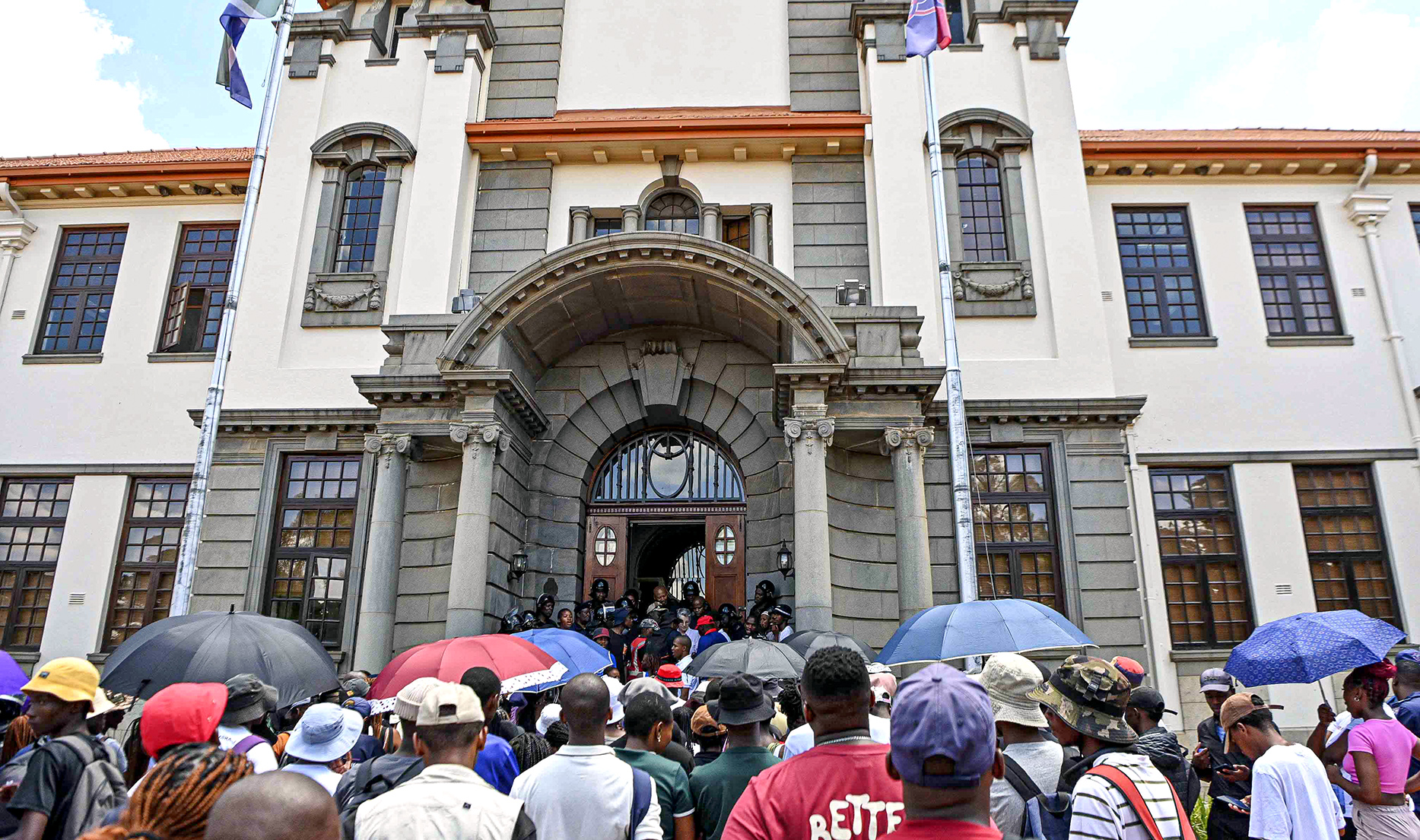
 Achieving a matric bachelor’s pass simply denotes a minimum eligibility threshold for university entry and does not guarantee a successful application. However, there are higher education alternatives. (Photo: Gallo Images / Volksblad / Mlungisi Louw)
 With more than 340,000 bachelor’s passes recorded nationwide and only about 235,000 spaces available across South Africa’s public universities, Higher Education Minister Buti Manamela said the system simply could not absorb every qualifying applicant.
This comes after an outcry that the department is locking out more than 100,000 deserving and qualifying matric students who want an opportunity to study at tertiary institutions. During a media briefing on Thursday, 22 January, Manamela said there would be a friendly tussle with the Basic Education Department because a bachelor’s pass, or categorising a pass as a bachelor’s, created an expectation that did not necessarily conform with university rules.
“It’s also critical to clarify a persistent misunderstanding. A bachelor’s pass does not guarantee admission to a university or to a specific programme. Secondly, an Admission Point Score (APS) does not necessarily guarantee someone a space for that particular programme… I think it’s important that we make that particular emphasis, and that on its own has exerted pressure.
We’ve been having fights with parents, and we’re going to have fights with parents into the coming week, until the university system begins to admit students,” said Manamela.
/file/dailymaverick/wp-content/uploads/2025/08/ED_568460.jpg "Minister of Higher Education Buti Manamela. (Photo: Frennie Shivambu / Gallo Images)")
In a Daily Maverick opinion article, Zanele Ngcobo and Nicky Roberts outlined the essential matter that parents, teachers and pupils overlooked.
A common misconception is that achieving a matric bachelor’s pass indicates strong academic merit. However, this pass level simply denotes a minimum eligibility threshold for university entry. The Department of Basic Education’s pass structure shows that a bachelor’s admission pass equates to only 23 APS points.
While this minimum APS meets the requirement for a bachelor’s pass, it is generally not competitive for university placement. Most university programmes typically require a minimum APS of around 28, with highly selective degrees, such as those in health sciences, commerce and engineering, often demanding substantially higher scores.
Read more: A matric bachelor’s pass isn’t a ticket to university – here are the real requirements, and other options
Universities echoed the minister’s message, pointing to strict capacity limits and enrolment targets set by the Department of Higher Education and Training (DHET).
University of Western Cape spokesperson Gasant Abarder said that the university had received more than 177,000 first-year applications, with 4,715 places available.
“The number of places is determined in consultation with the Department of Higher Education and Training,” said Abarder.
‘Highly competitive’
The University of Johannesburg (UJ) released a statement that it had received a record-high number of applications of more than 450,000, submitting 870,000 study choices, against an undergraduate first-year intake of 11,200 students.
“This capacity constraint highlights the highly competitive nature of university admissions in South Africa and the reality that not all qualifying applicants can be accommodated in traditional programmes,” read the statement.
Durban University of Technology (DUT) spokesperson Simangele Zuma said 155,630 applications had been received for first-year admission in 2026. “The university has only 9,416 spaces available” for first-year students.
“The main factor is the DHET targets. DUT has to comply with the enrolment targets set by DHET… We have sufficient beds reserved for first-time entry students. The Housing and Residence Life unit at DUT has also arranged temporary accommodation for prospective students who hold firm offers from DUT, but are experiencing challenges completing their registration,” said Zuma.
Capacity constraints
Nelson Mandela University spokesperson Primarashni Gower said they received a total of 297,524 first-time applications against 8,500 available spaces.
“The main considerations in determining this target include the capacity of the university to take in new first-year students in terms of the number of academic staff and infrastructure, such as lecture venues and laboratories, as well as the implications for support services such as student transport, accommodation and academic support.
“Expanding the capacity of the university in these areas to accommodate more first-time entering students has significant resource implications and would put the institution at risk of becoming financially unsustainable unless [the] government subsidy is increased proportionately,” said Gower.
The University of Pretoria (UP) spokesperson, Liesel Swart, said, “The number of those who started an application to UP for an undergraduate programme is about 340,000; those who met some form of the application requirements are about 57,000; those who were ranked based on academic merit and made offers are about 16,000; and spaces are about 9,700,” said Swart.
Departmental planning
Manamela said the department planned for all enrolments. “I don’t wake up in the morning and call the Director Deputy-General [and] each of the vice chancellors and tell them, this year we do 1,000 lawyers. It’s not a thumbsuck. There’s a process to arrive at that conclusion. But if the demand for law is 1,000, and we’ve committed to train 100, and that 100 is planned, does that constitute a crisis? Yes. For those 900 of them who want to train as lawyers,” said Manamela.
Meanwhile, parliamentary higher education committee chair Tebogo Letsie told Daily Maverick that no student would relish being left out when they saw their peers moving forward. “It is not the intention of the government to leave others behind. Unfortunately, many prospective students are not aware of other educational pathways that one can follow to achieve their educational goals,” said Letsie.
Read more: First-year student placements limited, but higher education minister says it’s all systems go for 2026
Alternatives for those not accepted
Higher education also consists of other learning pathways – Technical and Vocational Education Training (TVETs) and Community Education and Training institutions (CETs). Manamela urged that these institutions should not be overlooked by prospective students.
“TVETs and CET colleges are not residual options… They’re a central pillar of our PSET system. They provide practical skills and accessible and work-related education to the majority of South Africans and are essential to confronting unemployment, inequality and poverty,” said Manamela.
Letsie echoed Manamela on TVETs being an alternative.
“TVET colleges are now institutions of choice. Hence, they also receive a high number of applications from prospective students. This is a sign that prospective students choose to study at TVET colleges.
“If one looks at the variety of pathways that prospective students can choose from, it is evident that as a country, we do not have challenges of access to education and training, but about changing the narrative so that artisan training, private colleges and specialised institutions are seen as equally valuable.
“The challenge is that the focus is only on one institutional type – universities,” said Letsie.
Mental health and emotional wellness
During university enrolment and waiting periods, many applicants worry about being left behind, especially after being promised a university spot with a matric bachelor’s pass. Daily Maverick spoke to Dr Keitumetse Mashego on how not being accepted into university can cause stress in a prospective student.
“Sadly, it shatters their hopes and dreams. It can really spiral into severe mental health issues or suicidal ideation for some. Some can develop poor coping strategies (substance abuse). The way society pressurises education (specifically at universities) as the key to success implies that the inability to get access to it can lead to severe hopelessness and a negative perception of [one]self as a failure. It can additionally shatter family members who had put all their hope in the education of their children.”
She said learners now facing a tough time should understand that “delay does not mean denial. Identity is not wrapped around tertiary education, but to understand that they are more than the academic journey”, said Mashego.
Senior psychologist at Higher Health Siphesihle Dlamini told Daily Maverick that when students’ effort results in a closed door rather than an acceptance to university, the psychological impact could be significant.
“This rejection is often perceived not as a failure of the system, but as a personal failure. Instead of thinking, “There weren’t enough spaces,” students might think, “I wasn’t good enough.”
He said that “even if a student does not gain admission to their desired institution, they should still be celebrated for their accomplishment in passing matric. They are also encouraged to explore other opportunities, such as checking for openings at TVETs, CETs and private colleges, applying for DHET International Scholarships, or even entering the workforce and pursuing entrepreneurship,” said Dlamini. DM