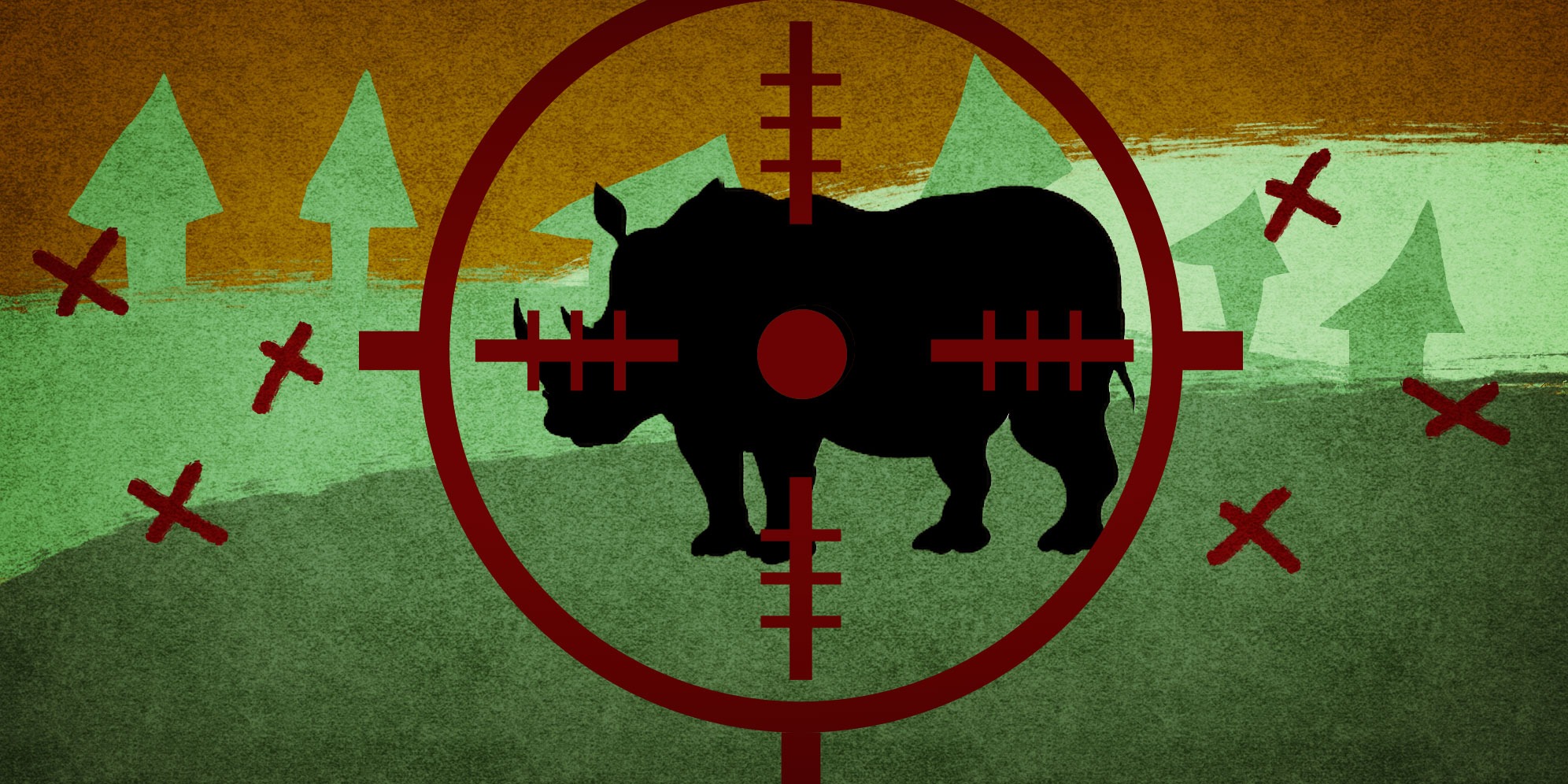
 Illustrative Image: Rhino silhouette. | Huning rifle sight. (Image: Freepik) | (By Daniella Lee Ming Yesca)
 /file/dailymaverick/wp-content/uploads/2025/10/label-Op-Ed.jpg)
South Africa’s newly released professional hunting statistics tell a story that is rarely stated plainly: trophy hunting is not a conservation tool, nor a reluctant compromise at the edges of wildlife management. It is a large, industrialised system of wildlife extraction, normalised through regulation, sanitised by conservation language and sustained by political accommodation.
Between 2016 and 2024, professional hunters operating under state permits recorded the killing of almost 300,000 wild animals by international clients, according to official Professional Hunter (PH) registers submitted to the Department of Forestry, Fisheries and the Environment. These figures are not activist estimates or leaked data. They are industry self-reports, compiled, accepted and archived by the South African state itself.
The animals listed are not limited to antelope. They include lions, elephants, rhinos, leopards and a long trail of species that rarely enter the public conservation debate: baboons, otters, honey badgers, monkeys, caracals, jackals, squirrels and other wildlife treated as legitimate commercial targets.
What these statistics document is not conservation under pressure. They document extraction at scale.
This is not subsistence use, cultural practice or emergency population control. It is a market-driven killing economy.
South Africa’s trophy-hunting industry is overwhelmingly a foreign, elite market, dominated by clients from the US and Europe. Official 2024 professional-hunting statistics show that of 7,756 foreign hunting clients, well more than 5,000 were from the US and Canada while 2,149 came from Europe, meaning more than 95% of all foreign hunters were from these wealthy regions. This is not a mass rural livelihood economy; it is a high-end, discretionary luxury trade designed for affluent international consumers.
That exclusivity is mirrored on the supply side: the professional hunting sector remains overwhelmingly untransformed, with only 101 of the 2,786 registered professional hunters in 2022 (from the answer to a parliamentary question) coming from previously disadvantaged communities. Together, the numbers expose trophy hunting not as a people-centred conservation model, but as a market-driven industry serving a narrow, global elite.
The scale we are meant not to notice
The hunting industry consistently presents itself as conservationist, scientific and tightly regulated. The PH statistics suggest something else entirely.
Year after year, thousands of indigenous animals per species appear in the registers – shot by paying clients in a routinised system that treats wildlife as units of offtake rather than participants in complex living ecosystems. This is not subsistence use. It is not cultural practice. It is not emergency population control. It is a market-driven killing economy, operating with the regularity and predictability of any other mega-extractive industry.
This bureaucratic flattening allows the industry to claim conservation success while laundering captive exploitation through wildlife policy.
Lions are the clearest example. From 2016 to 2024, about 3,600 lions were recorded as hunted by international clients in South Africa alone. At about R250,000 trophy fee per lion (based on the figures provided), this represents a multibillion-rand killing economy over less than a decade. At a total of more than R570-million paid to shoot lions, the financial scale becomes even more stark.
The question the statistics force us to ask is not whether this is profitable. It is what, exactly, is being conserved?
Lions: conservation symbol, commercial product
South Africa’s lion hunting figures cannot be understood without confronting the country’s captive lion industry – a system that has bred lions for decades for the explicit purpose of human use. These lions are manufactured commodities: bred in captivity, habituated to humans, sold into hunting operations, and until 2019 monetised again through skeleton and bone exports.
Crucially, the official PH registers do not distinguish between genuinely wild lions and those originating from captive breeding systems. On paper, they are all simply recorded as “lions”.
This bureaucratic flattening is not incidental. It allows the industry to claim conservation success while laundering captive exploitation through wildlife policy. A conservation model that depends on breeding thousands of apex predators for execution cannot plausibly claim moral authority over species survival. No regulatory language can turn a lion breeding facility into a protected area.
Any serious reading of South Africa’s lion hunting statistics must also confront the role of the US, long the primary destination for African lion trophies – indeed all trophies – with about 5,000 US hunters visiting South Africa in 2024 alone. Under the US Endangered Species Act, lion trophy imports require a permit and may be approved only if the US Fish and Wildlife Service determines the import will “enhance the survival” of lions in the wild or wild-managed. In South African policy, “wild-managed” animals are free-roaming wildlife living in natural habitat but subject to human management such as fencing, quotas or controlled removals, rather than being captive-bred. Captive-bred lions from South Africa are explicitly excluded from eligibility. This exposes a structural contradiction at the heart of the system since the dozens of lion trophies exported into the US (according to the CITES Trade database) suggest many are likely from captive-bred lions.
The continued killing of at least 627 lions in 2024 alone underscores the failure of repeated efforts to shut down South Africa’s captive lion breeding industry. This persists despite a 2018 National Assembly resolution calling for an end to captive breeding and “canned” hunting, the subsequent High-Level Panel review and commitments reflected in the Lion Policy White Paper, all of which recognised the industry as incompatible with conservation and animal welfare objectives. Yet implementation has stalled.
South Africa positions itself as a global conservation leader while operating one of the world’s most permissive trophy-hunting regimes for megafauna.
Instead of decisive action, the newly appointed environment minister, Willie Aucamp, has argued that further socioeconomic impact assessments and Cabinet approval are required before any closure can proceed, despite unequivocal Cabinet approval and overwhelming evidence to the contrary, clearly signalling continued obfuscation rather than reform. This reluctance has fuelled concern that there is little political will to dismantle the industry, particularly given public reporting on familial links to the hunting sector – connections that, while disputed, further erode confidence in the government’s stated intention to bring captive lion breeding to an end.
Elephants and rhinos: icons reduced to line items
Lions are not alone.
South Africa’s hunting statistics record the continued killing of elephants and rhinos, species universally recognised as facing severe conservation pressure. These hunts are frequently defended as exceptional – old bulls, problem animals, tightly controlled permits.
Yet the data shows something more troubling: normalisation through repetition. Elephants and rhinos appear in the PH registers not as ecological keystones, but as annual line items, absorbed into the same commercial logic as plains wildlife.
Once killing is accepted as a conservation tool, ethical limits erode rapidly.
Elephant hunts in South Africa have been marketed in the range of R600,000 to more than R1-million per animal. Rhino hunts have reached R1.5-million to R3-million per individual. Together, more than 750 elephants and rhino (black and white) were shot as trophies during the same period.
South Africa simultaneously positions itself as a global conservation leader while operating one of the world’s most permissive trophy-hunting regimes for megafauna. This contradiction is not theoretical. It is measurable.
The silent species: otters, honey badgers, monkeys and squirrels
Beyond the flagship species lies a quieter, more revealing layer of the data.
Between 2016 and 2024, PH registers record the killing of almost 3,000 chacma baboons, about 2,000 jackal, more than 350 honey badgers, almost 300 brown hyena and even otters, porcupines and squirrels. These animals are rarely described as trophies, yet they are repeatedly classified as legitimate commercial targets.
Trophy hunting persists in South Africa not because it works ecologically, but because it works politically.
Their deaths attract little public scrutiny precisely because they lack symbolic weight. But their inclusion matters. It reveals how trophy hunting culture expands outward, normalising lethal control across species boundaries. Once killing is accepted as a conservation tool, ethical limits erode rapidly. Predators, less-known antelope (like the tiny suni), meso-carnivores, primates – each becomes expendable within a system that prioritises client satisfaction over ecological restraint.
This is how industrial killing embeds itself: not only through iconic deaths, but through the cumulative erosion of ecological complexity.
When conservation becomes branding
Defenders of trophy hunting insist the model is scientific. They argue that hunting revenues fund conservation, incentivise tolerance of wildlife and protect habitat.
Yet the PH statistics offer no empirical evidence linking offtake to improved ecological outcomes. There is no demonstrated causal relationship between animals killed and population resilience, ecosystem integrity or long-term habitat security. For example, the breeding and hunting of so-called golden wildebeest or white lion offers no conservation benefit, as these animals are selectively bred for an unnatural colour mutation in captivity, or fenced spaces contributing nothing to the genetic integrity, ecological function or long-term survival of wild populations.
What the data does show is consistency of killing, even as South Africa’s broader biodiversity indicators continue to deteriorate. This is not adaptive management. It is quota-based extraction, driven by market demand and defended through conservation branding. This is a system that cannot fail – because every failure is blamed on implementation rather than design. This is not science. It is ideology.
A political economy of death
Trophy hunting persists in South Africa not because it works ecologically, but because it works politically. It provides foreign revenue without structural reform, conservation optics without land justice and rural narratives without genuine community power. Communities are routinely cited as beneficiaries, yet the hunting industry is silent on how revenue is distributed, or who controls land decisions. The animal absorbs the moral cost.
A study in 2025 debunked the narrative that rural communities depend on trophy hunting to survive and instead highlight a growing desire for coexistence and respect for animal sentience.
A system that requires the killing of hundreds of thousands of animals to justify its own existence is not conservation policy. It is a political compromise – one that trades ethical clarity for administrative and financial convenience.
South Africa’s Draft National Biodiversity Economy Strategy openly promotes the expansion of trophy hunting, selling it as conservation and rural development even as its ecological credibility, market stability and social legitimacy continue to erode. The strategy doubles down on an elite, foreign-driven killing industry while sidestepping its failures on transformation, accountability and biodiversity protection.
What the numbers force us to confront
South Africa’s hunting statistics do not describe a conservation success story. They document a moral economy of killing at industrial levels, refined over decades, protected by regulation and shielded by the language of science.
The real question is no longer whether trophy hunting can ever contribute to conservation in theory. It is whether we are willing to continue lowering ethical and evidentiary standards to preserve a system that depends on death at scale while claiming moral authority over life itself.
Once the numbers are seen clearly – lion by lion, elephant by elephant, baboon by baboon – they become difficult to explain away.
And impossible to unsee. DM
The statistics cited in this article have been compiled using various datasets and documents on the Department of Forestry, Fisheries and the Environment website. Some of the information was acquired via PAIA applications.
Dr Adam Cruise is an investigative environmental journalist, travel writer and academic. He has contributed to a number of international publications, including National Geographic and The Guardian, covering diverse topics from the plight of elephants, rhinos and lions in Africa to coral reef rejuvenation in Indonesia. Cruise is a doctor of philosophy, specialising in animal and environmental ethics, and is the editor of the online Journal of African Elephants.