


Dailymaverick logo

Maverick News

ANALYSIS

National Health Insurance — reports of a potential truce are greatly exaggerated

Amid ongoing legal battles over the National Health Insurance, hopes for a truce dwindle as political motives complicate negotiations on universal healthcare.

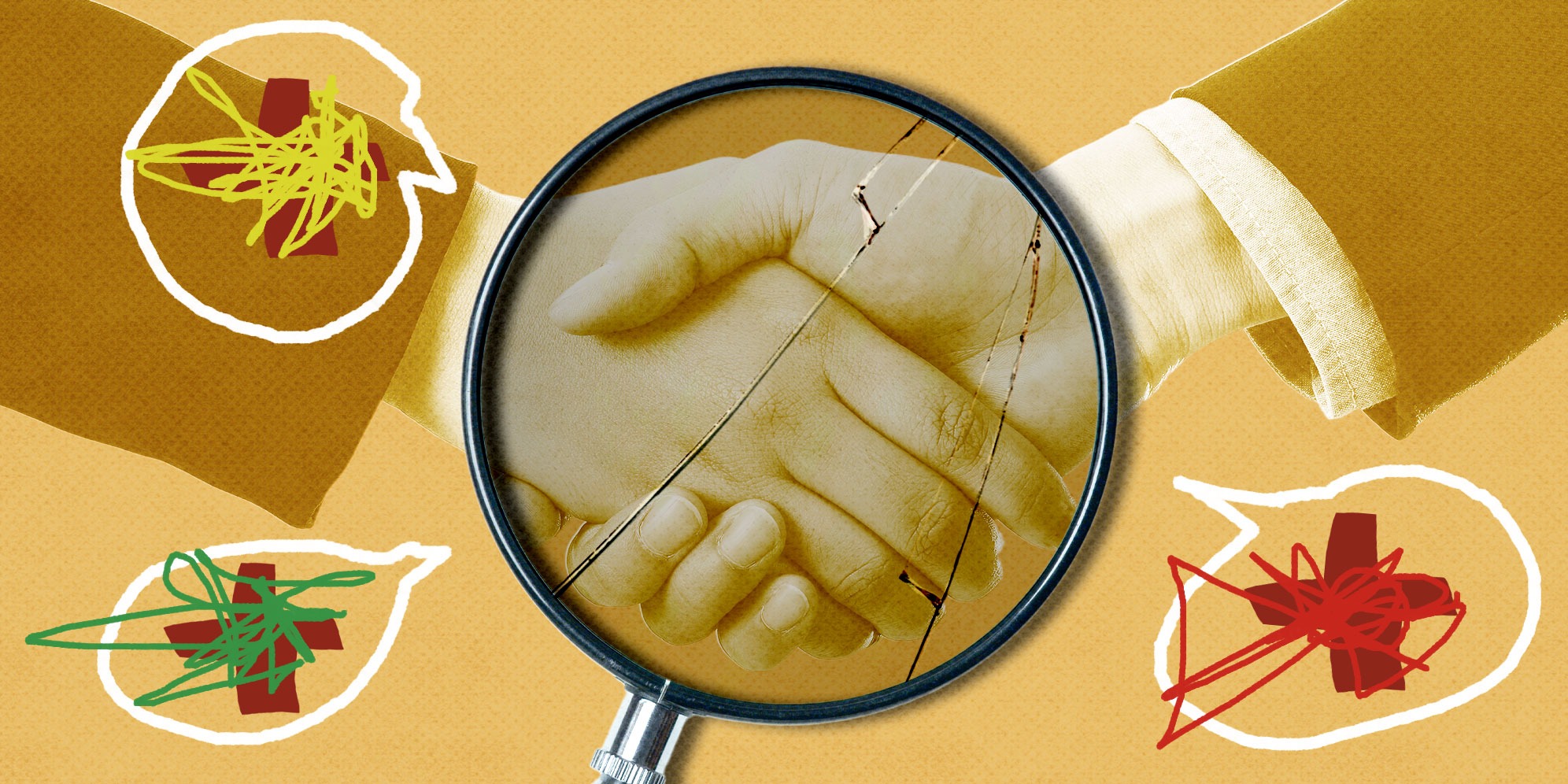
Illustrative Image: Handshake. | Magnifying glass. (Image: Freepik) | (By Daniella Lee Ming Yesca) Illustrative Image: Handshake. | Magnifying glass. (Image: Freepik) | (By Daniella Lee Ming Yesca)

There were hopes last week that there could be a truce in the nine court cases brought by various groups opposed to the government’s introduction of National Health Insurance (NHI). Unfortunately, it is unlikely that a truce will be reached, and the burning issue of universal healthcare will remain mired in the politics that the world’s most unequal society creates.

On Wednesday, News24’s Carol Paton reported that Finance Minister Enoch Godongwana had suggested in Parliament that all the NHI court cases should be withdrawn and those involved should sit around a table and reach an agreement.

On Thursday evening, the CEO of the medical aid scheme Profmed, Craig Comrie, said he welcomed the chance to negotiate and was looking forward to an invitation to sit down and talk.

Several of the other bodies that have brought cases against the NHI would probably agree with him.

Some have a very real interest in avoiding a court case, particularly because it can give the impression they are trying to prevent poor people from getting proper healthcare.

Some will be happy to negotiate because they know that most of the discussions will boil down to money. There might be debates about emergency treatment, the treatment of children or the treatment of cancer, but in the end, rands and cents will be the nub of many of the debates.

This means there is a path to negotiations, and people from the various sides will be happy to try to find common ground.

Some will be trying to keep their industry or the companies within it alive, while others will have a very different motive.

The SA Medical Association (Sama), representing doctors, has a constituency that will be directly affected by the NHI.

Sama is unlikely to accept anything that would prevent its members from being able to choose their employer. If, for example, the implementation of the NHI meant they could only work for the government, or would not be allowed to join the many specialists in Rosebank’s Sturdee Avenue, then Sama would never agree.

Instead, it will fight to the bitter end, which will inevitably lead to a court case.

Political motive

Others contesting the NHI have a political motive.

The DA is using its legal opposition to the NHI to show its voters that it will continue to fight for them.

One of the other political actors in this is AfriForum, which has not lodged a court application but has said it will issue a summons to stop any harm to any patient who could be affected by the NHI when it is implemented.

This means that even if there is a truce and the current legal actions are withdrawn, it would not be the end of the story.

Of course, it is also true that the ANC is using the NHI as a campaigning tool. From Gauteng Premier Panyaza Lesufi’s promise that the NHI would be implemented the day after the 2024 elections, to President Cyril Ramaphosa’s signing of the NHI Bill into law just before those polls, the ANC has shown it is aware of the power of this issue.

This means that some in the ANC also have no interest in negotiation — they want to be seen to be fighting for their voters.

In addition, it sometimes appears that the ANC is not 100% behind the NHI.

Last year, Godongwana refused to implement the National Department of Health’s call for the medical aid tax credit to be cancelled, saying that doing so would be an “attack on the middle class”.

In fact, even the ANC’s adoption of the NHI came as a surprise.

While the first mention of the phrase might have been at the party’s Polokwane conference in 2007, it was only at the ANC’s national general council in 2010 that it took any concrete form. But even then, it was not the major point of discussion among delegates and appeared to be almost an afterthought.

(As this reporter wrote at the time, this was a conference dominated by plans to regulate the media through a media appeals tribunal.)

Since then, virtually all of SA’s finance ministers have failed to embrace the concept.

The only one who appeared to show some support for it was the liar Malusi Gigaba, who was appointed at the height of Jacob Zuma’s populist phase.

The ANC has also never satisfactorily explained how the NHI would be funded, which makes this issue the Achilles heel of the party.

At the same time, Health Minister Dr Aaron Motsoaledi has consistently been a strong proponent of the NHI, and would be risking his political career to accept many concessions during negotiations.

ANC-NGC-Day3
Health Minister Dr Aaron Motsoaledi. (Photo: Felix Dlangamandla)

The ANC also needs to demonstrate to its voters that it is delivering something significant. If it concedes too much in negotiations, the concept of “universal healthcare” could lose its essence

Another critical aspect of this issue is that it is not clear whether the NHI, as the ANC currently wants to implement it, is constitutional.

Those who oppose it believe it is not, which means they could negotiate for a long time, knowing they could still go to court if negotiations failed.

They might see Godongwana’s call for a truce as a concession that the ANC knows it cannot win this battle.

All of that said, some kind of truce, perhaps a pausing of the court cases, might well provide space for cooler heads to prevail.

To put it bluntly, it is unlikely that the rich in our society will give up their privileged healthcare without a fight. Perhaps the aim should be to get them to share as much of it as possible — which will require a political solution, rather than a legal fight. DM

Comments

Loading your account…
Karl Sittlinger Jan 19, 2026, 06:53 AM

The issue is not goodwill or “the rich” refusing to share healthcare. It is that NHI centralises vast power and procurement without a funding model, proven governance, or credible protection against corruption. In a state with a documented history of large-scale capture, this is not paranoia but experience. You cannot negotiate away structural risk. Until funding, accountability, and anti-capture safeguards are concrete, litigation is not obstruction but responsible resistance.

D'Esprit Dan Jan 19, 2026, 11:19 AM

You comments section, once a fabulous, vibrant space for debate, has become a pathetic joke, strangling any kind of interaction amongst your PAYING subscribers. Get rid of the AI and introduce proper checks.

D'Esprit Dan Jan 19, 2026, 11:20 AM

Apologies Karl - a reply I submitted to your comment was so heavily censored by DM, that I chose to complain about the comments system, but forgot to do it as a separate comment!

Cape Doctor Jan 19, 2026, 07:45 AM

No, Mr Grootes, it is NOT a simple issue of rich vs poor. The vast majority of SA citizens benefitting from Medical Aid cover are not rich. Like me, they are middle-income employees or ex-employees for whom medical benefits or subsidies were just part of a remuneration package. Like me, many have medical conditions which will kill or disable them without access to decent medical care. Please do not let yourself sink into the mire of reductionist arguments just to maintain your readership.

D'Esprit Dan Jan 19, 2026, 11:21 AM

Well said!

superjase Jan 20, 2026, 11:00 AM

middle income in a country as unequal as south africa is pretty much the same thing as "rich". in any event, few people ever consider themselves to be rich - there is always someone richer, leaving people to consider themselves not rich.

Ed Rybicki Jan 19, 2026, 08:29 AM

“ it is unlikely that the rich in our society will give up their privileged healthcare without a fight.” Can you tell us why they should? They - taxpayers - already fund state healthcare, which is probably the best in Africa. On top of that, using their money, they fund their own - just as they do for education and security as well. Why should they - we - give up healthcare THAT WE PAY FOR?

D'Esprit Dan Jan 19, 2026, 11:11 AM

Two things, Stephen: you consistenly (and correctly) call Malusi Gigaba a liar - please extend this courtesy to Panyaza Lesufi who lied openly about NHI being implemented the day after the 2024 elections. Brazen lie, he knew it. Secondly, I'm not rich, but fork out a lot of money to ensure that I, and my family, have a semblance of good medical cover. The ANC-led plundering of public health ensures that me, and millions like me, will not accept the slop dished up by Motsoaledi's NHI.

Cobble Dickery Jan 19, 2026, 11:22 AM

One cannot help feeling that the NHI is just a plan for another corruption trough. Nothing to do with general health care. The ANC, thanks to its NDR, with its consequences: incompetence, general corruption and sloth, is very good at breaking what works and creating a mess. Almost all SOEs and ministries are like this. Why should NHI be any different?

Paddy Ross Jan 19, 2026, 12:27 PM

If one is unsure of whether the NHI will be a success or not, just remember Tembisa Hospital and the Lamborghinis.

Michele Rivarola Jan 19, 2026, 11:33 AM

This is nothing less than expropriation with no compensation. Individuals have contributed hundreds of thousands of rands in their younger age so that when old they could get decent health care. Now government wants to appropriate those funds whilst expecting the contributors to silently accept it. If there was a single government owned or run enterprise that was not either mired in corruption or insolvent the paying public might be more accommodating until then see you in court minister

The Proven Jan 19, 2026, 01:19 PM

Mr Groottes you miss one important point: NHI was signed into law just before the last election, in order to help the ANC gain votes - it did the opposite. It is hugely unpopular, particularly amongst the middle class (of which the overwhelming majority are previously disadvantaged persons). The ANC would do well to alter their views (to win back votes).

Ed Rybicki Jan 20, 2026, 10:28 AM

Yup! Well said ?

Johan Buys Jan 19, 2026, 01:37 PM

Stephen, it is very unfair to state “ it is unlikely that the rich in our society will give up their privileged healthcare without a fight”. ONE : You ignore that the reason that the poor have terrible medical care is entirely due to incompetent and corrupt DoH. TWO : The excellent quality of private health sector has absolutely no impact on the terrible quality of public health. Actually, young doctors are better paid in public than private!

User Jan 19, 2026, 01:51 PM

The NHI is entirely redundant. We already have "universal healthcare". It comes in 2 forms - private and public, both paid for by the taxpayer. The former is extremely expensive (by our standards), and the latter is extremely poor. In both cases this is largely because bureaucrats are allowed to run things. The solution is firstly to return decision making on priorities to medical personnel. Secondly, to provide competent care at public clinics and hospitals. The NHI is for the cadres to feed

User Jan 30, 2026, 09:11 PM

And DM's new (and even more broken) comments system says that my comment above is by "User" ??? Eish! And why have you also broken the ability to format a comment into paragraphs to improve readability?

Michael Cinna Jan 19, 2026, 04:51 PM

Does the author not have private health care? If we have a moral obligation - please take the lead and show us. Please add a beneficiary of the underclass to your health plan, otherwise your moral case rings hollow. The moral grandstanding of the privileged lecturing his own caste of their privileges. Beyond irony.