




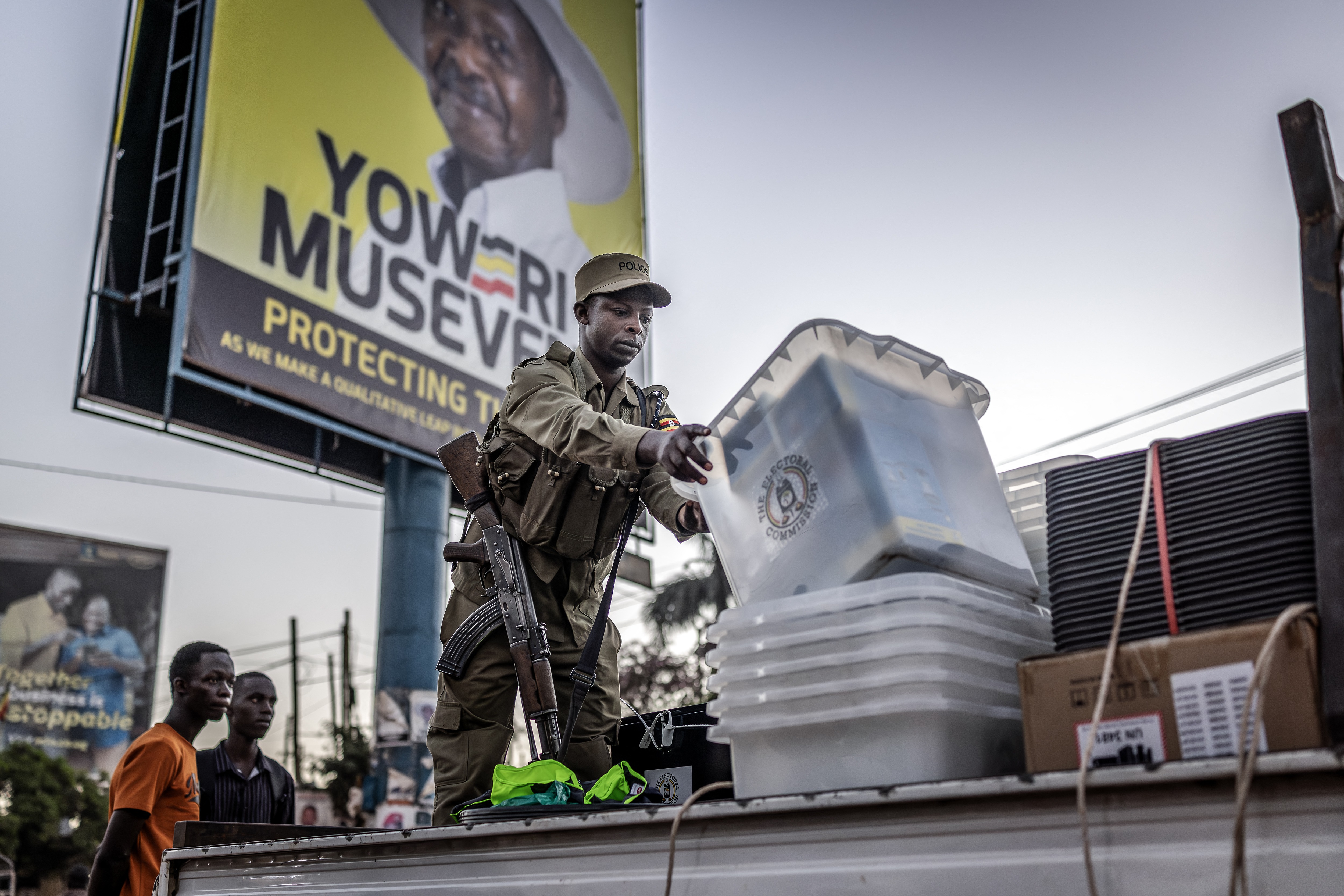
 A Ugandan police officer unloads ballot boxes from a truck at a polling station set up in front of an electoral billboard supporting Uganda's incumbent president and National Resistance Movement (NRM) presidential candidate, Yoweri Museveni, in Kampala on 15 January 2026, during Uganda's 2026 general elections. (Photo: Luis TATO / AFP)
 MTN Uganda, a subsidiary of South Africa’s MTN Group, has been urged to switch on its internet services amid concerns of human rights abuses in the country, as Ugandans cast their ballots on Thursday, 15 January.
The authorities in Uganda ordered a blockade on internet access and selected mobile services nationwide on Tuesday, 13 January, two days before the national election in which President Yoweri Museveni, who has ruled the country since 1986, is seeking to secure a seventh term.
Read more: Amid global geopolitical chaos, remember Uganda’s battle to unseat an authoritarian
The Uganda Communications Commission, the state telecoms regulator, ordered an internet shutdown, which started at 6pm in Uganda on Tuesday, to curb what it called “misinformation” about the vote.
“Following strong recommendation from the Inter-Agency Security Committee, the Uganda Communications Commission (UCC) on Tuesday issued a directive to all licensed Mobile Network Operators and Internet Service Providers to temporarily suspend public internet access and selected mobile services during the election period,” the UCC said in a public notice on Wednesday, 14 January.
“This measure was taken to mitigate the rapid spread of misinformation and disinformation, curb risks of electoral fraud and prevent incitement to violence, all of which could undermine public order, national security and the integrity of the electoral process,” it continued.
Notice on temporary suspension of public internet access and mobile services. pic.twitter.com/AP2agByEff
— UCC (@UCC_Official) January 14, 2026
The internet monitoring group NetBlocks, in a post on X on Thursday morning, confirmed that the widespread internet shutdown imposed by the UCC remained in place.
In response to questions from Daily Maverick, the MTN Group confirmed MTN Uganda had “complied with the [UCC] directive in line with its licence obligations”.
MTN Uganda is the east African nation’s largest telecoms firm and competes mainly with the local unit of India’s Bharti Airtel, according to a Reuters report.
Read more: Uganda to vote in tense election clouded by succession questions
Sikula Oniala, a researcher on Uganda and Tanzania at Amnesty International, told Daily Maverick that MTN Uganda, and other local telecoms service providers, are obligated to uphold and respect human rights in the jurisdictions in which they operate.
“We have not reached out to MTN. But we have seen some communication not just targeting MTN, but other internet service providers. I think we need to remind them that, according to the [United Nations Guiding Principles on Business and Human Rights], they have a responsibility to promote human rights – to respect human rights – in whichever jurisdiction they operate,” said Oniala in an interview.
“It is incumbent upon them to take measures to ensure that people are able to enjoy their rights in the jurisdiction, in this case in Uganda,” he added.
“The use of internet shutdowns are tactics that are deployed by authoritarian governments on the continent. In most cases, human rights violations happen during such dark periods, because once you switch off the internet, then people are not able to communicate or share what they have seen.”
Oniala said Amnesty International would be urging these companies to switch the internet on during this period and warned that failure to do so would constitute a violation of human rights.
“We will be urging these companies that they have an obligation to ensure that they switch the internet on and that people are able to use their services at this period, failure to which then they will be violating human rights,” he said.
MTN did not respond to Daily Maverick’s request to respond to criticism that by ceding to the UCC’s request, MTN Uganda is complicit in human rights violations in Uganda.
⚠️ Update: Voting has started in #Uganda, where a widespread internet shutdown imposed by the telecoms regulator remains in place.
— NetBlocks (@netblocks) January 15, 2026
The measure makes election observation difficult and encourages voter intimidation and coercion, casting doubt on the election's credibility. pic.twitter.com/mqkOy4AAEw
Digital rights watchdog Access Now and the #KeepItOn coalition have demanded that the Ugandan authorities “immediately” lift the ban on the internet and all communications in the country “to facilitate transparent, free and fair elections”.
“Despite calls by human rights groups and the international community — including the United Nations — to uphold democracy and resist shutting down the internet, authorities in Uganda refuse to listen,” its global campaign manager, Felicia Anthonio, said in a statement.
“Instead, they’ve decided to violate the rights of millions of people in Uganda by cutting them off from the rest of the world, a few days before elections. Shutting down the internet cannot become the norm when authorities want to exert their control and influence — such acts undermine democracy and disregard human rights,” added Anthonio.
/file/attachments/orphans/13647046_526115.jpg "People line up to cast their vote during the presidential elections at the Kamwokya in Kampala, Uganda, 15 January 2026. Eight presidential candidates, including incumbent Yoweri Museveni and NUP candidate Bobi Wine, are vying for the presidency. (Photo: EPA/DANIEL IRUNGU)")
Amnesty International’s regional director for east and southern Africa, Tigere Chagutah, has called the shutdown a “brazen attack” on Ugandans’ right to freedom of expression.
“Cutting off internet access under the pretext of preventing misinformation or preserving national security violates human rights at a critical moment in Uganda. It creates an information vacuum and a digital darkness that may provide cover for the perpetration of serious human rights violations. The fact that no end date for the internet shutdown has been given is also ominous,” he said in a statement on Wednesday.
Chagutah added that the internet shutdown was particularly “alarming” in the context of Thursday’s presidential election which, in the run-up, has seen “massive repression and an unprecedented crackdown” on opposition parties and dissenting voices.
‘Excessive deployment of forces’
Museveni is widely expected to extend his four-decade rule in Thursday’s elections, after a campaign which has been marred by violence, reported Reuters.
The 81-year-old is Africa’s third-longest ruling head of state. He has changed Uganda’s Constitution twice to remove age and term limits, and his stranglehold on the country’s institutions means there is little prospect of a free and fair election.
Museveni’s main opponent, 43-year-old pop star Bobi Wine, who won 35% of the vote in the last election in 2021, has garnered the support of many young voters angry about Uganda’s widespread unemployment and corruption.
/file/attachments/orphans/13647027_680093.jpg "Uganda's opposition leader, Robert Kyagulanyi, popularly known as Bobi Wine, prepares to vote during the presidential elections at the Kamwokya in Kampala, Uganda, 15 January 2026. Eight presidential candidates, including incumbent Yoweri Museveni and NUP candidate Bobi Wine, are vying for the presidency. (Photo: EPA/DANIEL IRUNGU)")
/file/attachments/orphans/AFP_20260115_92UL8CV_v1_HighRes_UgandaVote_557542.jpg "Uganda's incumbent president and National Resistance Movement (NRM) presidential candidate, Yoweri Museveni, waves at supporters as he leaves after casting his ballot in Rwakitura on 15 January 2026 during Uganda's 2026 general elections. (Photo: AFP)")
The United Nations (UN) Human Rights Offices in a report on Friday, 9 January, said the elections were taking place amid “widespread repression and intimidation”.
Ugandan authorities have detained hundreds of Wine’s supporters in the run-up to the elections, and have repeatedly used teargas and live ammunition at his campaign events, reported Reuters. The publication reported that Museveni has defended the authorities’ actions as a justified response to “lawless conduct” by opposition supporters.
Oniala told Daily Maverick that the internet shutdown has made it difficult for Amnesty International to monitor and document human rights violations during this period.
However, he said the organisation has heard about the “unnecessary use of force by security forces” from sources on the ground who it was able to communicate with. In Nansana and Kalungu, in central Uganda, two people were shot and killed on Wednesday, according to Oniala.
“We are yet to verify the people responsible,” he said.
Read more: Uganda orders two rights groups to halt work days before election
/file/attachments/orphans/13647043_310731.jpg "Members of Uganda security forces operate during the presidential elections at the Kamwokya in Kampala, Uganda, 15 January 2026. Eight presidential candidates, including incumbent Yoweri Museveni and NUP candidate Bobi Wine, are vying for the presidency. (Photo: EPA / DANIEL IRUNGU)")
Oniala said Amnesty International has also observed the “excessive deployment” of the Uganda People’s Defence Force (UPDF), which, according to international law, is not required to police civilian affairs.
“We have also observed arbitrary arrests and abductions,” said Oniala, who added that the Ugandan authorities have “normalised” abductions which occur on a near-daily basis.
“The heavy deployment of security forces has actually caused fear among the people,” he said.
On Thursday, voting took place in Uganda’s capital, Kampala, amid a heavy police presence, Reuters reported.
Oniala told Daily Maverick that the “nature of the violations” are similar to 2021: the internet shutdown; the intimidation of voters; the violation of press freedom.
“The problem in Uganda is the lack of accountability for these violations, such that no one was held accountable for what happened in 2021, and then they repeat the same [violations] again in 2026,” he said.
Africa’s trend of internet shutdowns
Internet shutdowns over election periods have become a common tool in Africa, largely as a tool for political control, Daily Maverick reported in December 2025. In 2024, Africa experienced 21 internet shutdowns in 15 countries, the publication reported.
Read more: Offline and silenced: Africa’s quiet rise of internet repression
In October 2025, the Tanzanian authorities orchestrated the worst massacre in the country’s post-independence history during a six-day shutdown of internet services ordered by the authorities.
The investigative non-profit Open Secrets in February 2025 published a report which exposed MTN’s role in internet shutdowns, revealing how the MTN Group and its subsidiaries have been implicated in human rights violations in Africa and the Middle East.
/file/attachments/orphans/13647455_344444.jpg "Members of the Ugandan security forces operate during the presidential elections in Kampala, Uganda, 15 January 2026. (Photo: EPA / ISAAC KASAMANI)")
“The use of internet shutdowns are tactics that are deployed by authoritarian governments on the continent. In most cases, human rights violations happen during such dark periods, because once you switch off the internet, then people are not able to communicate or share what they have seen. We’ve seen it in Tanzania recently when they had the internet shutdown and serious human rights violations were committed,” said Oniala.
“The killings, the arbitrary arrests, the disappearances and the abductions happen in such circumstances. The problem is that, as human rights organisations, we are not able to verify and document those cases because they happen in the dark,” he continued.
In Uganda’s case, Oniala said it is clear that the shutdown has also affected people’s everyday lives.
“Mobile money is now not operational and you can imagine what this does to ordinary people. Healthcare [services] have been impacted; people who rely on talking to their doctor via the internet are not able to do it during this period. Communication on normal lines has also been disrupted,” he said. DM