



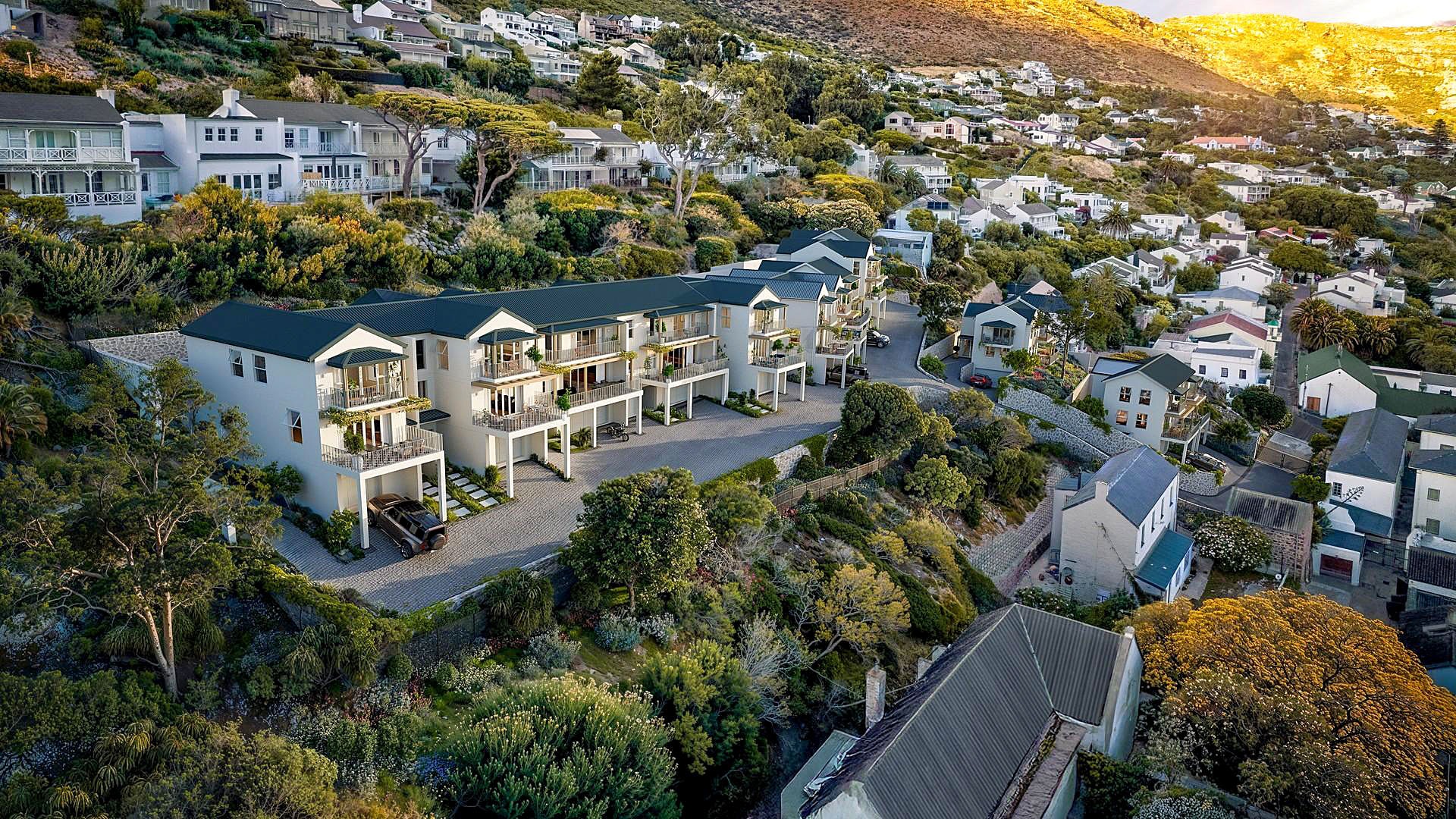
 The proposed Marisol ‘boutique’ development in Simon’s Town. (Source: Property24)
 /file/dailymaverick/wp-content/uploads/2025/10/label-analysis-2.jpg)
Walls, shards and bones
“The integrity of Simon’s Town, which we are in the process of losing, was one of the reasons that we originally bought here,” says a member of the residents’ committee. “Just look at Paternoster. They have development, but the integrity of the old fishing village is still there.”
It is a Friday morning in mid-November 2025, and Daily Maverick is involved in a group discussion that – as far as our previous reporting would seem to suggest – echoes the concerns of thousands of ratepaying Capetonians. For about two hours now, these six members of the ad hoc committee, all homeowners in the immediate vicinity, have been telling a story about their likely losses in the face of a local developer’s profits.
“The next big target for developers is the False Bay coast,” says another committee member. “The Atlantic Seaboard is already done.”
As a tour of the neighbourhood will soon reveal, it is obvious why a developer would be drawn to this particular location on False Bay’s western shore. With its egress onto St George’s Street, the famous old Simon’s Town thoroughfare that also goes by the name of M4 (the same M4 that runs through Fish Hoek, Muizenberg and Wynberg all the way to the Cape Town CBD), lies a narrow roadway called Wickboom Lane, which a visitor would almost certainly overlook unless he or she knew what was up there — cobblestone alleys, whitewashed houses, generous Bougainvillea and peerless sea views that, without much of a stretch, could be an island village in the Mediterranean.
/file/attachments/orphans/IMG_9273_336585.jpg "The view up Wickboom Lane from St George’s Street, Simon’s Town. (Photo: David Harrison)")
In fact, members of the committee claim that many of the off-plan buyers in the new development – advertised on the website as a “secure boutique estate” that offers “effortless coastal living” – are foreigners. To Daily Maverick, at a price list starting at just under R7-million for an entry-level two-bedroom townhouse, and projected monthly income from short-term rentals of between R50,000 and R85,000, this detail (later confirmed at 70% South African by the developer himself - which means 30% is foreign buyers) makes a whole lot of sense. To be specific, although Cape Town Mayor Geordin Hill-Lewis has disputed the assertion, critics have noted that the influx of foreign buyers is antithetical to the interests of the City’s middle-income ratepayers.
In this regard, it is telling that not one of the members of the residents’ committee — who claim, with documented verification, to represent 31 of the 35 homeowners in the enclave — is swayed by the likelihood that the new estate will increase the value of their own property. Instead of waiting quietly for their payday, they have chosen to alert Daily Maverick to the history of the site. Known officially as “ERF 4053”, they say, it has thwarted the ambitions of developers since the mayoral reign of Patrica de Lille.
“ERF 4053 lies behind the former Royal Naval Hospital in St George’s Street,” an article by veteran journalist John Yeld, published in the Sunday Argus in 2013, confirms. “The entire area was part of the Constantia Homestead of 1749, a farm that provided fresh produce for the VOC [Dutch East India Company] ships.”
The news value of the piece, as Yeld had already made clear, was the issuing of a “stop order” by the City of Cape Town and Heritage Western Cape to the owners of the plot at the time. According to the article, these previous owners — who had taken transfer of the property only two months before — had begun to clear parts of the site before a development plan had been approved.
“Using an excavator, the workmen caused serious damage, including the demolition of a historic retaining wall,” Yeld reported. “The workmen also uncovered some potentially important artefacts, including bits of human bones, glassware and pottery shards.”
/file/attachments/orphans/IMG_9274_929623.jpg "A historic retaining wall of the Dutch East India Company supply farm in Simon’s Town, ERF 4053. (Photo: David Harrison)")
And so now, as the neighbourhood tour arrives at the few retaining walls that are still intact, the questions all but ask themselves. What’s to stop the current developer, Classic Collection (Pty) Ltd, from erasing all evidence of the historic VOC terraces? What will become of the artefacts, shards and bones?
Daily Maverick put this question to Warwick Goosen, the CEO of Tintswalo Property Group, Classic Collection’s parent company. We also put the question to Simon Liell-Cock, the Democratic Alliance ward councillor for much of Cape Town’s deep south, including Simon’s Town, Ocean View, Scarborough and Kommetjie. Both men assured us that they would fully adhere to the requirements of Heritage Western Cape (see the responses below).
But equally significant, as gleaned from the dozens of pages of documentation that we have secured — made up of official rulings of the City of Cape Town, provincial and municipal correspondence and letters of complaint from the locals — are the other questions that demand answers. Most of them have to do with the status of Wickboom Lane as the only entrance and exit point for the trucks that will deliver the building materials for the construction of the boutique estate.
As these documents make plain, it isn’t only the local homeowners, mostly white South Africans, who have good reason to oppose the development. It is also the previous occupants of the land, who were evicted in the 1960s, under the provisions of an infamous apartheid law.
/file/attachments/orphans/WickboomLaneSimonstownJuterSquareDH1111copy_291423.jpg "Juter Square and Wickboom Lane in Simon's Town, which is facing a large residential property development, 9 December 2025. (Photo: David Harrison)")
/file/attachments/orphans/WickboomLaneSimonstownThomasLaneDH8578copy_815317.jpg "A view looking down Thomas Street towards the Noorul Islam Mosque, Wickboom Lane, Simon's Town, 5 December 2025. (Photo: David Harrison)")
To view or not to view
“We were never officially informed or notified by the City of Cape Town and Tintswalo about the Marisol development and its impact on the mosque and its patrons,” noted a letter addressed to Hill-Lewis and the developer of the estate — which, in the brochureware, had just been christened “Marisol” — in mid-September 2025. “The development will restrict all operations of the mosque.”
Written by Ashraf Gangraker, the chairperson of the Noorul Islam Mosques of Simon’s Town and Ocean View, the letter went on to state that access for patrons would be “significantly” compromised during the construction phase. Aside from the fact that the square at the top of Wickboom Lane, which had always been used for patrons’ parking, had now (in the plans) been set aside for construction vehicles, there was also the alleged problem with the access road itself.
/file/attachments/orphans/WickboomLaneSimonstownOldNavalHospitalDH8658copy_248903.jpg "The old naval hospital building and the entrance to the residential property development that has yet to start, 9 December 2025. (Photo: David Harrison)")
“Wickboom Lane in the past provided pedestrian access to Thomas Street,” said Gangraker, referring to the advertised address of Marisol (3 Thomas Street). “It was not designed for heavy vehicle access. It is our belief that Wickboom Lane and surrounding historic buildings will not withstand the load of heavy vehicles during the construction of the Marisol development.”
As the final point in the letter, Gangraker pointed out that ownership of ERF 4053 had initially been granted to Mogamat Adnaan Davis, the former principal of what was then the local Muslim school, “as restitution for his forcible removal in the 1960s”.
According to Gangraker, Davis would be “horrified” by the probable impact of the development on the mosque.
/file/attachments/orphans/WickboomLaneSimonstownNoorulIslamMosqueDH0855copy_315161.jpg "Abdusalaam Cader calls to Friday prayers at the Noorul Islam Mosque in Thomas Street, 5 December 2025. (Photo: David Harrison)")
/file/attachments/orphans/WickboomLaneSimonstownJuterSquareDH8714copy_638403.jpg "A view of Juter Square and Wickboom Lane in Simon's Town, 5 December 2025. (Photo: David Harrison)")
In an interview with Daily Maverick, Salaam Cader, a senior patron of the mosque and the only member of the original evicted community to have returned as a homeowner, filled us in on the backstory.
“The mosque was at the heart of what was then the Malay Quarter,” Cader informed us, adding that the building was inducted in 1923, after enough funds for its completion had been raised. “The community members were tradesmen, mostly, and they had the skills, so as soon as they had the money for the materials they would add a little bit more themselves.”
As for his own house, a historic Victorian structure next door to the mosque, Cader said it had once been the residence of Imam Ameen Baker, the first Muslim cleric to translate the Qur’an into Afrikaans.
/file/attachments/orphans/IMG_9275_593493.jpg "Salaam Cader outside his house on Thomas Street. (Photo: David Harrison)")
/file/attachments/orphans/IMG_9276_335464.jpg "After Friday prayers at the Noorul Islam Mosque, Thomas Street, Simon's Town. (Photo: David Harrison)")
“The house came on the market in 1986, but my family was unable to buy it,” he said. “We were living in Simon’s Town under the threat of eviction at any time; a few Indian traders, including my father and uncle, were the last to remain at the request of the white residents. So to get around the apartheid laws, we formed a [closed corporation] with the estate agent as the majority shareholder.”
It was only once the Group Areas Act was repealed, Cader recalled, that his family was able to take occupation of the house. Meanwhile, he explained, the rest of the Malay community had been integrated into the township of Ocean View, where — to add a bizarrely cruel insult to the injury of the loss of their ancestral homes — there was no view of the ocean at all.
“Look,” said Cader, “the people who have moved in here are very supportive of the mosque. You know, they realise that they have benefited because of the Group Areas Act.”
And so on Fridays, he clarified, when “most of the mosque’s patrons” arrive in their cars from Ocean View, there are never any complaints about “parking and stuff like that”.
/file/attachments/orphans/2025-12-1612_11_13-Greenshot_493605.png "Proposed Marisol development, Simonstown.<br>(Source: Property24)")
(Source: Property24)
But the Marisol development, by any measure, has exposed a much more profound layer to this common ground. On 21 September 2025, three days after Gangraker’s letter was sent, the chairperson of the Simon’s Town Civic Association, David Attwell, followed up with a letter to Hill-Lewis in support of the mosque and residents.
“Recent experience shows that Wickboom Lane cannot sustain heavy vehicle traffic. Originally constructed for pedestrians, this narrow brick-paved road breaks up under pressure, preventing vehicle access and compromising water supply even further than is already the case,” Attwell wrote.
“We note, especially, the objections lodged by the authorities at the Noorul Islam Mosque in Thomas Street, and we support their account of the historical sensitivities involved. Simon’s Town will always need to be mindful of past injuries and to respect the spiritual anchorage that the mosque provides. To limit access to and parking near the mosque sends precisely the wrong signal and will affect the wellbeing of the whole community.”
In search of praise and blame
From a strictly legal standpoint, if the documents in Daily Maverick’s possession are any indication, the “wellbeing of the whole community” rests on the deletion of a single clause, which — like every other facet of this kaleidoscopic story — contains a history all of its own.
This time, it is a history that begins in 2006, when Davis (the former principal of the Muslim school) sold ERF 4053 to its first would-be developer for a reported sum of R5-million. Two years later, in the summer of 2008, the Western Cape provincial government signed off on an application to rezone the site for 15 residential units, on the proviso that Wickboom Lane would serve in tandem with Hospital Lane as a “one-way couplet” for vehicular traffic. There was, however, a caveat – Heritage Western Cape would need to approve the plan.
In the event, Heritage Western Cape refused. This provincial department, which had been established in 2003 to “identify, protect and conserve” all sites and structures of archaeological value, knocked back the application on the basis that the “historical hospital steps” would be lost if Hospital Lane was transformed from a pedestrian facility into a roadway.
/file/attachments/orphans/Frame38_880812.png "Map of the enclave. (By Daniella Lee Ming-Yesca)")
For five years nothing happened, until (as above) Heritage Western Cape — with the support of the City of Cape Town — issued a “stop order” against the same would-be developer for jumping the gun on excavation.
Then, in December 2016, a curious letter was sent from the Western Cape’s then chief director of road network management, ML Watters, to one of the developer’s consultants.
As Watters made clear: “This branch has not changed its views on the development of the above property, albeit now for only 13 dwelling units, that the use of the narrow Wickboom Lane as the only access to the development … is unsafe and accordingly undesirable.”
Why was this curious? Because, in the very next paragraph, Watters noted that since the proposal for access to ERF 4053 had been accepted by the City of Cape Town’s traffic engineer, his branch had no choice but to “give its consent for the removal of paragraph 7.1” from the province’s 2008 approval document.
Paragraph 7.1, it turned out, was where the caveat about the one-way couplet appeared. On 2 March 2018, a decade after it had been stipulated by the provincial authorities, the City of Cape Town’s municipal planning tribunal — in a report that named Liell-Cock as the presiding ward councillor — officially deleted all reference to the condition.
/file/attachments/orphans/images1_587854.jpg "Simon Liell-Cock, the Democratic Alliance ward councillor for Simon’s Town, Ocean View, Scarborough and Kommetjie. <br>(Photo: City of Cape Town / Wikipedia)")
(Photo: City of Cape Town / Wikipedia)
And so Daily Maverick’s first question for Liell-Cock focused on what appeared to be his about-face, given the contents of a letter he had composed and signed in August 2017 — not only had he stated in this letter that the province was “100% correct” to deem Wickboom Lane “unsafe and undesirable” as a sole access point, he had also remarked on the lack of “justification” by the City of Cape Town’s traffic engineer.
Liell-Cock, insisting that the letter was not indicative of a “sudden change of heart”, informed us in writing that he had fought “for years” against the use of Wickboom Lane as the sole entrance and egress point.
“It is my opinion that the initial land use approval process was flawed from the very beginning,” he stated, “but a lot of that preceded my term of office and I inherited a fait accompli. The land use had already been approved. I felt that we had achieved some wins and that the use of Wickboom as sole access was the ‘least worst’ outcome taking all the facts into account.”
Among these wins, according to Liell-Cock, was the “reduction in units” from 15 to 13, a point that was immaterial to Watters. But regardless, when Daily Maverick pushed him on the issue, Liell-Cock was adamant.
“There is no discrepancy,” he claimed. “The [2 March 2018 report] was not the final approval, it was merely the approval to remove the one-way couplet… The original land use application was approved on appeal by the provincial government. In 2014 the law changed and the City became the sole authority.”
Liell-Cock, undeniably, was a step ahead of us on these details; the original application for development, which had been turned down by the city in 2006, was indeed approved on appeal — two years later — by the Western Cape government. Also, in 2014 a new law had relieved the provincial government of its appeal powers, as evidenced in a link supplied to us in Liell-Cock’s response.
And yet, by Daily Maverick’s reckoning, these details did nothing to alter the broad consensus among the residents of Simon’s Town. Whether blame lay with the province or the city, almost none of the enclave’s current and former residents, nor just about any of the ratepayers affiliated to the Simon’s Town Civic Association, wanted the development to proceed in its current form.
Still, as far as the ward councillor was concerned, there was nothing to be done.
“[Once] land use rights have been given, there is no legal mechanism for preventing the landowner from exercising them, nor would such a mechanism be morally acceptable,” Liell-Cock informed us. “The current owner paid a price for the property based on the rights awarded to the previous owner, so it follows that he will exercise his right to recoup his investment.”
The Tintswalo Property Group, likewise, pointed us to the law. Goosen, the CEO, was emphatic that he had “very little knowledge of the history behind the previous proposed development” — the property, he stated, “was purchased on the basis that there were existing current rights and valid approvals attached to same”.
He then added: “I would also like to note that we have met with the representative of the mosque as well as the residents a number of times, and we assumed that these engagements were all in good faith. We were presented with a number of proposals viz access during construction by the residents, and at no point did we state or imply that we would not continue to engage collaboratively on the most suitable, least disruptive solution for all involved. We remain committed to this in all respects.”
Not quite an epilogue
The residents of the enclave, like the patrons of the mosque, have, however, told Daily Maverick that they feel they have been sidelined. While all of our sources have insisted that they are not “anti-development” per se, they have sworn, in the same breath, that they were not officially informed of the developer’s plans.
To the members of the residents’ committee, who are mostly middle-income ratepayers, it is self-evident that the City of Cape Town should have alerted them before they “saw the news on Facebook”. And for the patrons of the mosque, as intimated by the letters of Gangraker and Attwell, it unfortunately feels like more of the same.
“The rights and the culture of the oppressed people are just trampled on,” says Cader.
/file/attachments/orphans/WickboomLaneSimonstownJuterSquareDH8509copy_243409.jpg "Juter Square ahead of Friday prayers at the Noorul Islam Mosque on Thomas Street, 5 December 2025. (Photo: David Harrison)")
/file/attachments/orphans/WickboomLaneSimonstownNoorulIslamMosqueDH0937copy_843257.jpg "After Friday prayers at the Noorul Islam Mosque on Thomas Street, 5 December 2025. (Photo: David Harrison)")
Liell-Cock appears to see things from a different perspective. As the ward councillor for Ocean View as well as Simon’s Town, he assured us that he understood the context.
“I have a very close relationship with the chairperson of the Ocean View mosque,” he noted in his written response to us, “and my son’s best friend is the grandson of the previous Thomas Street imam.”
The Marisol development, Liell-Cock said, would “have no impact” on the mosque. “The developer has already agreed, in conversations with the residents and the mosque, not to impact access,” he promised us.
Will Liell-Cock and Goosen hold good to their word? Only time, to state the obvious, will tell. Although both men agree that the construction of Marisol must adhere to the archaeological guidelines of Heritage Western Cape, neither is forthcoming with specifics. Also, the men do not agree on the question of an alternative access route via Jackson Steps, as put forward by an industrious resident of the enclave. Goosen, for his part, seems open to the idea, while Liell-Cock has noted that it would require “extensive civil engineering” at “significant cost” with “lengthy delays”.
/file/dailymaverick/wp-content/uploads/2025/06/0-1.jpg "Cape Town Mayor Geordin Hill-Lewis. (Photo: Shelley Christians)")
Cape Town mayor Geordin Hill-Lewis appears to have adopted the same position as the ward councillor. On 10 October 2025, after Lesley Wroughton, a leading member of the residents’ committee, had followed the example of Gangraker and Attwell with a letter to Hill-Lewis of her own, a reply was finally received.
“Should the City refuse [access via Wickboom Lane],” wrote Hill-Lewis, “it would mean that there would exist no other way for the owner of the property to access it. This would amount to arbitrary deprivation of the lawfully obtained development rights. The City therefore cannot prevent the owner from utilising this access.”
Against the wishes of many affected locals, then, it seems likely that Marisol will soon become a reality. If Wickboom Lane crumbles under the pressure, if traffic on St George’s Street grinds to a daily halt, if the residents of the enclave can’t leave in emergencies, if the surrounding buildings (some more than 200 years old) begin to crack and tilt, if the historical heritage is lost and – most immediately – if the patrons of the mosque cannot access their place of worship, who will make things right?
The point of their stand against the city, for almost every affected local, is to ensure that the matter is not left to chance. DM