



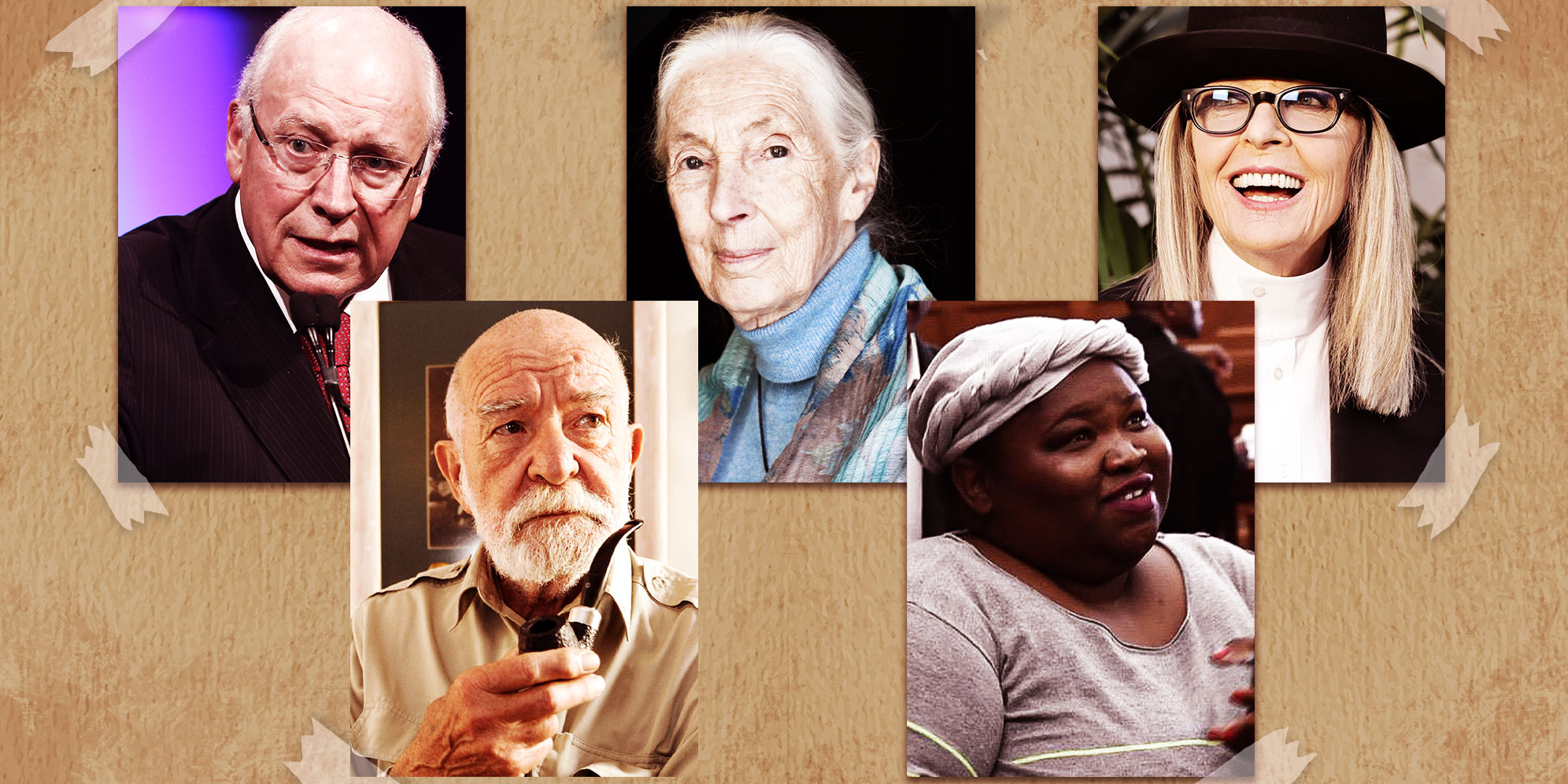
 Illustrative Image: Former vice-president Dick Cheney. (Photo: Tom Benitez – Pool / Getty Images) | Athol Fugard at home in Cape Town on 29 June 2012. (Photo: Gallo Images / Foto24 / Denzil Maregele) | Dr Jane Goodall attends the TIME 100 Summit 2019 on 23 April 2019 in New York City. (Photo: Craig Barritt / Getty Images / TIME) | Tshidi Madia at the Johannesburg High Court. (Photo: Felix Dlangamandla) | Diane Keaton attends the Ralph Lauren SS23 Runway Show at The Huntington Library, Art Collections, and Botanical Gardens in San Marino, California, on 13 October 2022. (Photo: Amy Sussman / Getty Images) | (By Daniella Lee Ming Yesca)
 “To everything there is a season, and a time for every purpose
under heaven: A time to be born and a time to die. A time to plant
and a time to harvest...”
— The Book of Ecclesiastes
Drama, cinema, literature and the arts
/file/dailymaverick/wp-content/uploads/2025/03/AV_00007692.jpg "Legendary South African playwright Athol Fugard during an interview in Cape Town on 19 April 2011. (Photo: Gallo Images / Sunday Times / Esa Alexander)")
Athol Fugard
For South African readers, we surely must begin with Athol Fugard, the playwright who passed away early in the year.
Fugard’s career effectively began with the Serpent Players, a group of African amateur actors in the Eastern Cape, but his output eventually encompassed dozens of dramas – several in collaboration with actors John Kani and Winston Ntshona – that had an influence and meaning far beyond their roots in his opposition to apartheid. A number of those works are now in the repertoires of theatre companies internationally, years after the realities of apartheid vanished.
Tom Stoppard
But at the end of 2025 came the news of the death of Britain’s most important contemporary playwright, Tom Stoppard, the Czech-born dramatist whose intellectually challenging works are among the most acclaimed plays of the past half-century.
His most famous works include the Tony Award-winning Rosencrantz and Guildenstern Are Dead (a play that inverts Hamlet by focusing on two minor characters trying to make sense of the tragedies at the royal court of Denmark), Travesties, The Real Thing, The Coast of Utopia trilogy and, most recently, Leopoldstadt – a play that explored a newly discovered heritage as a descendant of four grandparents who perished in the Holocaust.
Stoppard said he became a playwright because he was undecided about so many things and constructing dialogue where characters take opposite points of view “is the best way to contradict yourself”. His ambivalence is likely to have stemmed from a childhood where his family had fled Czechoslovakia during World War 2, and then traversed Singapore and India, before settling in England.
/file/attachments/orphans/1497775147_273927.jpg "Tom Stoppard, winner of the Best Play award for Leopoldstadt, at the 76th Annual Tony Awards at Radio Hotel in New York City on 11 June 2023. (Photo: Cindy Ord / Getty Images for Tony Awards Productions)")
Stoppard co-authored the script for Shakespeare in Love, wrote the scripts for other films such as The Human Factor and Empire of the Sun, and was the script doctor for blockbusters including Indiana Jones and the Last Crusade and Star Wars: Episode III – Revenge of the Sith.
Joan Plowright
Beyond Fugard and Stoppard, redoubtable British director Joan Plowright also passed away this year. She had influenced the work of some of South Africa’s most influential director/playwrights, such as Barney Simon.
Diane Ladd
Actress Diane Ladd, three-time Oscar nominee for performances in Alice Doesn’t Live Here Anymore, Rambling Rose and Wild at Heart, also passed away this year. A cousin of playwright Tennessee Williams and mother of actress Laura Dern, she was a regular on television shows like ER and performed on Broadway as well. Summing up a career, she said: “Many years ago, I used to say, I haven’t lived long enough to be great. Now I don’t say that. I can do Shakespeare, Ibsen, English accents, Irish accents, no accent, stand on my head, tap dance, sing, look 17 or look 70.”
David Lynch
The late filmmaker David Lynch was a writer/director whose films drew upon stylised dream states, lost innocence, eroticism and mysteries under placid, peaceful exteriors. His first film, Eraserhead, became a cult favourite and his next, The Elephant Man, garnered two Oscar nominations.
/file/attachments/orphans/2193663099_471729.jpg "David Lynch at a ceremony honouring Sissy Spacek on the Hollywood Walk of Fame in Los Angeles on 1 August 2011. (Photo: Graham Whitby Boot / Sportsphoto / Allstar via Getty Images)")
He took on Frank Herbert’s Dune instead of a Star Wars flick – it was a visual treat, but not a hit with critics. Later films included Blue Velvet, Wild at Heart, Lost Highway, Mulholland Drive and Inland Empire. But his biggest, popular impact came with the TV series Twin Peaks.
Lynch, a devotee of transcendental meditation, said: “People see things like stress, traumatic stress, tension, anxiety, sorrow, depression, hate, anger and fear start to lift away. So, it’s like pure gold coming in from within, and garbage going out.”
Prunella Scales
This year, the world also lost British actress Prunella Scales. Best known for her role as Sybil Fawlty in the classic TV show Fawlty Towers, with John Cleese, her résumé ranged from Shakespeare to Eugene O’Neill.
Older readers can recall the American television show Lassie, which starred June Lockhart as the family’s mother. Years later, she became the matriarch of yet another family, this time in Lost in Space. About Lassie, she recalled who was really the top dog on set: “If the scene had gone well, and maybe we hadn’t gotten the dialogue quite right, if the dog was right, they’d print it.”
Diane Keaton
The world has also lost two of its greatest movie figures, Diane Keaton and Robert Redford. Keaton was an actress equally adept in comedy and drama, in films that ranged from Baby Boom, Annie Hall and Looking for Mr Goodbar, to The Godfather and Reds.
/file/attachments/2985/DM-HEADER_752485_8d0d1e3c36b11a6a699ef3732ac12fa6.jpg "45th AFI Life Achievement Award recipient Diane Keaton during a gala tribute to her at the Dolby Theatre in Hollywood on 8 June 2017. (Photo: Charley Gallay / Getty Images for Turner)")
While in her Broadway debut in Hair she met Woody Allen at an audition for his new comedy, Play It Again, Sam. They appeared together in the stage version and then the film version of it, too. In Keaton Allen had found his perfect cinematic foil.
Later in life Keaton also directed films and wrote bestselling books of memoirs and photographs. Receiving the American Film Institute Life Achievement Award, she said: “I don’t think about my film legacy. I’m just lucky to have been here at all in any way, shape or form. I’m just fortunate. I don’t see myself anything other than that.” But to write about her demands acknowledgement of the marvellous fashion sense that was uniquely hers.
Robert Redford
But how could we forget Redford? His screen presence gave audiences a kind of dopamine hit from his charisma right from the start and then on to hits like Butch Cassidy and the Sundance Kid, The Sting, The Way We Were, Out of Africa, The Natural and All the President’s Men. There were also cult classics including Jeremiah Johnson and The Milagro Bean Field War, which Redford directed (both favourites of this writer.) Behind the camera he also directed Ordinary People starring Mary Tyler Moore and Donald Sutherland, and won best picture and best director Oscars for it.
/file/attachments/orphans/2235767342_468483.jpg "Robert Redford (1936-2025) during the National Medal of Arts ceremony in the Andrew W Mellon Auditorium in Washington DC, on 9 January 1997. (Photo: Ron Sachs / Consolidated News Pictures / Getty Images)")
Beyond being a film star or director, he founded the Sundance Institute and the film festival that shares the name, leveraging his celebrity to support an independent film sector and generations of young filmmakers. He also used his fame to support environmental and ecological causes from his home base in Utah.
Claudia Cardinale
Among the other famous stars, Italian actress Claudia Cardinale has also passed away. She had appeared in more than 100 films and TV productions, with her biggest critical triumphs coming in Federico Fellini’s 8½ and Luchino Visconti’s The Leopard. She later became a UN goodwill ambassador for women’s rights.
Describing her strategy for picking roles, she had said: “It’s like a man. When he’s going after you, if you say yes immediately, after a little time he goes away. If you say no, he desires you for a long time.”
Terence Stamp
Terence Stamp also passed away in 2025. He earned a best supporting actor Oscar nomination for his first film appearance in Billy Budd, but his biggest popular fame came as General Zod in two Superman flicks. Other notable performances were in The Collector and Priscilla, Queen of the Desert.
He spent nearly a decade during the Seventies on a spiritual quest in India, fearing he had aged out of his young-man good looks. But following the role as General Zod, Stamp said: “I can rarely get through the day without somebody coming up to me and saying, ‘Kneel before Zod!’”
Gene Hackman
Hollywood great Gene Hackman – and his wife Betsy Arakawa – both passed away at their retirement home in Santa Fe, New Mexico, in 2025 as well. Hackman had been a dramatic star in The French Connection, The Conversation and Unforgiven, but he also wowed fans with his over-the-top role as Lex Luthor in Superman films. But there were so many other great roles by Hackman such as I Never Sang for My Father, Bonnie and Clyde, Mississippi Burning, The Conversation, No Way Out, Hoosiers, Get Shorty and The Royal Tenenbaums.
/file/attachments/orphans/2225536672_932176.jpg "Gene Hackman attends a Film Critics of Los Angeles Awards luncheon at the Bel Age Hotel in West Hollywood on 19 January 1993. (Photo: Vinnie Zuffante / Getty Images)")
The French Connection cemented Hackman’s stature as a bona fide star with his depiction of a barely in control cop desperate to smash a ring of heroin smugglers – a modern Captain Ahab in pursuit of a drug smuggler of a white whale.
Loretta Swit
Among television’s most memorable characters was Major “Hot Lips” Houlihan, played by the late Loretta Swit, in the long-running drama, M*A*S*H. She worked hard to deepen her character during the show’s 11-year run. It has been said her character encouraged countless women to become nurses, in part because the show was closer to reality than any other medical show. Or, as she said, “I think M*A*S*H took on cult status because we told everybody the truth.”
Baek Se-hee
Before her death, South Korean memoirist Baek Se-hee gained international fame with her memoir, I Want to Die but I Want to Eat Tteokbokki, focusing on her struggle with depression. Reacting to reader comments, she said: “When they said it was like a light was shining into the darkness of their life, I was so surprised; all I’d done was be honest in public, but here was someone comforted by that.”
Val Kilmer
Hollywood also lost actor Val Kilmer. Memorable roles as a brooding artist, obsessive criminals, doomed lawmen and a fighter jock nicknamed Iceman made him an audience favourite. For many, his most memorable character was the naval pilot Tom Kazansky in Top Gun, a role he reprised in the sequel, Top Gun: Maverick, where his own very real illness became a plot element.
/file/attachments/orphans/1188560036_578329.jpg "Val Kilmer at the annual Thespians Go Hollywood Gala at Avalon Hollywood in Los Angeles on 18 November 2019. (Photo: Michael Tullberg / Getty Images)")
Richard Chamberlain
Another long-time audience favourite, Richard Chamberlain, also passed away in 2025. He first starred as a young physician in the TV series, Dr Kildare. Over time, he became the “king of the miniseries” from roles in Shogun and The Thorn Birds. As Dr Kildare, he was receiving 12,000 pieces of fan mail per week and many writers sought medical advice from him.
Moving to England, he appeared in BBC series, films and stage productions with A-list actors. Late in life he came out as a gay person and said he was now able to accept himself for who he was. “I think love is the source of wisdom, of strength, of intelligence. It’s a presence that exists within us and without us. I think it’s all of that. It’s not a box of chocolates.”
Music
Louis Moholo and Feya Faku
Notable South African musicians lost this year were jazz masters Louis Moholo and Feya Faku.
A drummer, Moholo had been in famous groups like The Blue Notes, the Brotherhood of Breath and Assagai. With the Blue Notes, he performed with Chris McGregor, Johnny Dyani, Nikele Moyake, Mongezi Feza and Dudu Pukwana. He left South Africa in 1964, only returning 40 years later.
Fezile “Feya” Faku, who played trumpet and flugelhorn, performed at festivals around the world. In South Africa he collaborated with Abdullah Ibrahim, Bheki Mseleku and Zim Ngqawana. He passed away in Switzerland where he had been preparing for performances there.
/file/attachments/orphans/ED_333886_260809.jpg "Feya Faku at the first Drive-In Jazz Concert at the Sandton City Rooftop on 24 September 2021. (Photo: Gallo Images / Oupa Bopape)")
Just as this article notable passings was being finished, South Africa lost another notable musician – Pops Mohamed (born Ismail Mohamed-Jan). He hailed from the East Rand and his ancestry included Portuguese, Indian, Xhosa and Khoi. His initial musical instruction was at the legendary Dorkay House and Bantu Men’s Social Centre in downtown Johannesburg.
He developed his unique blend of indigenous traditional African and Western instruments for performances that included the genres of kwela, pop and soul – together with his unique takes on jazz. Pops liked to say his favourite instrument was the guitar-like kora. He once told a radio interviewer: “I used to witness migrant workers… coming with traditional instruments to the shebeens and playing their mbiras (thumb pianos) and their mouth bows… and at the same time you’d have jazz musicians playing Count Basie stuff on an old out-of-tune piano… and these traditional guys would be joining in, jamming on their instruments.”
Alfred Brendel
2025 also saw the passing of Alfred Brendel, the Czech-born virtuoso pianist who specialised in the works of Beethoven, Liszt and Schubert. He was the first pianist to record Beethoven’s complete works for solo piano. Unlike most professional pianists, he was largely self-taught after the age of 16. Of his recordings of Beethoven’s late sonatas, The Daily Telegraph called them a “magisterial approach... sprinkled with touches of Brendel’s strange, quirky humour”.
/file/attachments/orphans/115211699_742231.jpg "Alfred Brendel attends the Hay Festival in Hay-on-Wye, Wales, on 4 June 2011. (Photo: David Levenson / Getty Images)")
Connie Francis and Robert Flack
This past year the world also lost two renowned American singers – Connie Francis and Roberta Flack.
Francis recorded more than a dozen Top 20 hits, including Who’s Sorry Now?, Lipstick on Your Collar, Everybody’s Somebody’s Fool and Where the Boys Are. In 2025, years after Francis had retired (and following a violent rape that affected her voice), her recording of Pretty Little Baby became a social media sensation, streaming 10 billion times on TikTok. She said: “I’m flabbergasted to think that a song I recorded 63 years ago is captivating new generations of audiences is truly overwhelming for me.”
Flack was the genre-blending singer and pianist whose ballads spanned R&B, jazz, folk and pop. Her successes included the Billboard Hot 100-topping singles The First Time Ever I Saw Your Face, Killing Me Softly with His Song and Feel Like Makin’ Love.
/file/attachments/orphans/1201998086_151655.jpg "Roberta Flack attends the pre-Grammy gala and salute to Sean ‘Diddy’ Combs in Beverly Hills, California, on 25 January 2020. (Photo: Gregg DeGuire / Getty Images for The Recording Academy)")
D’Angelo, the Grammy-winning singer, blended hip-hop, soul, funk, punk and gospel, reshaping R&B and spurring the new genre of neo-soul. His music became a part of the Black Lives Matter movement. He left the music scene for a decade but returned with the Grammy-winning Black Messiah. To critics who complained about his being away from the spotlight, he quoted Beethoven, saying: “I don’t make music for you. I make music for the ages.”
Jimmy Cliff
Jimmy Cliff, a Jamaican ska, rocksteady, reggae and soul musician, also passed away this year. Cliff is credited with helping to popularise reggae music internationally and was known for such songs as Many Rivers to Cross, If I Follow My Mind, You Can Get It If You Really Want and covers of Cat Stevens’s Wild World, Johnny Nash’s I Can See Clearly Now (from the Cool Runnings soundtrack) and Hakuna Matata. Inducted into the Rock and Roll Hall of Fame, he is one of only two Jamaicans so honoured.
/file/attachments/orphans/2232262923_407424.jpg "Jimmy Cliff performs during the Mile High Music Festival at Dick’s Sporting Goods Park in Commerce City, Colorado, on 15 August 2010. (Photo: Tim Mosenfelder / Getty Images)")
Ace Frehley
And then there was Ace Frehley, founding member and lead guitarist for Kiss, the band whose makeup, costumes and stagecraft included smoking guitars, fireworks and stage blood. In the years before Kiss, he had been a roadie for Jimi Hendrix. Tongue in check, he told Guitar World magazine: “I’m always flattered when people tell me I influenced them. If I knew I was going to influence thousands of guitar players, I would have practised more!”
Cleo Laine
This year we also say farewell to British singer Cleo Laine. She brought her four-octave vocal range to jazz, pop music, Broadway shows and opera. Of her audition with jazz band leader Johnny Duckworth, he said: “We were just completely overwhelmed, because there was a finished article – a singer who sung like herself and didn’t sing like a watered-down version of Ella Fitzgerald or Doris Day or whatever it may be.”
/file/attachments/orphans/1756141007_583275.jpg "Cleo Laine in London on 27 October 1978. (Photo: TPLP / Getty Images)")
Ozzy Osbourne
And then there is Ozzy Osbourne. He was a founding member and frontman of the heavy metal group Black Sabbath, before he became the star of the MTV reality series that starred his family, The Osbournes. His personal excesses led his own group to eject him, but in a solo career he issued 13 more albums. With Osbourne, Black Sabbath reunited one last time in July 2025 for his final public gig.
/file/attachments/orphans/2233606481_899511.jpg "Ozzy Osbourne attends a book signing at the Book Passage in San Francisco on 21 February 2010. (Photo: Tim Mosenfelder / Getty Images)")
Marianne Faithfull
Marianne Faithfull, the Sixties rock chick, has also passed away. A pop star at 17, Mick Jagger’s muse at 19, by 24 she was a junkie on the streets. With Jagger, she became one of the most photographed couples in London, but a police raid ruined her public image, although worse came with a drug overdose and heroin addiction. Eventually, she regrouped and released a daring comeback album, Broken English. As she said: “I became myself and it was not a person people thought I was. It was more intelligent, stronger, ravaged in its own way, but very quite interesting.”
Lalo Schifrin
Also among the departed is composer Lalo Schifrin. He won Grammys, was nominated for Oscars and had more than 200 TV and film credits to his name. But this Argentinian jazz pianist is best known for a single piece of music, perhaps the most recognisable TV theme composed: the edgy music he wrote for Mission: Impossible. Schifrin said of it: “The producer called me and told me, ‘You’re going to have to write something exciting, almost like a logo, something that will be a signature, and it’s going to start with a fuse. So, I did it and there was nothing on the screen... I wrote something that came from inside me.”
Schifrin had studied with composer Olivier Messiaen, became a jazz musician and classical conductor and worked with Dizzy Gillespie, Count Basie, Sarah Vaughan, Ella Fitzgerald, Stan Getz, George Benson, Zubin Mehta and Daniel Barenboim. But it was that Mission: Impossible theme with its unusual 5/4 time signature, instrumentation calling for a flute, bongos and a bass riff, that was unique. Schifrin also wrote scores for many other television series as well as films such as Cool Hand Luke. Demonstrating versatility, he wrote the grand finale musical performance for the 1990 World Cup championship for the Three Tenors, who sang together for the first time.
Brian Wilson
Brian Wilson moved along as well this year. He was a founding member of the iconic California rock group, the Beach Boys, which began in 1961 when his parents went on a trip and he used the money they had left for food to rent instruments to play with a friend and his brothers instead. The group eventually recorded 29 albums and dozens of hits.
/file/attachments/orphans/1402072778_165918.jpg "Brian Wilson performs at The Kia Forum in Inglewood, California, on 9 June 2022. (Photo: Scott Dudelson / Getty Images)")
Like the Beatles, Wilson used rich vocal harmonics, orchestral and electronic instruments and studio overdubbing to create dense textures for albums such as Pet Sounds, named by Rolling Stone as the second-greatest album of all time. The band splintered over artistic differences and Wilson fell into a deep depression. Eventually, he healed sufficiently to begin recording again, reuniting with original Beach Boys members for a 50th anniversary Grammys appearance.
Sly Stone
Also among those who have passed away was Sly Stone of Sly and the Family Stone. They created a unique hybrid of rock ‘n roll, R&B and funk, and the group became one of the most influential musical ensembles of the late 1960s and early 1970s. Stone said he created their racially mixed blend of men and women to inspire audiences, telling an interviewer: “I wanted people to look onstage and see the world and how the world can get along.”
Stone’s performances and musical innovations gradually grew darker and later albums carried significant social commentary. But by the 1980s, the group broke up and Stone was spotted living in a van in Los Angeles. Eventually he published a co-written memoir, with a title taken from his classic 1969 song, Thank You (Falettinme Be Mice Elf Agin).
Science and technology
James Watson
This year saw the passing of Nobel laureate zoologist James Watson, one of the scientists who unlocked the structure of DNA, the molecule that drives heredity, evolution and reproduction for virtually every living thing on Earth. His research partner was Francis Crick (although the two downplayed vital contributions from X-ray crystallographer Rosalind Franklin). Years later, Watson said: “If you’re going to do science, why not discover something important?” And they did.
/file/attachments/orphans/97352811_904114.jpg "Dr James D Watson attends the Literacy Partners 26th annual Evening of Readings pre-gala kick-off at Michael’s in New York City on 1 March 2010. (Photo: Mike Coppola / Getty Images)")
However, his views on race, intelligence and women eventually put him at odds with most fellow scientists and the public, but that unravelling of DNA’s structure is now at the centre of biology.
Jane Goodall
Among scientists, we must also celebrate anthropologist and conservationist Jane Goodall. Her work came from a challenge by paleoanthropologist Louis Leakey to her to study chimpanzees in their natural habitat. Leakey theorised that studies of other primates might shine light on human evolution.
Her work transformed the study of primates as she witnessed how they fashioned and used tools, skills previously believed to be unique to humans. Through books, articles, documentary films and public appearances for six decades, Goodall generated a shift in how humans thought about their closest biological relatives.
/file/dailymaverick/wp-content/uploads/2025/10/AFP__20241018__36KE7HZ__v1__HighRes__FranceNatureEnvironmentEthologyPortraitBlackAnd.jpg "Jane Goodall with ‘Mr H’ in Paris on 18 October 2024. (Photo: Joel Saget / AFP)")
She gained the animals’ trust as she watched them use twigs to harvest termites along with displays of so-called human emotions. Goodall remembered: “A lot of people refused to believe it. Why should they believe this young girl? She hadn’t even been to college!” But the National Geographic Society sent a cameraman, Hugo van Lawick, to document it all.
Later, she established the Jane Goodall Institute, dedicating her life to environmental protection. She lectured around the world and was in California on a speaking tour when she passed away.
Asked why she continued at her age, she replied: “Because there’s a message to get out, and I’m getting older, and there’s less time left ahead of me, and the world’s falling to pieces. Everybody can do something.”
James Lovell
Of course there were also the space heroics of James Lovell who also passed in 2025. A naval test pilot, he became Nasa’s most-travelled astronaut, flying on two Gemini and two Apollo missions. Of his Christmas Eve Apollo 8 flight around the moon, he said: “We’re like three school kids looking into a candy store window, watching those ancient old craters on the far side, slowly slip underneath us. I could put my thumb up to the window, and completely hide the Earth. You have to think about that – over five billion people, everything I ever knew, was behind my thumb!”
On his last mission, the Apollo 13 flight, the oxygen tank explosion in the service module of their craft led to “Houston, we’ve had a problem,”, as Lovell, Jack Swigert and Fred Haise had to use the lunar module as their ad hoc lifeboat while flight controllers and engineers worked to guide the damaged spacecraft home. Lovell’s calmness was followed by millions in real time and then, millions more in the film version of it. He never made it to the moon, but he noted: “Going to the moon, if everything works right, it’s like following a cookbook. It’s not that big a deal. If something goes wrong, that’s what separates the men from the boys.”
Politics
Dick Cheney
Contemplating the passing of controversial individuals, there is the singular figure of Dick Cheney. He made the American vice-presidency have real power but he promoted foreign policies that encompassed wars in Afghanistan and Iraq. And he defended the extraordinary use of surveillance, detention and interrogation in response to the 9/11 terrorist attacks.
His reputation has been sullied by justifying the invasion of Iraq based on the purported existence of Iraqi weapons of mass destruction as well as pushing for easing environmental regulations. Cheney was sometimes compared unfavourably to Darth Vader.
Late in life he confessed he could not vote for Donald Trump (but did for Kamala Harris) despite being a lifetime Republican, presumably due to Trump’s unflinching attitudes towards LGBTQ issues. (Cheney’s daughter, Mary, had come out as gay.) “Freedom means freedom for everyone,” Cheney said.
Meanwhile, three figures from South Africa’s political and governmental realm also passed away in this year – Franklin Sonn, David Mabuza and Nathi Mthethwa.
Franklin Sonn
Sonn had been a teacher and educational administrator before becoming democratic South Africa’s first ambassador to the US during a period of unparalleled bilateral good spirits.
Returning to South Africa, he headed the Afrikaans Handelsinstitut, was a founder member of the New Africa Investments Limited group and served as a board member of many businesses in a busy retirement before his death.
/file/attachments/orphans/AV_00018073_602763.jpg "ACSA chairperson Franklin Sonn during the results presentation in Johannesburg on 20 August 2009. (Photo: Gallo Images / Financial Mail / Robert Tshabalala)")
David Mabuza
Mabuza had been South Africa’s deputy president and deputy president of the ANC and, earlier, premier of Mpumalanga. A teacher by training, he entered politics via the Black Consciousness movement while a student, and rose through the South African Democratic Teachers Union to become its leader. His career was marked by numerous controversies regarding corruption and yet other serious charges.
/file/attachments/orphans/944759400_396826.jpg "David Mabuza at the memorial service for Winnie Mandela held at Orlando Stadium in Soweto on 11 April 2018. (Photo: J Countess / Getty Images)")
Nathi Mthethwa
Mthethwa had been South Africa’s Ambassador to France from 2024 until his death in 2025. Previously he had been in Parliament and as a Cabinet member. He became minister of police where he had had controversial roles during the Marikana Massacre and Nkandla-gate controversy. He later became minister of arts and culture (later renamed minister of sports, arts and culture) but was removed from Cabinet and named the country’s ambassador to France. His death came amid still unclear circumstances.
/file/attachments/orphans/TL_2252028_586952.jpg "Nathi Mthethwa at the Team South Africa welcoming ceremony in the Paralympic Games Village in Paris on 27 August 2024. (Photo: Roger Sedres / Gallo Images)")
Journalism and media
Bill Moyers
Bill Moyers passed away this year. He studied for the ministry but became press secretary to a president, a newspaper publisher, a bestselling author, commentator for NBC ad CBS television networks and then the award-winning presenter of current affairs programming for America’s public television network. Some of his broadcast conversations with philosopher Joseph Campbell became a bestselling book as well.
Thinking about the changes in the country, Moyers said: “While I know many honourable people, we’ve lost the other side of the coin – we’ve lost the shame that produces honour. It’s almost impossible to imagine anything today that is so shameful that it costs the wrongdoer in public.”
Tshidi Madia
Matshidiso “Tshidi” Madia was a fast-rising South African broadcast journalist held in esteem by her colleagues before she passed away this year. She was associate editor for politics at Eyewitness News. Widely respected in political and media circles, she was the only journalist who scored a one-on-one interview with President Cyril Ramaphosa before the 2024 general elections.
/file/attachments/2985/Presentation-149_239765_5628cc9b12ddde007163caf780a8e704.jpg "Tshidi Madia died in hospital on 27 August 2025 after a short illness. (Photo: Redi Tlhabi / X)")
Fashion and design
Giorgio Armani
For anyone who ever admired or wore a power suit, the name of Italian fashion master, Giorgio Armani, means almost everything. His designs had a relaxed elegance and he eventually reshaped his eponymous Armani suits into a women’s clothing line as well, explaining that it was in response to an emerging feminist movement.
After first working for other designers, by the 1970s his own ready-to-wear style had broken through onto the international fashion map. Those unlined sports jackets, paired with a T-shirt, became an instant success, as were his women’s pantsuits. Armani eventually built his company into a $10-billion empire offering fashion, home design, bars and restaurants, perfumes, cosmetics, and even a basketball team, Olympia Milano.
/file/attachments/orphans/1098021808_809810.jpg "Giorgio Armani during Paris Fashion Week on 22 January 2019. (Photo: Pascal Le Segretain / Getty Images)")
Humour and satire
Tom Lehrer
This year the world also lost two inspired satirists, Tom Lehrer and Jules Feiffer. Lehrer began as a mathematics instructor at Harvard and MIT, but he had already started a career as musical satirist covering politics, marriage, race, religion, the Boy Scouts, the Cold War and the environment.
Some of his songs were also send-ups of musical styles, such as The Elements which married a Gilbert and Sullivan melody to the periodic table of elements. Unusually for a recording artist, he relinquished copyright to his songs, giving everyone permission to use them without paying royalties. Of his material, he said: “I heard that Joan Baez – whom I’ve never met – was asked in an interview if she sang lullabies to her baby. She said that doesn’t work, but she sings The Old Dope Peddler [a Lehrer favourite] to him and he goes right to sleep.” Funny guy.
Jules Feiffer
Cartoonist and author Feiffer garnered Pulitzer Prizes for work that included a long-running comic strip, plays, screenplays and children’s books covering childhood, urban angst, politics, sexism and war. Feiffer explained in interviews that his work dealt with “communication and the breakdown thereof, between men and women, parents and children, a government and its citizens, and the individual not dealing so well with authority”.
His satirical strip, Feiffer, was a fixture of the Village Voice for more than four decades. He wrote the script for Carnal Knowledge as both a play and a film, directed by Mike Nichols. Among his most enduring works were his illustrations for The Phantom Tollbooth.
Sports
There have losses in sports and extreme sports as well. Baseball great Dave Parker and the wrestling performer Hulk Hogan are gone, as is Felix Baumgartner, the first man to sky-dive from the stratosphere, reaching supersonic speed – and living to tell the tale. After landing, he said: “When I was standing there on top of the world, you become so humble, you do not think about breaking records anymore, you do not think of about gaining scientific data. The only thing you want is to come back alive.”
George Foreman
And then there was George Foreman, heavyweight boxing champion and pitchman for an outrageously popular kitchen appliance. He won – and lost – the heavyweight title twice, including the match against Muhammad Ali in Kinshasa, The Rumble in the Jungle.
/file/attachments/orphans/917267480_715807.jpg "George Foreman at the Houston Sports Awards on 8 February 2018. (Photo: Gary Miller / Getty Images for Houston Sports Awards)")
A few years later Foreman had a religious epiphany that led him to become an evangelist. As he said: “For 10 years, I didn’t even make a fist. I didn’t box, I didn’t try to box, I was done with it. I was a preacher, a happy, fat preacher.” But financial worries drove him back to the ring and he won a title match, becoming the oldest heavyweight champion to date. He then signed up to market a kitchen grill, in exchange for a chunk of the company. Over 15 years, the company sold 100 million of the George Foreman Lean Mean Fat Reducing Grilling Machines.
He married five times and had 12 children, naming all five boys “George”. He explained: “You got Muhammad Ali, Joe Frazier, Kenny Norton, Ron Lyle, you let those people hit you on the head and see how many names you’re going to remember – it would be confusing. I kept it simple. I never forget a name!”
Boris Spassky
The chess fraternity also lost grandmaster Boris Spassky. He was beaten by American Bobby Fischer in a televised tournament in Reykjavik, Iceland, that became an international sensation. Fischer eventually surpassed Spassky in their 21-game tourney, becoming the first American to attain the world chess title after years of Soviet domination.
Spassky said later he had been pressured by the head of the Soviet chess committee to end the tournament early. “But I resisted – I wanted to play! What a fool I was.” He later moved to France, only returning to Russia in 2012. “You can’t imagine how relieved I was when Fischer took the title off me. Honestly, I don’t recall that day as unhappy.”
/file/attachments/orphans/492046732_465650.jpg "Boris Spassky attends the opening ceremony of the World Rapid and Blitz Chess Championship and the special screening of Pawn Sacrifice at Kino International in Berlin on 9 October 2015. (Photo: Sebastian Reuter / Getty Images for World Chess by Agon Limited)")
Architecture
Frank Owen Gehry
Frank Owen Gehry was a Canadian/American architect and designer. (He changed his original surname of Goldberg to Gehry on a whim.) Many of his buildings drew on a sense of whimsical fluidity, and his designs used non-traditional building materials, such as those shimmering titanium surfaces. He was also a pioneer in using sophisticated software (originally made for aircraft design work) to address complex design issues.
Some of his signature buildings such as the Guggenheim Museum in Bilbao, Spain, the Disney Concerl Hall in Los Angeles, and the Louis Vuitton Foundation building in Paris, are among the world’s most important works of contemporary architecture. Architecture critics say Gehry’s Guggenheim Museum revived a belief that architecture could be ambitious, beautiful and popular simultaneously.
In an interview, he once recalled that his grandmother would come home from the market with a live carp – something that eventually inspired the undulating fish-like imagery that later appeared in much of his work. “We’d put it in the bathtub and I’d play with this fish for a day until she killed it and made gefilte fish.”
Religion
Pope Francis
The Catholic Church faced a major challenge over its future guidance as Pope Francis’s health declined towards his passing as the church’s leader. From the moment Argentinian cleric Jorge Mario Bergoglio delivered his first words as pope, it was clear “business as usual” for the Vatican was at an end. Driving home the point, his choice for his papal name was of a saint who had lived in poverty upon hearing a divine summons to “rebuild my church, for it is in ruins”.
In his time as pontiff he spoke to topics seen as controversial within the Church, such as gay priests and the role of women in leadership. He offered a more welcoming tone to the LGBTQ community, saying: “If someone is gay and he searches for the Lord and has good will, who am I to judge?” He also spoke out about climate change, offered critiques of the international financial system and spoke favourably about the opening of borders for refugees from conflict and economic hardship. In all this, he earned the sobriquet, the “People’s Pope”.
/file/attachments/orphans/461608174_453303.jpg "Pope Francis waves to thousands of followers as he arrives at the Manila Cathedral in the Philippines on 16 January 2015. (Photo: Lisa Maree Williams / Getty Images)")
Some final words
We would be remiss if we did not acknowledge the millions of innocents who passed away this year around the world – in Ukraine, the Middle East, throughout Africa and elsewhere – amid conflicts. Most of these people may be unnamed, but their collective passing should matter all the same.
We also want to squeeze in mention of two extraordinary people who passed away just two days before 2025 began – Jimmy Carter and Dada Masilo. Carter was the former American president who devoted decades to humanitarian causes around the world, while Masilo was a South African choreographer whose exhilarating works were built upon ballet classics, but she reworked them with unique twists drawn from her very fertile imagination.
Hambani Kahle to each of you. DM