



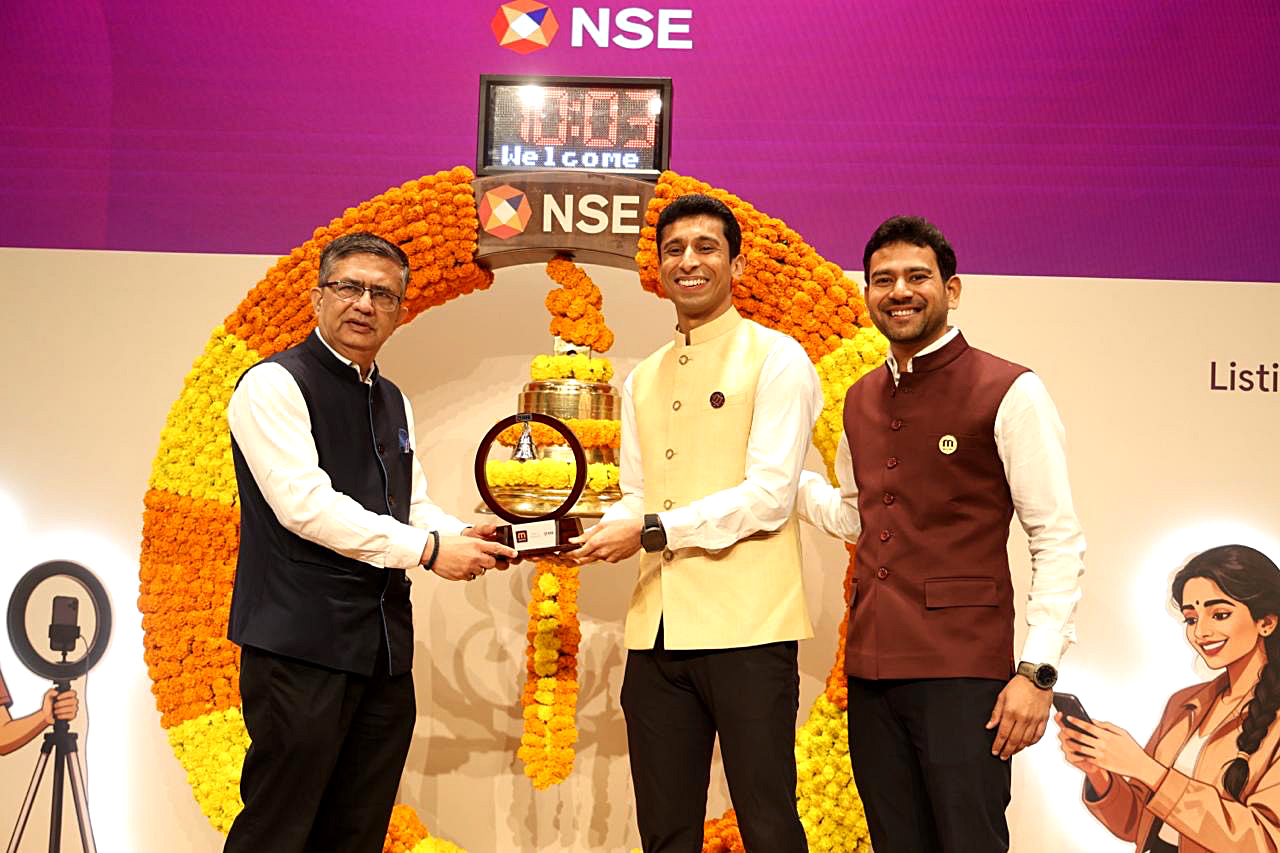
 From left to right: Ashish Chauhan, MD and CEO of National Stock Exchange (NSE), Bombay; Vidit Aatrey co-founder and CEO, Meesho, and Sanjeev Barnwal, co-founder and CTO, Meesho. (Photo: Supplied / Prosus)
The Indian public markets today witnessed the validation of a contrarian business model as e-commerce platform Meesho made an explosive debut on the National Stock Exchange (NSE).
The listing represents a major financial transaction and a landmark moment for India’s digital economy, establishing that a focus on the mass market, the “next 500 million” as Saurav Jain, Prosus’ lead investor in Meesho called it, is a viable, high growth strategy.
Meesho shares jumped approximately 58% on debut, listing at 162.5 rupees against an issue price of 111 rupees, Reuters reported. This performance values the company at 789.3 billion rupees, or approximately $8.78-billion.
Read more: From São Paulo to Soweto — how Prosus and Lesaka are defining growth on the JSE
Jain told Daily Maverick that this milestone was merely the starting line.
“If you look at any of the other value-based e-commerce players globally, this is still day zero for the company. It’s not even day one. We see a lot of headroom for growth.”
A zero commission strategy
Meesho’s success lies in its strategic decision to target the vast, largely underserved population outside of India’s top metropolitan areas. While incumbents competed for the most affluent 50 million users, Meesho built a platform explicitly for the “next 500 million” value-conscious consumers in smaller urban centres.
Success required the company to deviate from traditional e-commerce methods. They made two decisions that are now central to its model: a zero commission rate for sellers and an asset-light logistics model.
Jain said that this in-house logistics platform allowed the company to serve customers at the “lowest cost possible”.
The technology was designed for the reality of the mass market as the app was engineered for smaller sizes to accommodate basic smartphones with limited storage, Jain said.
“What stood out for us was a deep understanding of [the] Indian customer base,” he said. “And over a period of time, what also stood out for us was their ability to take very bold strategic bets.”
Prosus holding its stake
A notable feature of this Initial Public Offering (IPO) is the commitment from its lead investor, Prosus. The global technology group, which has invested more than $8-billion in India according to company reports, chose to retain its approximate 11.2% stake post-listing.
Prosus has positioned itself as an important player in India’s consumer internet landscape, with Meesho’s debut marking the fourth portfolio company to list in the past year, following Swiggy, BlueStone and Urban Company.
Read more: From bots to big bucks: Naspers’ AI army powers a Takealot turnaround
This is part of an “ecosystem strategy” designed to create interconnected growth across high frequency sectors such as food delivery (Swiggy), fintech (PayU), and home services (Urban Company).
“[Meesho is] a great example of what it means to build for India – which requires both product and business model innovation. We remain focused on supporting companies like Meesho that are building for the long term, with technology at the core,” said Ashutosh Sharma, head of Prosus India.
How this affects you
Meesho’s high valuation boosts the net asset value of Prosus and Naspers shares. Local investors gain indirect exposure to massive Indian tech growth. The IPO proves Prosus’ long-term ecosystem strategy works. The growth reinforces Prosus’ goal to achieve a 5x return on its Indian portfolio, which is important for narrowing the discount in the Naspers/Prosus share price.
Fintech synergy and financial maturity
Meesho benefits from this interconnected ecosystem, specifically its financial services collaboration with the fintech arm, PayU.
Read more: Prosus to buy Just Eat to create a European food delivery ‘champion’
PayU has become an important partner by providing credit lines to Meesho sellers. This financial service helps solve working capital issues for small merchants, creating a flywheel effect that supports the platform’s overall growth.
“Consumer tech has been very important for us, given that we operate and invest in multiple marketplaces globally,” Jain said. “What that has allowed us to do is share a lot of learnings of what works and what does not in terms of business model, product innovation and AI.”

Meesho’s listing comes amid a broader market shift away from pure growth metrics to fiscal discipline. The company has been free cash flow profitable for the past two years.
With more than 234 million annual transacting users and 2.3 billion orders enabled in the past 12 months, Jain cited this fiscal health as evidence of the “maturity of tech companies”, distinguishing the wave of listings as a validation of the digital economy’s ability to operate sustainably at scale.
AI and increased frequency
With a population of more than 1.4 billion, Meesho’s current Indian user base still leaves headroom for expansion.
The next phase of growth would focus on increasing user frequency, moving average users from five orders to seven, and eventually nine orders annually, Jain said.
Innovation, particularly in Artificial Intelligence (AI), would be embedded for personalising results and optimising fulfilment to lower costs further.
Read more: The AI surge and the magpie effect hypnotising the C-Suite
“One in six of every Indian transacts on Meesho,” according to Jain. “But with AI, probably the way we do commerce will change entirely.”
Prosus described the listing as an “important milestone for India’s maturing consumer internet ecosystem”, showing that “building for India” demands distinct, locally engineered business models. DM