




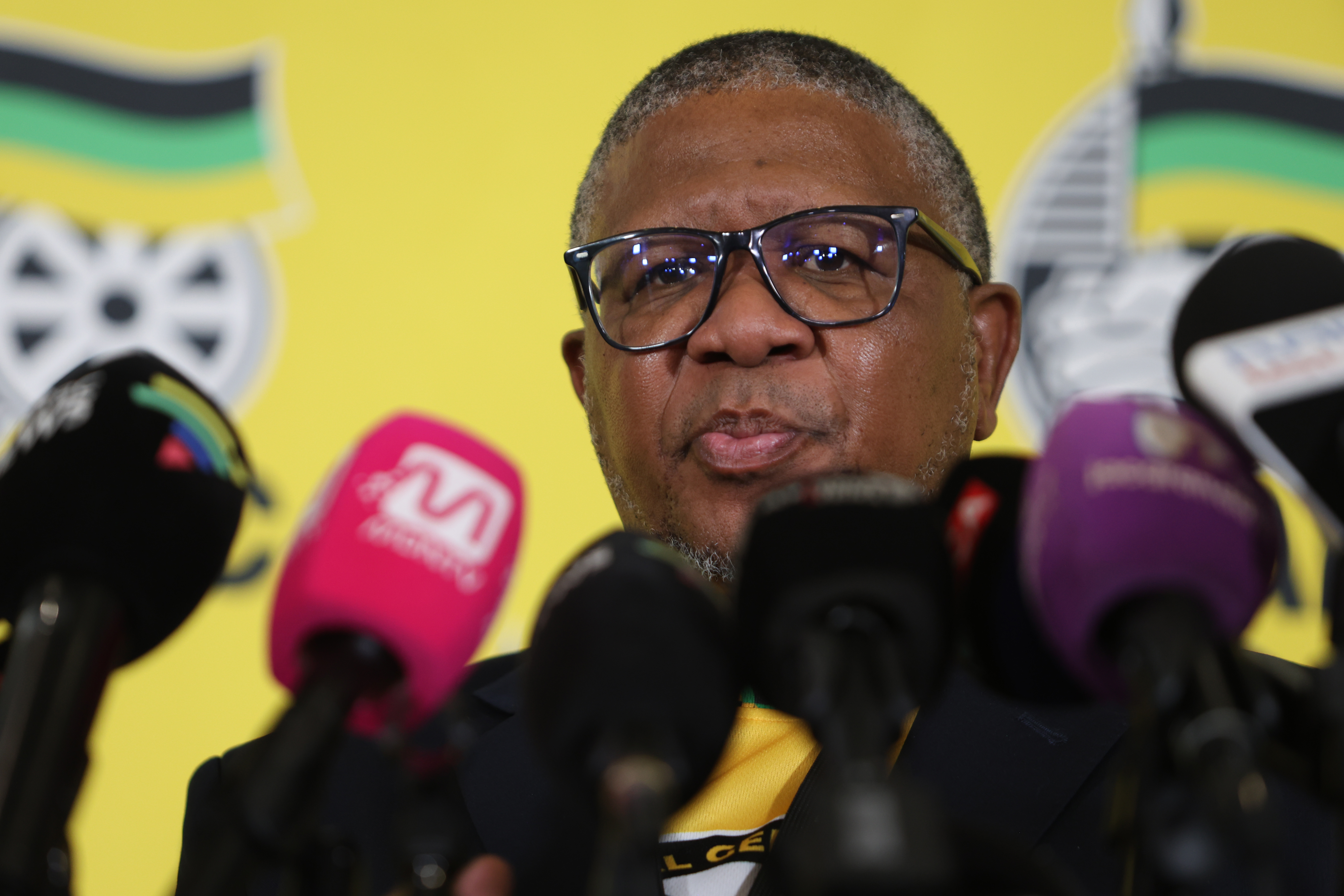
 ANC Secretary Fikile Mbalula at the ANC’s National General Council at Birchwood Hotel in Boksburg on 10 December. (Photo: Felix Dlangamandla)
 The ANC’s 67-member KwaZulu-Natal Provincial Task Team (PTT), led by veteran Jeff Radebe, hasn’t yielded the expected results and will be changed significantly, says ANC Secretary-General Fikile Mbalula.
Briefing journalists on Wednesday, 10 December, on the third day of the ANC’s National General Council (NGC) in Gauteng, Mbalula said, “I can assure you that there’s going to be changes in KZN. That structure is too big, and we are going to make it leaner.”
This year, the ANC National Executive Committee (NEC) replaced the provincial executive committees of Gauteng and KZN with PTTs after the two provinces suffered major electoral losses in 2024.
KZN is the ANC’s largest province by membership, but it was the hardest hit by the rise of the uMkhonto Wesizwe (MK) party. The ANC’s share of the provincial vote in KZN dropped from 54.22% in 2019 to 16.99% in 2024.
When the ANC announced the KZN PTT, it said, “This intervention, framed within the constitutional mandate of the NEC, reinforces the principles of unity, renewal and organisational rebuilding.”
But the party has continued to struggle in the province. In the most recent by-election in KZN, in November, the ANC lost Ward 17 in the iLembe District Municipality to the MK party. Its share of the vote plummeted from 65% in 2021 to only 30%.
On Wednesday, Mbalula said the PTT would be disbanded after its initial mandate expired. Changes to the provincial leadership would occur in February 2026, he said.
/file/attachments/orphans/6I1A5518_956660.jpg "Fikile Mbalula at the ANC’s National General Council at Birchwood Hotel in Boksburg on 10 December. (Photo: Felix Dlangamandla)")
“We are not happy about our performance there. We thought we were bringing a Ferrari, but I think now that is a [Toyota] Tazz that is operating,” said Mbalula.
“We need to get out of that particular situation. We have not been doing well. We are facing an existential crisis there, the tsunami. It’s a big disappointment for the ANC, and then we’re going to deal with it.”
He said the PTT was “fighting over who must lead, not the task we gave them”.
Mbalula said the party was going to “fetch” people who would build the ANC in KZN and appoint them to lead the party in the province — “root and branch, not people who are concerned about who must lead and all of that and just leave and abandon the task”.
/file/dailymaverick/wp-content/uploads/2025/02/WhatsApp-Image-2025-02-25-at-20.17.09.jpeg "From left: KwaZulu-Natal provincial task team first deputy Weziwe Thusi, convenor Jeff Radebe, ANC Secretary-General Fikile Mbalula, provincial task team coordinator Mike Mabuyakhulu, Mabuyakhulu’s deputy Nomusa Dube and task team provincial fundraiser Nomagugu Simelane. (Photo: Supplied)")
On Monday, 15 December, there will be a hotly contested motion of no confidence in KZN Premier Thami Ntuli (IFP), which, if passed, will collapse the government of provincial unity. The KZN government of provincial unity comprises the ANC, DA, IFP and National Freedom Party, which has since switched sides and said it will support the motion of no confidence.
/file/dailymaverick/wp-content/uploads/2025/05/ED_543981.jpg "KZN Premier Thami Ntuli. (Photo: Gallo Images / Darren Stewart)")
Read more: Kingmakers, knives and numbers: The vote that could hand KZN to Zuma’s MK party
GNU composition to stay
While Mbalula slammed the ANC’s KZN leadership, he was more supportive of the Government of National Unity (GNU).
Eight months ago, there was a strong push within the ANC to “reset” the composition of the GNU, possibly without the second-biggest party, the Democratic Alliance (DA).
Now, it seems this won’t occur.
“There’s no need to tamper with something that does not need tampering,” said Mbalula. “We are operating very well.”
Mbalula’s remarks contradict the ANC’s midterm review, which he delivered on Tuesday. The 294-page report painted a bleak picture of the future of the GNU.
Read more: ‘Time is not on our side’ — ANC reflects on GNU and declining voter support
Delivering the report, Mbalula said that although the GNU was able to work through some of its differences, its weaknesses threatened the stability and credibility of the 7th administration.
The report cited “relentless attacks on transformation policies and South Africa’s foreign policy stance by the DA, despite their agreement to the Statement of Intent. These attacks have been amplified through global networks, the courts, the media and state roles they hold within the GNU.”
It warned that although the ANC saw opportunities in the current political mix, “time is not on our side”.
“We must move with the speed of lightning in executing plans so that tangible results are felt on the ground, particularly on inclusive growth, job creation, poverty reduction, combating crime and corruption and improving service delivery. Ultimately, the GNU will be judged not on plans, but on execution.”
The contestation over passing the Budget was one of many examples of significant fractures within the fragile 10-party GNU, which remains divided over the National Health Insurance Act, the Bela Act and the Expropriation Act, which Mbalula said were all “here to stay”.
In April, the ANC’s National Working Committee decided to reset the GNU to possibly include other political parties in the event that the DA voted against other pieces of legislation.
This week, Sunday World reported that the ANC in North West had lobbied for the removal of the DA on the basis that the GNU would not collapse if this were done. According to Sunday World, the ANC’s North West chairperson, Nono Maloyi, said the provincial government of unity in Gauteng was “working extremely well” without the participation of the DA, and this model could be replicated at the national level.
In August, the ANC said: “The ANC remains the central and stabilising force in the GNU. We will continue to review structural arrangements to ensure stability and sharpen the focus on service delivery. The ANC is not a spectator; it leads.”
Ramaphosa’s intervention
During Wednesday’s briefing, Mbalula said that after the party decided to reconfigure the GNU, President Cyril Ramaphosa called a meeting between GNU leaders, which was successful and halted any changes to the GNU.
/file/attachments/orphans/WFD_9264_581176.jpg "President Cyril Ramaphosa arrives at the ANC’s National General Council on 8 December. (Photo: Felix Dlangamandla)")
“We have not had challenges. We managed to pass the mid-term budget, and now you must tell me that that does not showcase the stability of the GNU,” said Mbalula.
“There’s no need to tamper with something that does not need tampering. We are operating very well. We are now going to tighten screws around the issue of the Statement of Intent and working with all political parties.”
The party’s midterm report signalled that the ANC was prepared to look beyond the GNU for support during times of disagreement with the DA.
“The failure to pass the Budget in April provided critical lessons. The ANC has learned to build tactical, issue-based voting alliances — particularly when some GNU partners use Parliament to pursue narrow interests.”
This is what happened during the Budget breakdown process, when the ANC lobbied ActionSA and Build One South Africa to approve the Budget if the DA did not come on board. With the support of these two parties and other GNU members, the ANC could command a slim majority in Parliament without the DA’s backing. DM