



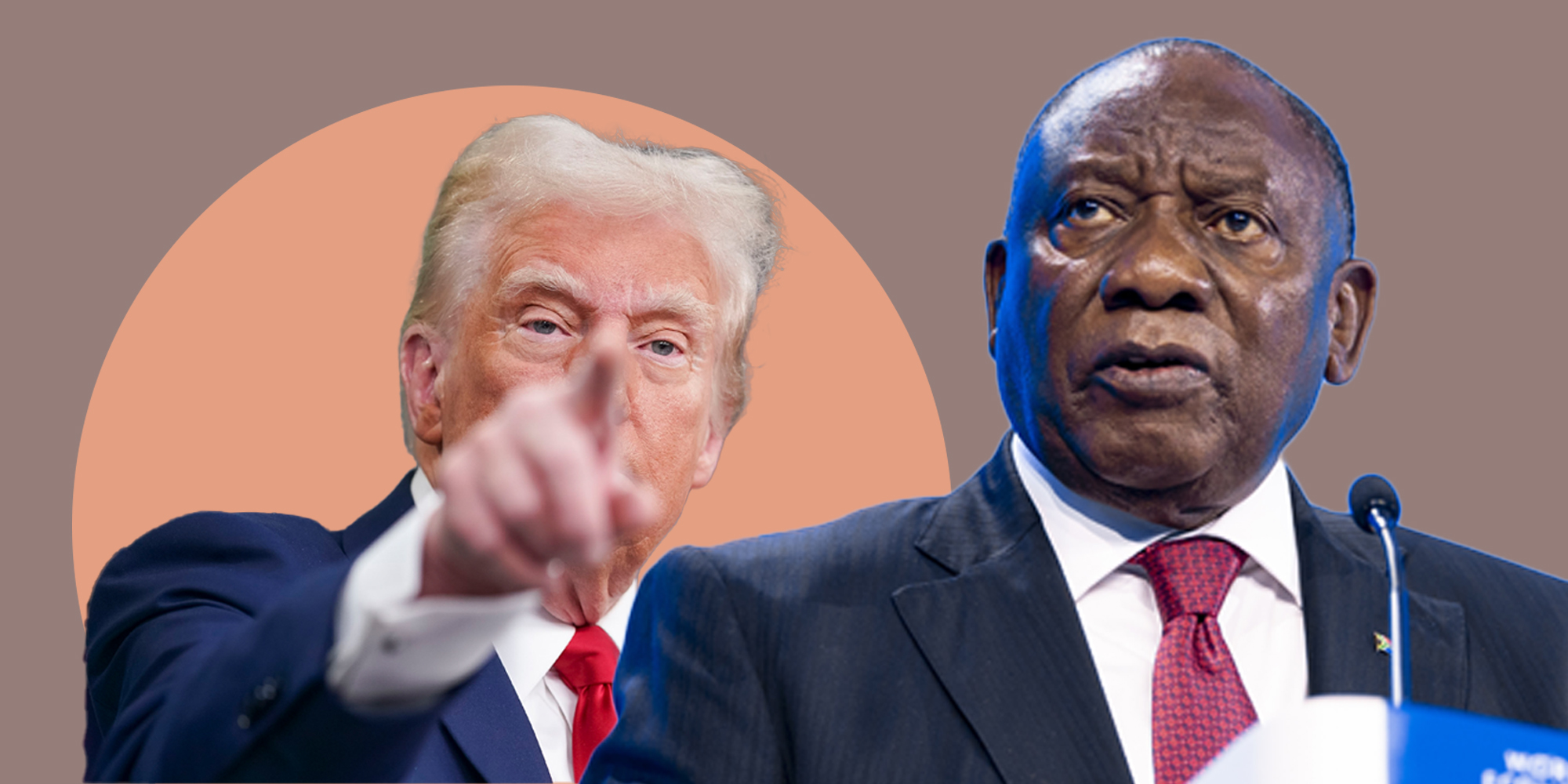
 US President Donald Trump. (Photo: EPA-EFE / Will Oliver) | South African President Cyril Ramaphosa. (Photo: EPA-EFE / Michael Buholzer)
 Every now and then something I read from history has a huge resonance with what I’m reporting on at the moment.
I did not expect to find that reading a book about the beginning of World War 1 might inform my understanding of the relationship between our government and the Trump administration.
But paging through (not really... I’m a confirmed fan of the Kindle) The War that Ended Peace: The Road to 1914 by Margaret MacMillan reminded me how impossible it is for us to deal with Donald Trump.
One of her points is that in countries like Germany and the UK, for the first time people representing countries in international affairs had to take into account public sentiment. They had to respond to the way voters (who were all male) felt about certain issues. This meant their lives became a lot more complicated.
Before that, leaders had a much freer hand. This allowed them to keep the details of some treaties secret, for example, something which seems impossible to manage now.
Now, I think things have swung so far that Trump is creating his foreign policy solely for public sentiment. In short, he is attacking us simply to ensure he wins the votes of his conservative white voters in the US.
Clearly our government has now had enough of this.
Over the weekend President Cyril Ramaphosa told a family meeting that Trump’s false claims about a “white genocide” here were “blatant misinformation”.
It followed public speculation in the Sunday Times that International Relations Minister Ronald Lamola might even be barred from entering the US and declared persona non grata, because he said Trump was following a policy that fed the ideology of white supremacy.
I’m sure that if you are involved in a business deal with an American company right now, that was pretty scary to watch. You’d immediately think that doing trade with the US was about to become even more difficult than it already is.
But I think, actually, we have no choice.
Trump has made it clear that no matter what we do, he is going to come for us. As pointed out many months ago, he literally hates the entire philosophical concept of South Africa.
And while Ramaphosa held his tongue in the Oval Office, he would know that if you don’t speak up to a bully, eventually that silence becomes a habit.
If you let Trump lie about the “white genocide” he is only going to move on and lie about something else.
It also helps our government that what Lamola and Ramaphosa are saying about Trump is true. What he and his officials are saying is helping white supremacy.
That’s why they say it!
But I think where Ramaphosa has been very clever is to make the context of all of this the G20. This means that when he speaks it is not just as South Africa, but with the support of other countries.
Trump says he won’t invite us to the G20 Summit in Miami next year. By making the issue South Africa’s non-inclusion he is going to force other countries to make a decision. Either they support South Africa or the US.
Considering that 18 other countries came to our G20, and then signed up to the Leaders’ Declaration, it would seem that we are actually in the warm embrace of many friends.
Countries like Germany or the UK have to decide who to back. And since they have already backed us it would be difficult for them to step away now.
Don’t forget, in many cases they’ll also be looking to show their constituencies that they are prepared to stand up to Trump.
And if there is pressure on them to do that, just imagine the pressure that is on any ANC politician here. This is the organisation that was created literally to fight white supremacy.
It would be asking more than is humanely possible for them to not speak up.
Meanwhile, I suspect that we might start to see a lot more of Lamola.
We know that he is ambitious, we know that Ramaphosa might well support him to be his successor, but we also know that he is not that popular in the ANC.
Suddenly he might have the fight he needs. If Trump does pick on Lamola, and tries to make him the symbol of his problems with us, this will only help Lamola. With Ramaphosa’s help he might well be able to use this to get more support in the ANC.
It is amazing how things have come full circle. Suddenly our domestic politics would be determined by international affairs.
That was unimaginable back in the days before the end of the peace. DM