




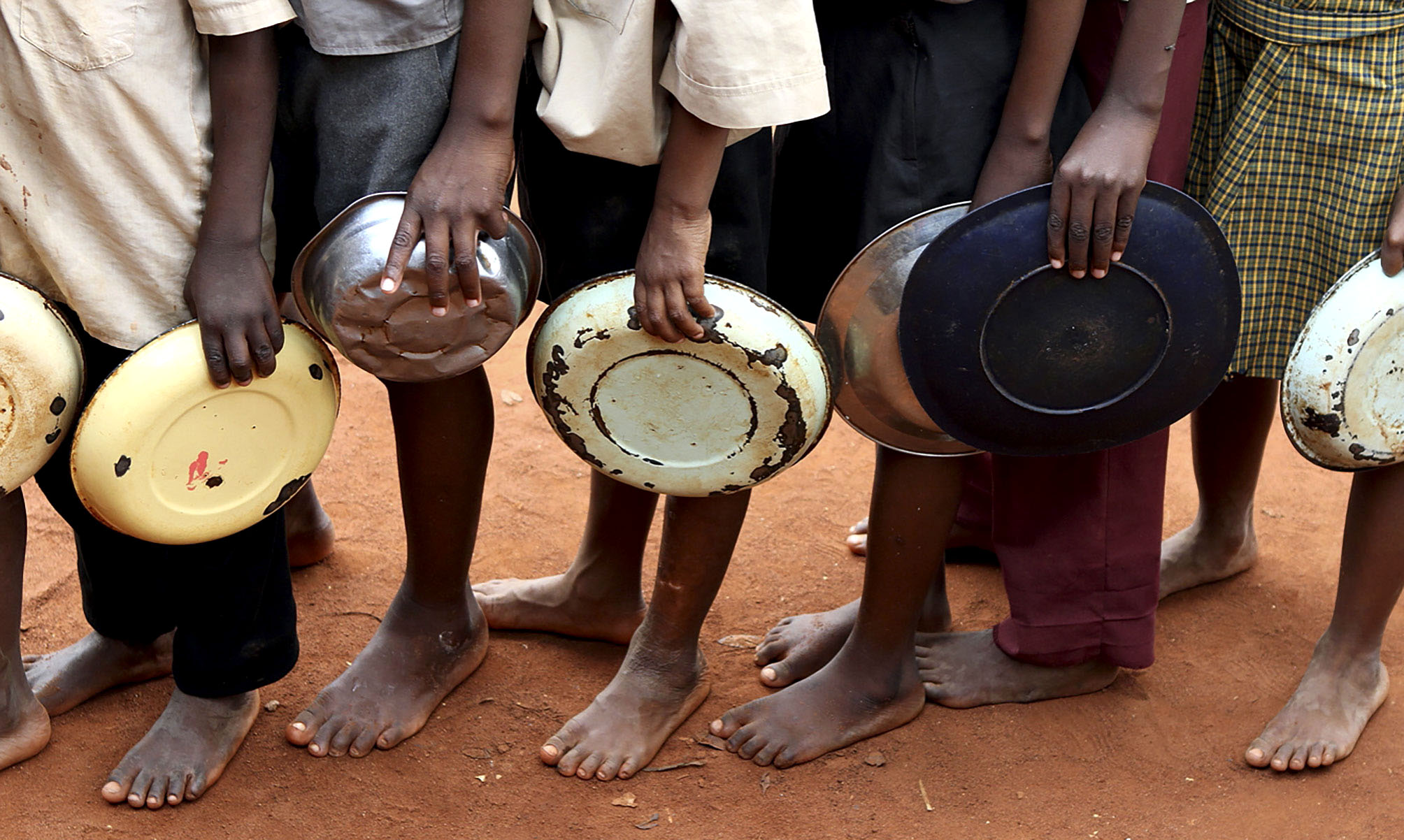
 Constitutionally, every child has the right to basic nutrition. In practice, that right has no teeth. (Photo: Gallo Images / Sowetan / Sandile Ndlovu)
 The G20 Leaders’ Declaration included concerns about food insecurity, but they ring hollow against the backdrop of mounting aid cuts by some of the signatories, as well as the absent US.
“We recognise the fundamental right of everyone to be free from hunger and we affirm that political will to create the conditions to expand access and affordability to safe, healthy and nutritious food is needed,” reads the declaration.
“We therefore reiterate our commitment to ensuring resilient and sustainable food systems and food security through open and non-discriminatory trade policies consistent with WTO [World Trade Organization] rules.”
The spectre of hunger — and in extreme cases starvation — still haunts even fertile lands, and it has many causes, including climate change, conflict, the persistence of rain-fed subsistence farming in much of Africa and other developing regions, and the linked fate of poverty.
/file/attachments/2984/Global-Hunger-and-Development-Assistance-Data_853564_c105b2c9e04d0d8c4d635f8c16053e9b_685311.jpg)
Read more: Malawi and the curse of the perpetual hunger crisis
“While we welcome progress made in reducing hunger in the world, we are still alarmed that up to 720 million people continued to experience hunger in 2024 and that 2.6 billion people were unable to afford healthy diets,” says the declaration.
However, some of the signatories have themselves been slashing aid, though not on the grim scale that the Trump administration has with its gutting of USAID.
“For the first time in nearly 30 years, the United States, France, Germany and the United Kingdom have all reduced their ODA [official development assistance] contributions in 2024. If they proceed with announced cuts in 2025, it will be the first time in history that all four have cut ODA simultaneously for two consecutive years,” says a study released 19 November by the Barcelona Institute for Global Health and other organisations that was published in The Lancet.
The modelling and number crunching by the researchers involved in the study paints a harrowing picture.
“The abrupt decline in Official Development Assistance could result in more than 22 million additional deaths by 2030, including 5.4 million children under five,” it says.
This jibes with other studies tracking the lethal impact of the USAID cuts and warnings sounded by NGOs and aid organisations.
Much of the focus has been on the slashing of health programmes such as those covered by the US President’s Emergency Plan for AIDS Relief (Pepfar), which is credited with saving tens of millions of lives in Africa.
This also affects food security, notably in countries where agriculture is predominantly carried out by small-scale, subsistence farmers, as it threatens to undermine the health of the workforce required to produce crops. And this is on top of the direct cuts to food aid.
/file/dailymaverick/wp-content/uploads/2025/06/LZ.Jozini-KZN.92.jpg "Despite South Africa producing enough food to feed everyone who lives in it, more than 63.5% of households in the country face food insecurity. (Photo: Black Star / Spotlight)")
Still, the G20 declaration is not completely toothless on the food security front.
Wandile Sihlobo, the chief economist at the Agricultural Business Chamber of SA, welcomed the commitments to the WTO rules in global agriculture.
“South Africa’s agricultural sector is export-led, and the WTO plays an essential role in ensuring fairness in international trade. The fairness of global trade is also key to ensuring that the world can achieve food security through trade, among other interventions,” said Sihlobo.
“Beyond South African agricultural matters, the G20 placed a necessary spotlight on the challenge of poverty, which remains a reality on the African continent. Unlocking agrarian productivity across the continent will help ensure we overcome this challenge.” DM