




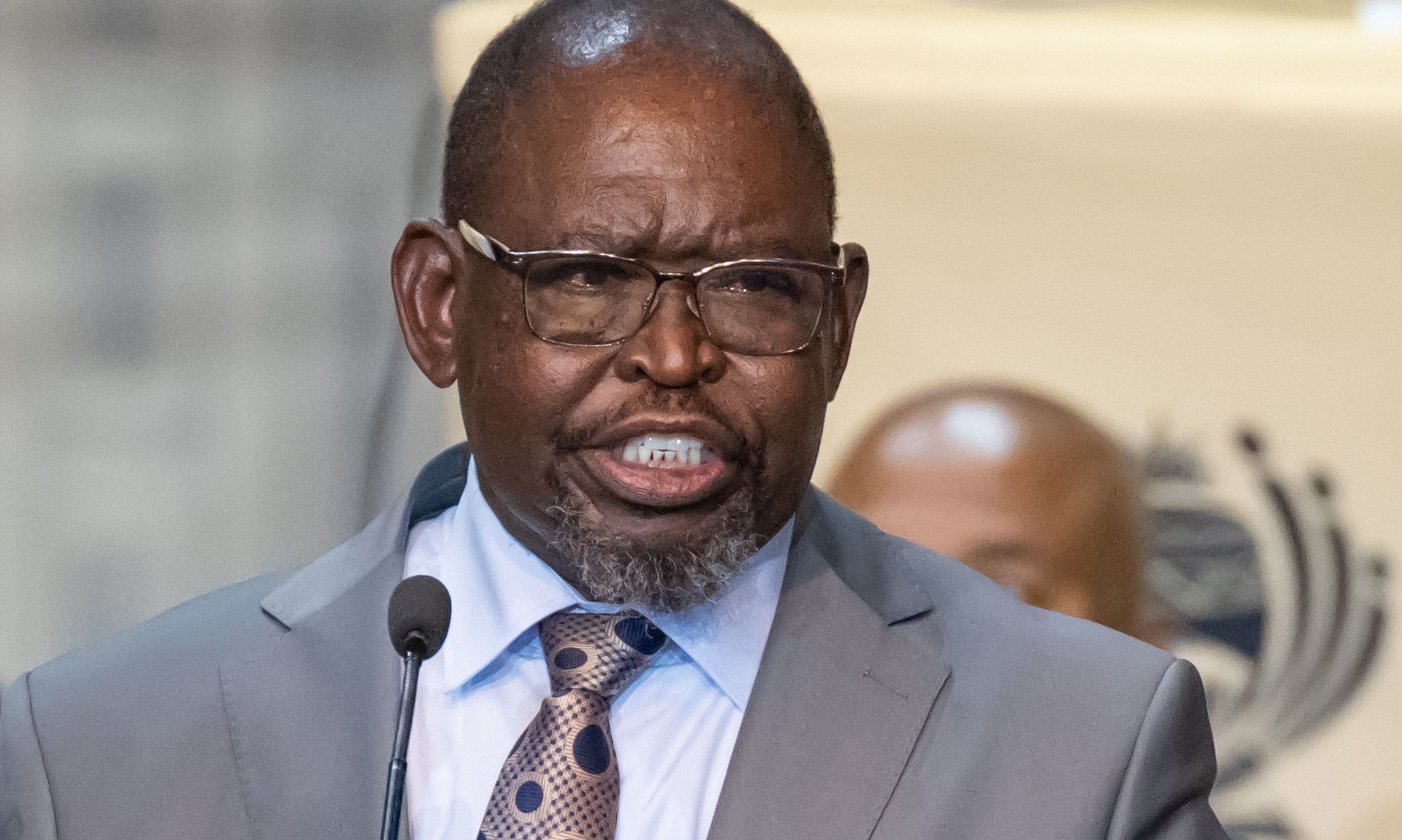
 Finance Minister Enoch Godongwana delivered his Medium Term Budget Policy Statement in Cape Town on 12 November 2025. (Photo: Jeffrey Abrahams / Gallo Images)
 When Finance Minister Enoch Godongwana stepped up to the podium on 12 November to address the nation on the Medium Term Budget Policy Statement (MTBPS), there might’ve been a hint of relief behind his wide smile. Against all odds, South Africa’s tax collector has outperformed expectations.
“The better-than-estimated tax revenue is due to stronger household expenditure, which has boosted value-added tax collections, and improvements in corporate tax receipts and dividend tax,” Godongwana said.
The South African Revenue Service (SARS) appears to be on track to rake in more revenue than the Treasury had pencilled in back in May. Compared to the 2025 Budget, the gross tax revenue estimate for 2025/26 has been revised upward by R19.7-billion.
Effective collection strengthens fiscal outlook
Domestic VAT collections rose by 7.8% and the Treasury reported that net VAT collections are now expected to pass the projections set out in the 2025 Budget estimates.
“This stronger revenue trajectory removes the need for additional tax increases in the baseline forecast over the next two fiscal years,” said Tertia Jacobs, treasury economist and fixed income specialist at Investec.
Read more: ‘Only game in town’: Treasury must now slash the fat with no hike for the VAT
Company and dividend tax collections were also strong across the trade, electricity and finance sectors, boosted by significant one-off payments from the mining and retail industries.
Strong growth in payments from fuel importers has driven fuel levy collections, which are expected to improve in 2025/26.
“This reflects the Minister of Finance’s consistent message since Budget 3.0, that if SARS effectively collects what is already due, the need to introduce new or higher taxes diminishes significantly,” the South African Institute of Taxation (SAIT) said. “The policy direction, therefore, appears to be one of strengthening the existing system, rather than expanding it.”
Read more: Where your tax money goes — how the state spends every R100
When the economy performs slightly better than expected or prices of key commodities stay higher for longer, the tax take gets fatter. That gives the government a bit of fiscal breathing room.

PAYE and import taxes lag
PAYE (Pay As You Earn) collections, or personal income tax, however, has been “marginally below expectations”.
Import VAT, customs duties and specific excise duties are expected to come in below the 2025 Budget projections, mainly because of slower import growth weighing on VAT and customs revenues.
How this affects you
- No new tax hikes (for now): Stronger tax collections mean the government won’t need to raise VAT or income taxes in the near future.
- Less borrowing pressure: Higher revenue could ease the state’s reliance on debt, helping stabilise public finances.
- Imports could stay pricey: Slower import growth and weaker customs revenues hint at ongoing pressure on the rand and import costs.
- SARS tightening compliance: Expect more rigorous tax enforcements as SARS expands its debt collection efforts.
Strong start, but momentum may fade
Revenue collections for the first half of 2025/26 were 9.3% higher than the same period last year.
The strong domestic VAT collections were propped up by resilient household consumption spending, which, according to the Treasury, outweighed the weaker outlook for import VAT.
But medium-term revenue prospects are weaker than previously anticipated despite the “overperformance” in near-term collections. The Treasury attributes this partially to the impact of lower inflation on the projected growth in tax bases.
Despite this, tax collections are expected to remain buoyant over the medium term, Godongwana said.
“The compliance revenue year-on-year has grown by almost 14%,” SARS commissioner Edward Kieswetter said. “Traditionally, the second half [of the financial year] is always better than the first half.”
Collecting smarter
The Treasury has adjusted its expectations of corporate and personal income tax collections downward owing to a weaker profitability outlook and lower wage bill growth.
“Improved tax revenues will require more sustainable economic growth and further gains in tax compliance and administration,” the finance minister said.
That has been financed with an additional R4-billion allocation to SARS in the 2025 Budget, intended to increase debt collection by between R20-billion and R50-billion a year.
Read more: Majority of SA’s US dollar millionaires back a 2% wealth tax, survey finds
“SARS’s strategic use of debt collectors, alongside its expanded compliance drives, signals a clear move towards a more data-driven, enforcement-oriented tax administration,” SAIT said.
SARS data for the first six months of 2025/26, however, shows that debt collections remain below estimates because of the legal and technical complexity of settling many cases.
“The universe of debt collection is more complex,” Kieswetter said. “A lot of the low-hanging fruit, which requires just a phone call, a little bit of rattling the cage, now requires tougher legal engagement such as civil judgments, letters of demand.”
Godongwana said the Treasury will continue to monitor SARS’ revenue performance for the rest of the year. “This assessment will inform whether the R20-billion in additional tax increases for the 2026 Budget, as earlier proposed, can be withdrawn. A final decision will be announced in the 2026 Budget.”
Read more: SA Revenue Service eyes billions in unpaid taxes after record R1.85-trillion collection
To make up for revenue shortfalls in the 2025 Budget after the proposed VAT rate hike was scrapped, R20-billion in additional tax revenue was included in the fiscal framework for 2026/27.
The MTBPS mentions that Kieswetter’s team has acquired a particular set of skills to address complex cases, which is expected to improve collections for the rest of the year.
“We’ve seen an increase of 35% in civil judgments, which means that we also need to supplement that with a different range of skills,” Kieswetter said. SARS currently has 81 specialised personnel and is hoping to ramp it up to 250, including debt collectors and litigation attorneys, he said.
A fiscal lifeline
The R19.7-billion increase may not be a jackpot, but it could mean less reliance on borrowing to plug the budget hole left by the withdrawn VAT rate increase from May.
“The adjustment in revenue means that we can make changes to our spending estimates,” Godongwana said. “For the current year, additional expenditure of R15.8-billion is proposed.”
Read more: Treasury’s spending review — Government’s Gordian knot
With social spending demands rising and Eskom and Transnet’s troubles far from over, a few billion in extra revenue won’t fix the fundamentals. But it might stop the fiscal ship from taking on more water – at least for now. DM