



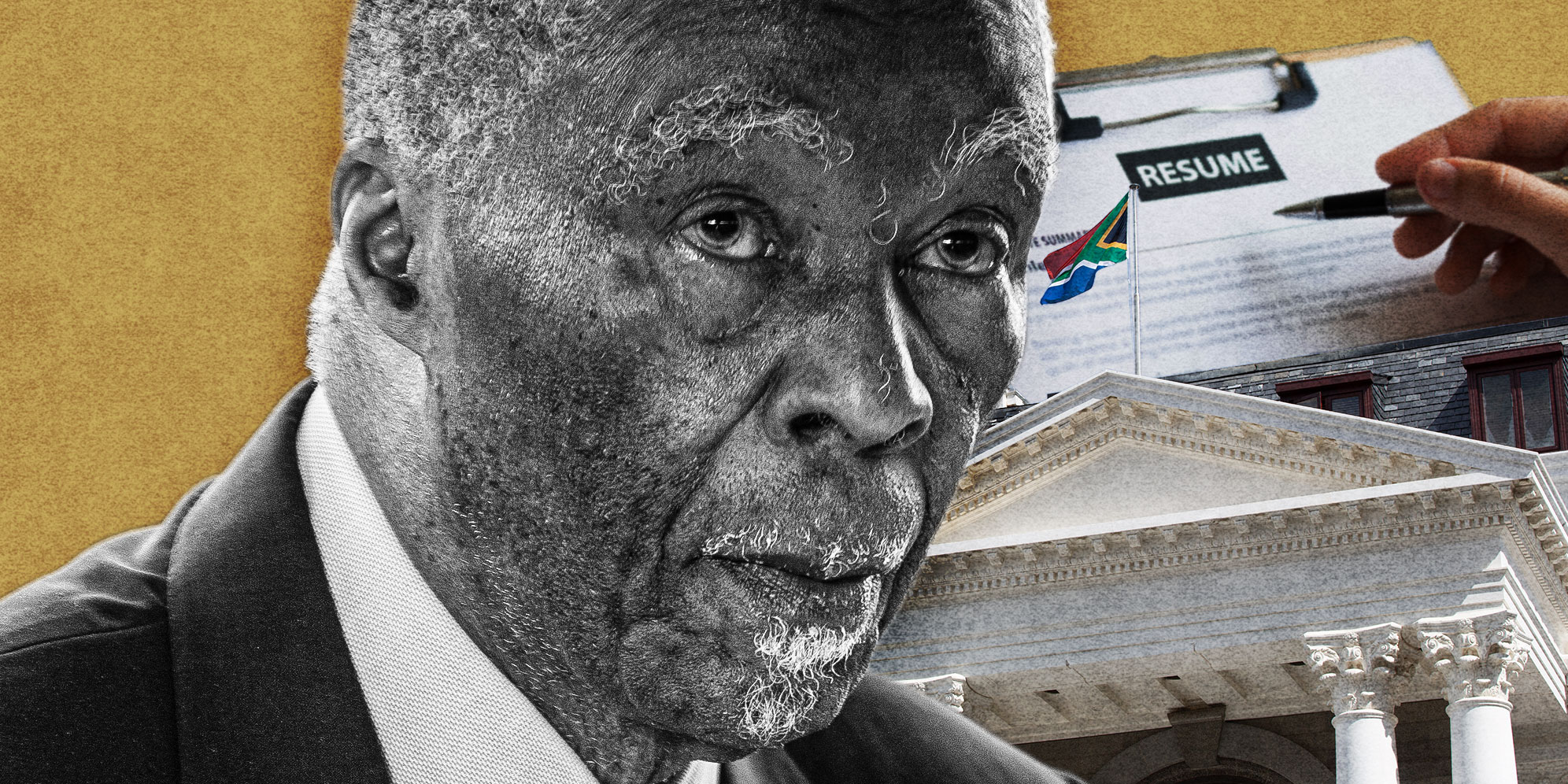
 Illustrative Image: Former South African President Thabo Mbeki. (Photo: Per-Anders Pettersson / Getty Images) | Parliament building (Photo: Daily Maverick) | Resume (Photo: Istock)
So fractured and corrupt has much of our politics become that many people now reach for structural solutions to our problems. The latest suggestion comes from former president Thabo Mbeki, who believes Parliament should assess a person’s capability before voting for them to be President. Capability and qualifications are not the problem. And Mbeki’s hypocrisy will only serve as an example to others.
Nine days ago Mbeki told a conference in the Eastern Cape that the way in which our Presidents are elected (currently by the National Assembly in its first meeting after an election) is wrong.
He said that “the question is never asked if a President is capable and a fit and proper person”, and went on: “When Parliament said I must become President, they did not have a clue what I was capable of doing, and they never asked.”
Mbeki appears to be suggesting that MPs should consider what capabilities or qualifications a person has for the position of President.
The hypocrisy is breathtaking.
Mbeki himself was elected in this way. And did not, back in 1999, have any problem in appointing Jacob Zuma as deputy president despite the fact that he had no qualifications.
Mbeki did not then suggest that either he or Zuma should undergo a test of capability.
And, if Mbeki is now suggesting that people should have particular qualifications to be President, he is showing, once again, that he is not a democrat.
If, for example, the bar was that a presidential candidate should have a tertiary qualification, it would remove, at a stroke, the leaders of both MK and the DA (Julius Malema left school with just a matric, but later studied and attained an honours degree through Unisa).
The real message that Mbeki is sending is that only people like him are capable of being President.
Famously, Mbeki has a master’s degree in economics from the University of Sussex.
But he himself showed, while President, that he was no respecter of those with qualifications in their own fields.
Time and time again he overruled medical experts on the issue of HIV. These were people who had immense medical qualifications, people who had spent their lives studying the disease.
But he, with his economics degree, continually overruled them.
While he, along with many other older men, might believe that they have now come across wisdom, he has repeatedly shown that he has not.
Just three years ago he told an audience at Unisa that he had not changed his views on HIV.
These comments, at that time, could not have been more dangerous.
He was speaking, one should remember, DURING A PANDEMIC, when the government was trying to encourage people to get vaccinated against Covid-19, when the sitting President himself had been injected with a vaccine on live TV.
But Mbeki felt that he could make these unscientific comments. As the Academy of Science of South Africa pointed out at the time, his comments will “certainly fuel the latent stigma and denialism that health professionals, scientists, NGOs and civil society have worked so hard to mitigate”.
Mbeki’s sin – and it is surely a sin – is compounded by the fact that he is chancellor of the University of South Africa. He has a moral obligation to stand up for science. He has chosen, repeatedly, not to do this.
In the process he has weakened the legitimacy of the very qualifications he now claims should be criteria for Presidents.
As has been consistently pointed out on these pages, qualifications do not indicate someone’s real fitness for office.
It may be tempting to ignore Mbeki’s comments as just the rantings of a former president, a person who is no longer politically relevant.
Unfortunately, because he is a former president, and was our second democratic President, people still look to him for guidance.
Last week, before the parliamentary ad hoc committee investigating the SAPS, Malema complained: “We are subjected to these kind of things that politicians and other people can just do as they wish but they never get arrested.”
Whether it be the way in which he benefited from the looting of VBS, or how he has evaded justice for the On-Point scandal (which involved his friend, then Limpopo premier and now Deputy Police Minister Cassel Mathale), Malema has shown himself to exhibit exactly this kind of behaviour.
Mbeki and Malema may be a class apart, but they are not alone.
Just two weeks ago, Deputy President Paul Mashatile told people celebrating the birthday of OR Tambo that the ANC should “renew itself” in honour of Tambo. This from a person who has claimed ownership of a property worth nearly R30-million but who earns only a government salary.
And he has still not publicly disavowed the actions of the VIP protection unit members transporting him, despite a finding last week that they do have a case to answer regarding their obvious assault on a motorist.
Even Malusi Gigaba, a man known to be a lying liar who lies, has claimed, with an apparent straight face, to be concerned that the ANC’s “renewal” is not properly dealing with corruption.
And, of course, President Cyril Ramaphosa himself has claimed that the ANC is “number one” in the dock of public opinion, while not properly explaining why he kept US dollars in a couch.
Unfortunately, the damage caused by Mbeki’s comments does not end there.
While there are many problems that can be caused by a lack of education among public representatives (as has been lamented many times, a large proportion of our local councillors are not able to query the accounts of the institutions they lead), it is a price that we pay for democracy.
Imagine if a person with universal appeal were to be the leader of the biggest party in Parliament, nominated by that party to be President, only for their opponents to use their lack of qualifications against them?
One can imagine another party going to court to use such a requirement against a person they cannot defeat politically.
This would be a recipe for disaster.
Many people in our society and elsewhere believe we should look to our elders for guidance.
It is a monumental pity that Mbeki has chosen to make such comments, and continues to refuse to accept that he has made monumental mistakes. DM