




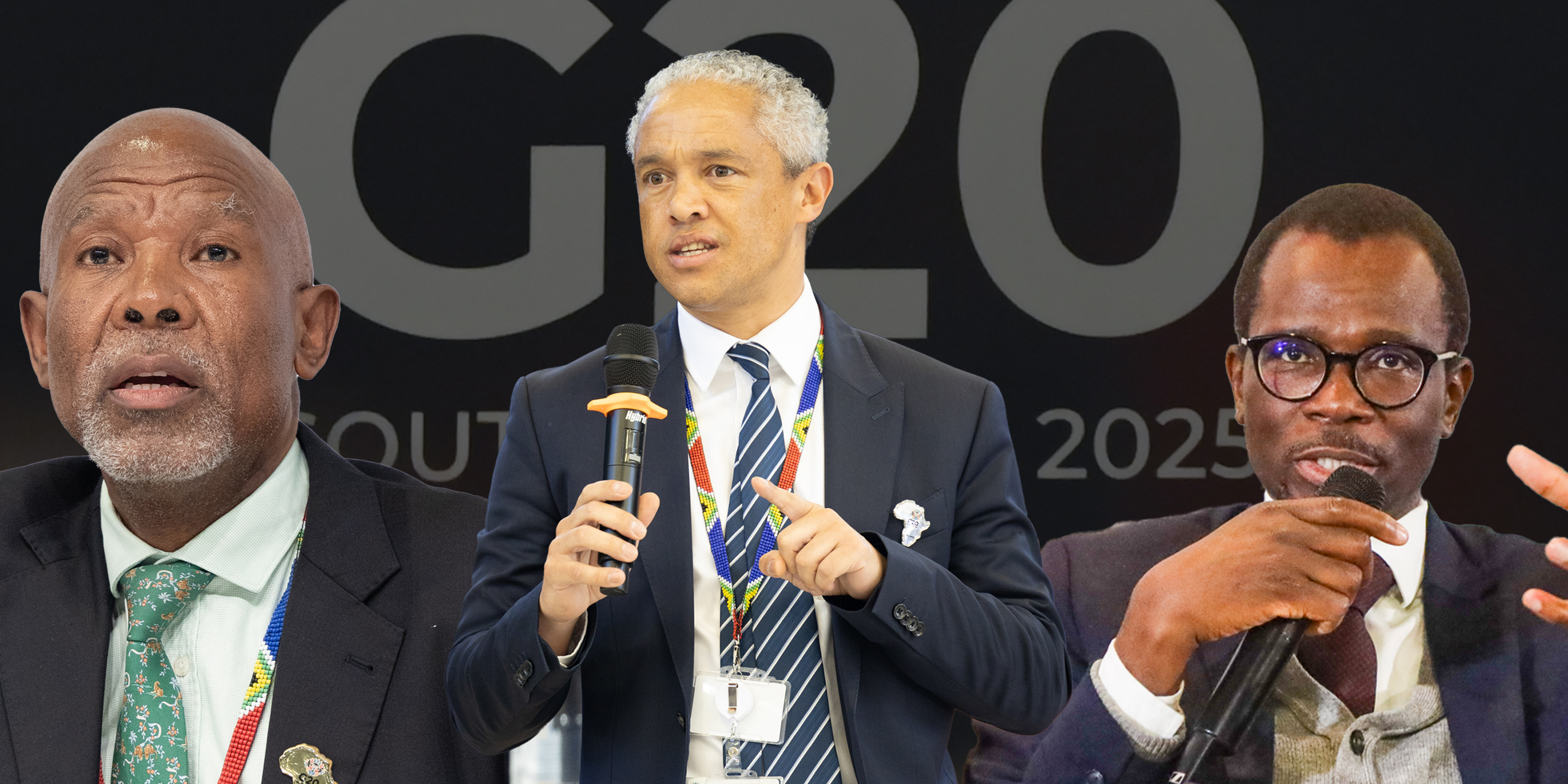
 Illustrative image: G20 Logo. (Photo: /Darren Stewart / Gallo Images) | Lesetja Kganyago, governor of the South African Reserve Bank. (Photo: Misha Jordaan / Gallo Images) | Dr Duncan Pieterse, National Treasury director-general. (Photo: Misha Jordaan / Gallo Images) | Dr David Masondo, deputy minister of finance. (Photo: OJ Koloti / Gallo Images)
 Addressing the media on Thursday night after the G20 Finance Ministers and Central Bank Governors (FMCBG) meeting in Washington, DC, the South African Reserve Bank governor, Lesetja Kganyago, observed that several key measures had been realised during South Africa’s presidency of the G20.
These included:
- The launch of the G20 Africa Engagement Framework to ensure consistent engagement with Africa’s growth and development challenges over the next five years;
- Advancing the multilateral development bank roadmap to make it more effective for developing countries;
- Progressive discussions on artificial intelligence from regulatory and macroeconomic perspectives; and
- A reaffirmed commitment to enhancing cross-border payments to make them cheaper, faster and more inclusive.
“Amid rising geopolitical tensions and fragmentation, South Africa prioritised global cooperation and development, with a special focus on Africa,” said Duncan Pieterse, director-general of the National Treasury.
“We have emphasised the need for global policy responses that reflect the lived realities of emerging markets and developing economies, including low growth, constrained fiscal space, rising debt service costs and limited access to long-term affordable capital. Our focus on Africa permeated the finance track, where significant progress has been achieved.”
Earlier this week, however, around 165 civil society groups criticised South Africa for failing to make progress on debt sustainability issues during its presidency of the G20 major economies and urged it to push for reforms before it hands over to the US on 1 December.
Signed by the European Network on Debt and Development (Eurodad), Amnesty International, the Malala Fund and ActionAid International, among others, the letter lauded President Cyril Ramaphosa’s decision to make debt sustainability one of four priorities for South Africa’s presidency, but added: “So far, nothing tangible, let alone ambitious, has been achieved.”
Read more: Groups blast lack of progress on debt issues during South Africa’s G20 presidency
“African governments are currently spending nearly 17% of their revenues just to service debt — often paying more to creditors than for their own citizens’ health and education. This isn’t just a fiscal challenge; it’s a human one,” said Mavis Owusu-Gyamfi, president and CEO of the African Center for Economic Transformation.
“Imagine what those resources could achieve if redirected toward strengthening clinics, training teachers or ensuring families have access to clean water. Every dollar used to pay debt is a dollar that could change a life — a child’s chance to learn, a mother’s access to health care and a community’s path out of poverty.”
An assessment from the African Centre for Economic Transformation (Acet) shows that:
- A 5% cap on debt servicing across all 21 countries would unlock more than $320-billion in revenue for African governments.
- Across the 21 countries, a 10% cap on debt servicing could unlock enough money to provide sanitation access to nearly 10 million people while also averting roughly 23,000 deaths of children under five every year.
- In Egypt, limiting debt repayments to 5% of government revenue would allow the country to achieve universal access to clean water and sanitation, while eliminating maternal mortality.
- In Angola, reducing the cost of debt to 14% of government revenue would allow the country to avoid the deaths of more than 700 mothers in childbirth, as well as more than 8,000 children under the age of five every year.
- In Ethiopia, a 14% cap would enable some 340,000 children to attend primary school, reducing the out-of-school population by nearly 5%.
Commenting on these findings, Dr Ed Brown, senior director of research, policy and programmes at Acet, observed, “These numbers show that debt reform isn’t just about balance sheets — it’s about empowering children to go to school, helping mothers survive childbirth and giving communities access to clean water.” The global financial system must work for development, not against it, he added.
Chair summary
On Thursday night, rather than issuing the customary formal communique, the panel shared a “chair summary”.
National Treasury’s Pieterse acknowledged the need to address excessive imbalances throughout the world, but in a way that contributes to an open global economy and without compromising sustainable global growth.
“Both this chair summary as well as the declaration from Durban earlier this year spoke about the importance of the World Trade Organization [WTO] to advance trade issues and acknowledge that the agreed-upon rules in the WTO are integral as part of the global trading system,” he said.
Read more: The price of inequality — Africa’s fight for fair finance at the G20
The Ministerial Declaration on Debt Sustainability
- Building upon the progress that has been made, we, the Finance Ministers of the G20, commit to the following to further enhance debt sustainability:
- We recognise that a high level of debt is one of the obstacles to inclusive growth in many developing economies, which limits their ability to invest in infrastructure, disaster resilience, healthcare, education and other development needs.
- We reaffirm our commitment to support efforts by low- and middle-income countries to address debt vulnerabilities in an effective, comprehensive and systematic manner.
- We reiterate our commitment to further strengthen the implementation of the Common Framework for Debt Treatments beyond the DSSI [Debt Service Suspension Initiative] in a predictable, timely, orderly, and coordinated manner.
- We reaffirm our call to enhance debt transparency from all stakeholders, including private creditors.
- We support the ongoing review of the International Monetary Fund (IMF)-World Bank Low Income Countries Debt Sustainability Framework (LIC-DSF), which will result in further improving the methodology underpinning the IMF-World Bank Debt Sustainability Analysis (DSA) for LICs and thus contribute to understanding and addressing debt vulnerabilities more effectively.
- We note the voluntary use of crisis-resilient debt clauses where appropriate, which could potentially provide vital breathing space and liquidity.
- We note the efforts to explore the consideration of the use of liability management operations and debt-for-development, debt-for-climate, or similar swaps on a voluntary and case-by-case basis, with a balanced view on their benefits and limitations to help strengthen debt sustainability.
- We remain committed to engaging constructively with key stakeholders in further advancing common understanding, including with the private sector, official bilateral and multilateral creditors and debtor countries, for example, in the context of the Global Sovereign Debt Roundtable (GSDR). It is important to engage with and enhance the voice of borrower countries.
- We continue to urge the international community to support vulnerable countries with a strong reform agenda whose debt is sustainable but are facing liquidity challenges, and encourage the IMF and the World Bank to continue their work on feasible options to support these countries, which should be country-specific and voluntary. We will also discuss how to support these countries, with the support of the IMF and World Bank. We look forward to receiving further reports on this matter from the IMF and the World Bank for discussion.
- We underscore the importance of addressing gaps in debt management, debt transparency, public financial management and domestic resource mobilisation, and will continue to advance adequate capacity-building initiatives to this end.
Harsh criticism followed after the documents were released. Iolanda Fresnillo, the policy and advocacy manager at the European Network on Debt and Development, said: “We are extremely disappointed to see absolutely nothing new in the G20’s declaration on debt today. It reiterates limited and ineffective tools like the Common Framework for Debt Treatments instead of supporting real reforms at a more inclusive forum — the UN.
“South Africa — like Brazil before them — said debt would be one of the priorities of their Presidency. The declaration published today is the latest illustration that the non-inclusive, non-democratic G20 is the wrong space to advance on real solutions for debt.”
Sara Harcourt, senior policy director at ONE Campaign, said for an African-hosted G20, the Ministerial Declaration on Debt was “woefully insufficient” to meet the needs of African countries that are having to choose between paying their debts or paying teachers and nurses.
“We need urgent and effective action to reduce current debt burdens and decrease borrowing costs so countries can invest in their people and grow their economies,” she concluded. DM