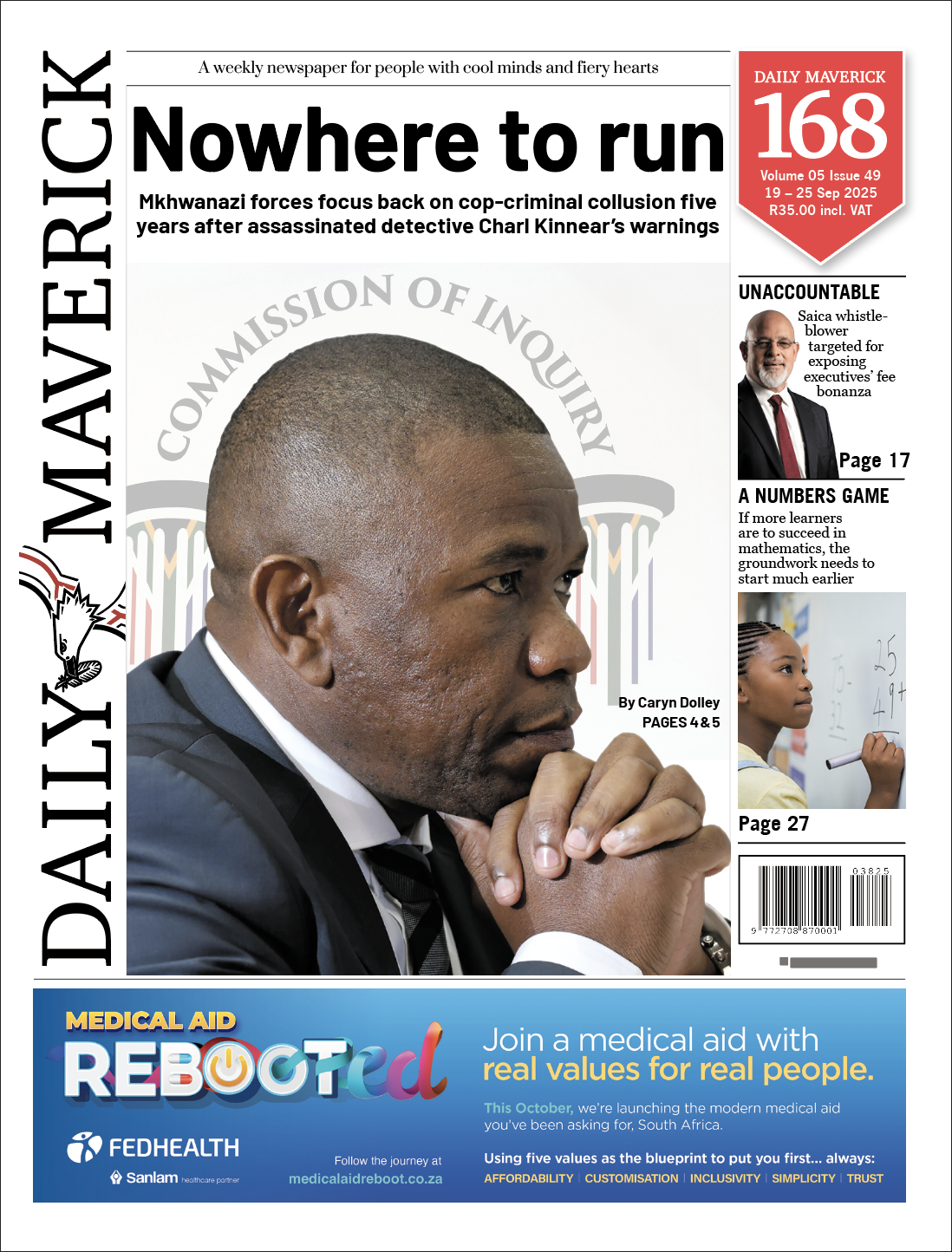
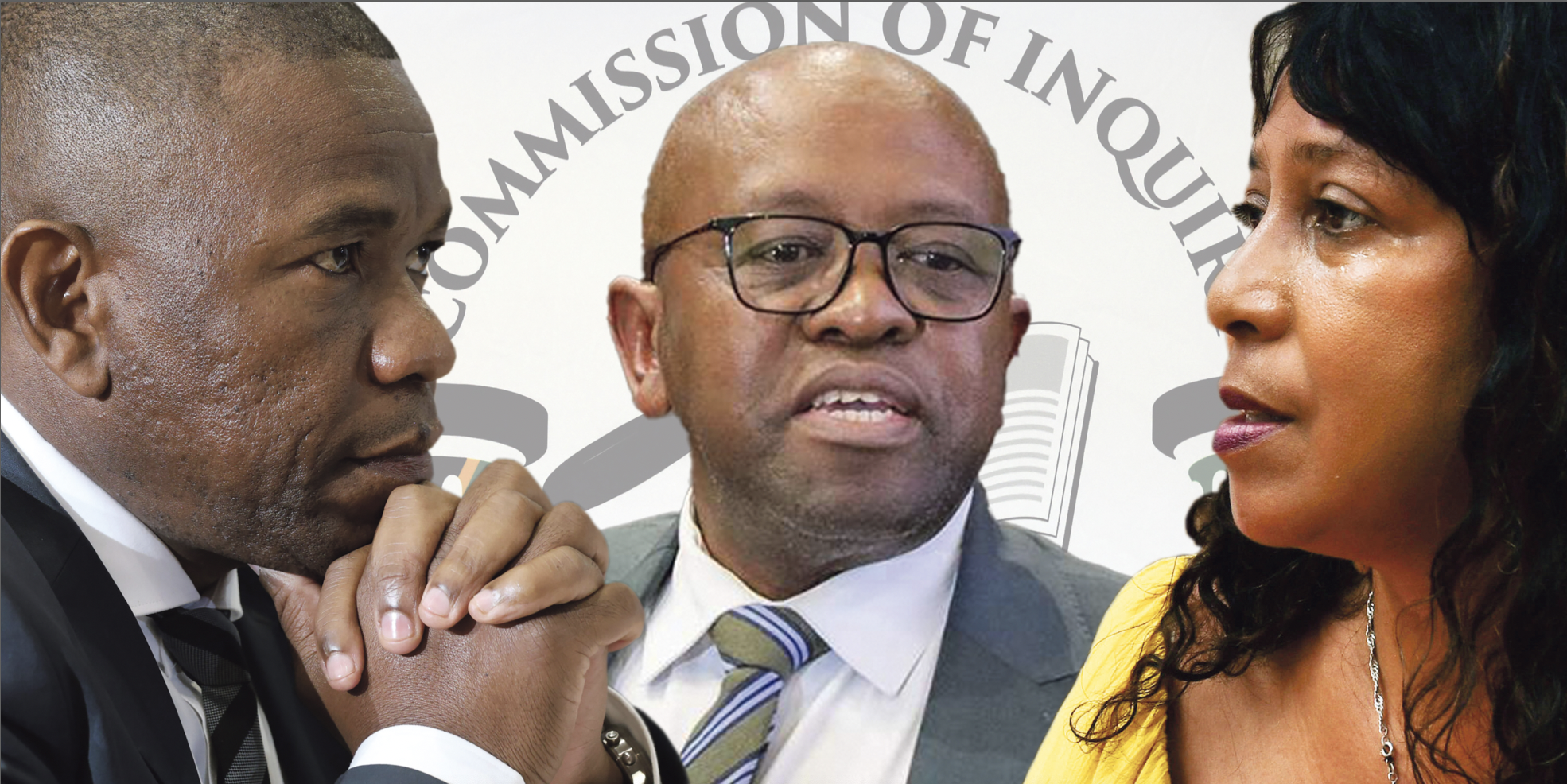
 From left: KwaZulu-Natal Police Commissioner Lieutenant General Nhlanhla Mkhwanazi, Justice Mbuyiseli Madlanga, and Nicolette Kinnear. (Photos: Felix Dlangamandla / Gallo Images)
 “Now this bomb has exploded in their faces, now they have nowhere to run – at the expense of my husband’s life.”
These are the words of Nicolette Kinnear, the widow of senior detective Charl Kinnear, who was assassinated five years ago. She was speaking this week about police bosses having to deal with the Madlanga Commission of Inquiry – the most seismic development in democratic South Africa’s law enforcement structures.
The commission, which officially started on Wednesday, 17 September, is investigating accusations of collusion, political interference and corruption in the criminal justice system, including the South African Police Service (SAPS).
Nicolette expressed frustration that it took so long for the state to turn its focus to such suspicions. This is because, in the run-up to her husband’s murder, he had complained to his bosses about fellow police officers working against him and siding with a crime suspect.
She felt that had Kinnear’s complaints been given proper attention at the time, “instead of wiping the mess under the carpet”, the SAPS might have picked up deeper problems that now form the basis of the Madlanga Commission.
Crucially, her husband’s murder might have been prevented.
Kinnear was investigating an array of individuals, including colleagues suspected of fraudulently creating gun licences for criminals, when he was shot outside his home in the Cape Town suburb of Bishop Lavis.
The murder happened on 18 September 2020 – five years almost to the day before the start of the Madlanga Commission.
President Cyril Ramaphosa ordered the creation of the commission to investigate astounding accusations made by KwaZulu-Natal’s police commissioner, Lieutenant General Nhlanhla Mkhwanazi, during a press conference in July.
Among his explosive allegations was that Police Minister Senzo Mchunu, who has since been placed on special leave, disbanded KwaZulu-Natal’s political killings task team – effectively to protect crime suspects. Mchunu has denied wrongdoing.
Mkhwanazi was the commission’s first witness on Wednesday. He testified about a policing plan to try to safeguard two detectives involved in investigating the April 2024 murder in Vereeniging of engineer Armand Swart.
Swart was shot after the company he worked for unearthed corruption related to Transnet contracts.
/file/dailymaverick/wp-content/uploads/2024/11/Thamm-Kinnear-wife7.jpg "Charl and Nicolette Kinnear. (Photo: Supplied)")
Threats and intimidation
Firearms seized in that case were linked to various other violent crimes, pointing to an organised crime syndicate.
One of the accused who was arrested was a police officer, Michael Pule Tau.
Mkhwanazi alleged that senior officers offered bribes to investigators looking into the Swart murder and connected matters, and that corruption appeared to run through it all. Tau was granted bail in August last year and resigned from the SAPS.
Testifying at the Madlanga Commission, Mkhwanazi said: “This sparked great concern among investigators as well as the prosecution team because they started fearing [for] their lives… Those threats were coming verbally and, in some instances, [with] physical intimidation. At times I’m told they were being followed as they were moving around.”
/file/dailymaverick/wp-content/uploads/2023/12/Caryn-Cape-town-run-by-gangs-Inset-1.jpg "Charl Kinnear was assassinated outside his home in Bishop Lavis, Cape Town in 2020. (Photo: Noor Slamdien)")
As for Kinnear, he had also feared for his life. Although his killing does not appear to have a direct link to the matters that led to the establishment of the Madlanga Commission, it is fundamentally related to it because, before his murder, he had complained about dubious dealings in the SAPS, especially in the Western Cape.
After he was killed, there were promises to crack down on such things. The police minister at the time of Kinnear’s murder was Bheki Cele, who said shortly after it happened: “This family deserves to know whether their father was failed and, if so, heads must roll.”
/file/dailymaverick/wp-content/uploads/2024/03/ED_492814.jpg "Former Police Minister Bheki Cele. (Photo: Gallo Images / Darren Stewart)")
But Cele is now linked to matters about which Mkhwanazi raised the alarm. This is because, as News24 reported, Cele has been associated with businessman Vusi “Cat” Matlala, who is a central figure in Mkhwanazi’s allegations, including the claim that Matlala was financially backing Mchunu’s political aspirations.
Matlala had other ties to policing. He was awarded a R300-million police health services contract, which was later terminated.
He has been held in custody since his arrest in May on charges including conspiracy to commit murder and money laundering. Some of these relate to an attempted hit on his ex-girlfriend, actress Tebogo Thobejane, in 2023.
This week, Matlala was denied bail in the magistrate’s court in Alexandra, Johannesburg. The magistrate ruled he failed to prove that he was not a flight risk and would not interfere with witnesses.
As for the Kinnear matter, Daily Maverick has established that several aspects of it are still dragging along. In the five years that have passed since his killing, a senior officer accused of failing to ensure his safety has died and another retired.
/file/dailymaverick/wp-content/uploads/2025/07/p4-caryn-senzo.jpg "Illustrative image. From left: Minister of Police Senzo Mchunu, Vusi 'Cat' Matlala and KwaZulu-Natal police commissioner Lieutenant General Nhlanhla Mkhwanazi. (Photos: Theo Jeptha, Luba Letsolle and Deaan Vivier / Gallo Images)")
Culpable homicide
The Independent Police Investigative Directorate (Ipid) has looked into why Kinnear was not protected by state-organised security at the time of his murder. He was under obvious threat and some colleagues knew that his cellphone was being tracked.
Ipid even accused Khehla Sitole, the national police commissioner at the time Kinnear was killed, of failing to cooperate with its investigation relating to his death. Sitole denied it.
But this may have been among the issues that contributed to Ramaphosa prematurely ending Sitole’s contract “in the best interests of the country” in February 2022.
Meanwhile, Ipid produced a final report on the Kinnear matter. Dated May 2022, it was only declassified at the end of last year, after controversy over previous attempts to keep it secret.
The report made scathing findings against various senior police officers.
/file/dailymaverick/wp-content/uploads/2024/07/LIGHT-BLUE-13.jpg "Lieutenant General Fannie Masemola. (Photo: Gallo Images / Brenton Geach) | Charl Kinnear, who was assassinated outside his home in Bishop Lavis, Cape Town. (Photo: Supplied) | General Khehla Sitole. (Photo: GCIS)")
Daily Maverick asked Ipid what had happened to the findings, now more than three years old. Its spokesperson, Lizzy Suping, responded: “The SAPS national commissioner must still provide a report to Ipid on the recommendations submitted in the Kinnear matter.”
Daily Maverick asked the SAPS about the Ipid recommendations on 11 September, but had received no response by the time of publication, so it is not clear what has happened to any implicated police officers.
Although there has been an intense response from the state to Mkhwanazi’s accusations, which are of national importance, there still appears to be some lethargy in the case of Kinnear.
Suping, in her response this week to other Daily Maverick questions, said that Parliament’s previous police portfolio committee chairperson, Tina Joemat-Pettersson, had said the Kinnear issue would remain on its agenda until the police report was submitted. Joemat-Pettersson died in 2023.
The previous year, in a push for accountability, Nicolette Kinnear lodged culpable homicide complaints against police officers she believed had enabled Kinnear’s murder by failing to protect him.
Suping, referring to that criminal case, told Daily Maverick: “Ipid’s criminal investigations on culpable homicide are under way.”
Kinnear’s complaints
/file/dailymaverick/wp-content/uploads/2025/02/ED_546582.jpg "Nafiz Modack appears at Western Cape High Court on 12 February 2024 in Cape Town, South Africa. The accused face various charges under the Prevention of Organised Crime Act, including the assassination of crime investigator Charl Kinnear in September 2020. (Photo: Gallo Images / Die Burger / Jaco Marais)")
Charl Kinnear’s concerns about dubious activities among colleagues started emerging in December 2018, when he sent a 59-page grievance letter to his bosses.
Among the allegations he made was that some officers tied to Crime Intelligence in the Western Cape were aligned with organised crime accused Nafiz Modack, who has since been convicted of corruption.
Modack is among those still on trial in connection with Kinnear’s killing. (The gunman who actually pulled the trigger, however, does not seem to have been arrested.)
Ipid’s final report on the Kinnear matter found that a “rogue” police unit had indeed existed and “created further animosity among leadership sowing division” in the Western Cape SAPS.
“This may have created a perfect opportunity for underworld syndicates and figures such as Nafiz Modack to infiltrate the SAPS to monitor the movement of key role-players,” Ipid said in the report.
This somewhat mirrors what Mkhwanazi alleged during the July press conference that sparked the Madlanga Commission.
Kinnear had complained that police officers had sided with a crime suspect in the Western Cape; Mkhwanazi, in essence, said the same thing had happened with senior officers linked to police headquarters.
Kinnear had claimed there were rogue activities linked to the Western Cape’s Crime Intelligence unit; Mkhwanazi suggested there were individuals with nefarious agendas embedded in South Africa’s national Crime Intelligence unit.
Mkhwanazi also alleged that there was pressure “to make sure that Crime Intelligence is handed over to the criminal syndicate”.
As for the Kinnear case, Ipid made several other findings against police officers. These included that two officers attached to the priority crime unit, the Hawks, “acted unlawfully and criminally” in failing to act on information they had, and this “resulted in the killing of the late Lieutenant Colonel Kinnear”.
Ipid also made harsh findings against former Hawks head Godfrey Lebeya. “[He] failed to ensure that the [Hawks] members implicated investigated the threat against the state and therefore failed to protect the national interest or security of the state,” its report said.
Lebeya, at the time, countered through a spokesperson that there was “some level of ignorance” about the Hawks’ investigative methods. He retired a few months ago.
Kinnear was part of the Western Cape’s Anti-Gang Unit, then headed by Major General Andre Lincoln (who in the 1990s had investigated suspected connections between organised crime and government officials).
/file/dailymaverick/wp-content/uploads/2024/06/Godfrey-Lebeya.jpg "Former National Head for the Directorate for Priority Crime Investigation Lieutenant General Godfrey Lebeya in Pretoria, South Africa. 29 November 2022. (Photo: Gallo Images / OJ Koloti)")
Read more: Anti-gang unit still in disrepair as shootings persist
Ipid’s findings about the Anti-Gang Unit included that it was underresourced. It also found that Lincoln should be charged since his “inaction … constituted misconduct” under SAPS regulations and “a serious dereliction of his duty” as a senior officer.
Daily Maverick previously reported that Lincoln said the Anti-Gang Unit had at one point undertaken to protect Kinnear, but the protection was later withdrawn because all members had to be deployed elsewhere.
In an affidavit for a Labour Court matter involving the Kinnear accusations, Lincoln said that “the charges [against me] are plainly ridiculous and are nothing more than retribution”. Lincoln, who had health problems, retired from the police towards the end of 2021. He died in May 2025. Mkhwanazi was among those at his funeral.
/file/dailymaverick/wp-content/uploads/2023/07/0000274152.jpg "Major-General André Lincoln who led the Anti-Gang unit (Photo: Gallo Images / Netwerk24 / Jaco Marais)")
Drugs and guns
It is atop all this that the Madlanga Commission, created because of a whole new set of police corruption accusations, is now unfolding. Other areas it is set to investigate include Mkhwanazi’s allegations that a drug cartel based in Gauteng was controlling a criminal syndicate that extended into various state entities, including the police.
Kinnear was investigating similar matters in the run-up to his murder. He had been looking into shootings in the Western Cape, including some that may be linked to the drug trade.
And he had investigated allegations that police officers in Gauteng were involved in creating fraudulent gun licences for suspects in the Western Cape.
According to Ipid, this “exposed the inadequacies and corruption within the SAPS Central Firearms Register”.
The police watchdog’s findings suggest that Kinnear therefore also played a role in exposing corruption on a national scale – the core theme the Madlanga Commission is now investigating. DM
This story first appeared in our weekly Daily Maverick 168 newspaper, which is available countrywide for R35.