




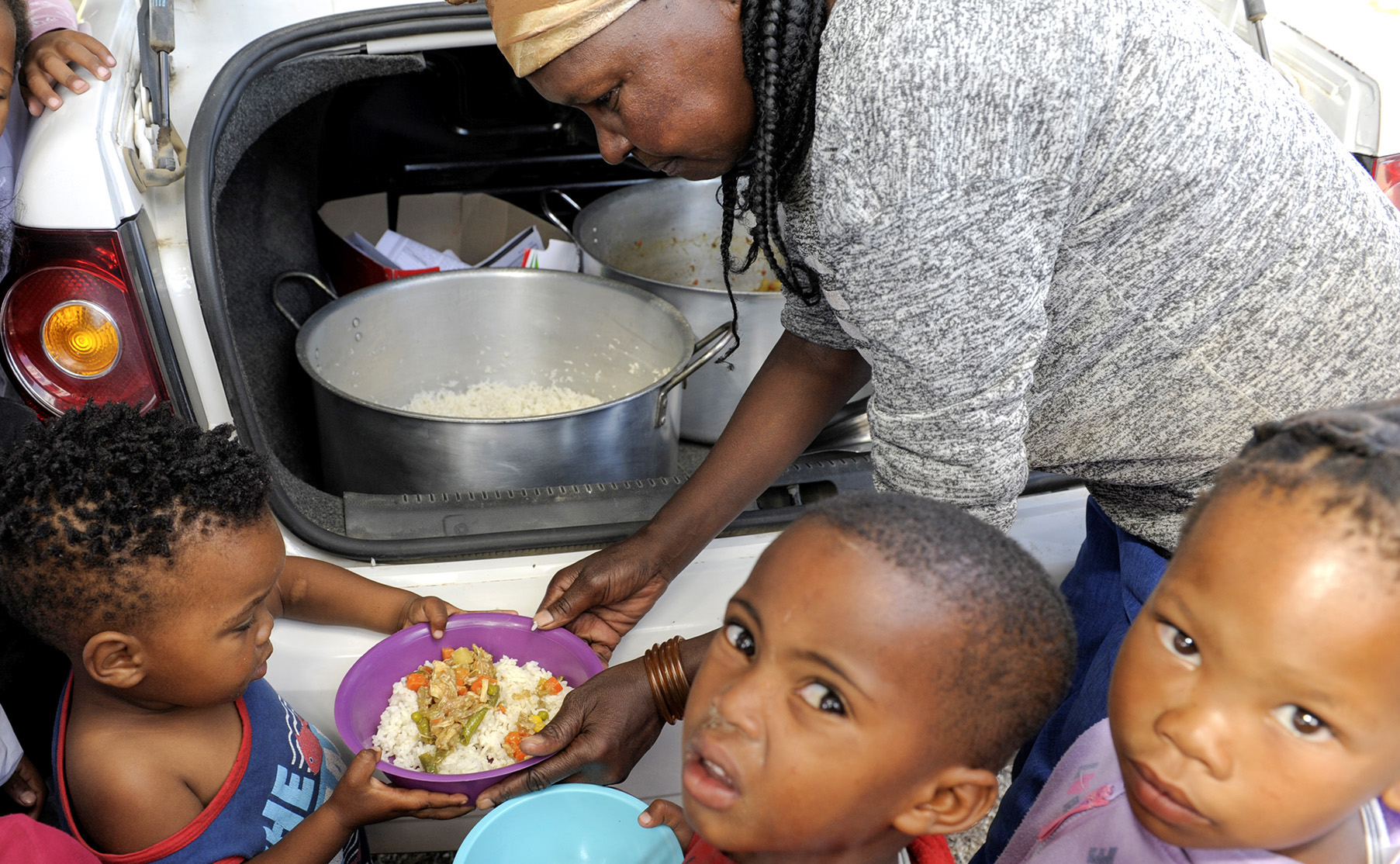
 Children receive meals from a mobile soup kitchen in the rural town of Hutchinson in the Northern Cape. (Photo: Joyrene Kramer)
Rural communities in South Africa suffer from conditions of extreme poverty, with only their unskilled labour to trade. Over the past decade, to address unemployment, the Local Economic Development (LED) approach has been favoured. LED focuses on attracting external investments, but importing skilled labour for safeguarding their investments.
/file/dailymaverick/wp-content/uploads/2023/10/CovidGrant-1.jpg "Unemployment and desperation is rife in the Eastern Cape. (Photo: Donna van der Watt)")
Village Economic Development (VED), on the other hand, aims to utilise available community assets supported by local labour. It promotes an internal focus to escape from the devastating clutches of unemployment instead of waiting for outside investors/donors to rescue them.
Undoubtedly, though, this is a challenging undertaking; historically, communities have been structurally disadvantaged by apartheid social engineering, through inferior education, and there is often a dearth of local assets and capital.
But that is not a reason to give up.
On closer inspection, communities do have substantial collective buying power through the considerable South African social grant system on which millions depend. Unfortunately, this is mostly siphoned out of communities to the formal sector and external traders, encouraged through LED investment in shopping malls in some rural villages. Malls are populated by national chain stores. This way, the little income people have is mostly transferred away from their communities.
Economic development or social asset stripping?
To an untrained eye, it might look like some rural villages show signs of economic development. However, scratch the surface and you discover that most of these green shoots are due to overpaid senior public servants and suspicious allocation of government tenders.
In reality:
- The trading sector is monopolised by external players, in both the formal and informal sector.
- Tourism is generally inaccessible due to substantial upfront capital investment requirements.
- Participation in agriculture is largely through labour supply or at subsistence farming level.
- The manufacturing sector is mostly barren.
From a social perspective, the high unemployment rates cause hopelessness and, in some cases, depression, mental illness and substance abuse.
/file/dailymaverick/wp-content/uploads/2024/10/DSC_5617-copy-1.jpg "More than 29% of South African children up to the age of five are stunted due to severe acute malnutrition. (Photo: Deon Ferreira)")
Poverty is causing stunting, which is irreversible, due to lack of adequate nutrition – a recent Daily Maverick article reported how learners in Bushbuckridge are “taking turns to eat”.
Lack of economic opportunities force males and youth to emigrate to the cities. This results in absent fathers and capacity loss, as well as informal settlements in the receiving cities.
/file/dailymaverick/wp-content/uploads/2025/07/9813474.jpg "Shacks in a high-density area of Khayelitsha, Cape Town. (Photo: EPA / Nic Bothma)")
Because of hopelessness, people are susceptible to alcoholism, resulting in further poverty.
This is mainly due to:
- Lack of leadership – cadre deployment means people without capacity are employed in strategic positions.
- Inferior basic education and underequipped schools.
- Hand-out syndrome – communities have been conditioned to wait for handouts instead of proactively searching for sustainable income-generating opportunities.
Understanding poverty
This dire situation makes it necessary to re-examine the current failed trajectory for economic inclusion – a different approach could assist the poor all over South Africa as well as internationally.
The most important difference must be the recontextualization of what poverty is and what it is not. If poverty is defined only in economic terms, then the focus will be different from when the definition is about quality of life and the sustainability of a quality-of-life system. Max Neef, the Chilean economist, refers to it as human scale development – it requires a de-emphasis of the monetary construct of poverty.
Right now is a suitable time to overhaul how we organise and distribute available resources and rethink how to eradicate poverty. Ubuntu must be dusted off and reintroduced in all spheres of society, starting with leaders elected to ensure that the majority benefit from the abundant available opportunities and resources.
A different worldview needs to be cultivated and should infiltrate all walks of life. However, a hopeful worldview alone will not change behaviour – it needs an accompanying sustainable methodology.
A different vision based on widespread participation needs to be constructed.
To complete the strategic action, an accompanying project implementation plan, including a budget and progress evaluation system, needs to be developed.
Transformative solutions
To harness the transformative power of community capital injected through social grants, the only universal community asset available, it is proposed that individual villages should organise their buying power into consumer cooperatives.
/file/dailymaverick/wp-content/uploads/2025/09/61T6cCMKinL._UF10001000_QL80_.jpg "(Source: Amazon)")
In my 2018 book, Fighting Poverty in South Africa – a Practical Guide, I explore how VED requires a bottom-up inclusive approach, utilising existing community assets and capacity.
One idea, for example, is to survey the food and fast-moving consumer goods (FMCGs) that villagers buy regularly. Then, to source it in bulk and sell it to members with a slight mark-up to cover operational expenses and to build reserves. The reserves can finance additional opportunities, such as production and manufacturing.
In time, the unemployed should be able to produce most products they consume. This will be achieved with the establishment of additional primary production and agricultural cooperatives.
In turn, these village cooperatives must be supported by regional hubs or secondary cooperatives to provide economies of scale, access to resources and expertise that primary cooperatives might not have.
Successively, these secondary cooperatives can be supported by a provincial or national tertiary hub/cooperative; mainly for bulk procurement and marketing purposes. In my book, I call this a Hub and Spokes approach.
Long-term approach
Of course, such an approach – a miracle if it succeeds – will not happen overnight. It is a long-term evolutionary process to be built from the ground up. My book puts forward a detailed description/methodology on how this can be achieved.
Suffice it to say that it requires full-time support, great effort and hard work. Additionally, a dedicated structure must be established, such as a VED Institute, to provide ongoing support for the development and training requirements of grassroots initiatives. VED Institutes could be sprouting in all rural areas if this collective approach is embraced.
Training must be provided on a Just-In-Time basis instead of Just-In-Case!
In other words, provide skills training where it is needed to address operational constraints. This means newly acquired skills will be entrenched by applying them immediately, not fading away over time due to non-use.
The Hub-and-Spokes principle is based on mutual benefit: if the Spokes (primary co-ops) thrive, the Hubs will also do well in being rewarded for their support. Symbiotic relationships lead to the provision of a better quality of services/support, as they will be considered valuable enough to be paid for.
Deploy a poverty-fighting army
Finally, to support the process, I propose the creation of a poverty-fighting army.
Since rampant inequality in South Africa is much more of a security threat than military invasions, some of the military personnel/resources should be diverted to assist with supporting the sustainability of rural cooperatives. In other words, have specialist platoons available to work with and support communities.
For example, a poultry farming platoon with all the knowledge available to establish and support a chicken farm while providing Just-In-Time training to co-op members.
Other specialist platoons, such as for management, finance and governance, must be available to deploy where co-ops are experiencing challenges.
Perhaps one of the most valuable aspects of the poverty-fighting army could be to arrange for a system of conscription of school leavers and/or recently qualified graduates. This might alleviate the plight of the unemployed youth and allow them to gain valuable skills and experience.
Proof of concept
The Bushbuckridge Crèches Confederation (BCC) Non-Profit Organisation supports the BCC Cooperative, which consists of 55 member crèches in the Acornhoek region. They are represented by Barumiwa (Messengers) in each sub-grouping.
The support structure is currently establishing chicken farms for both layers and broilers at 22 of the 55 member crèches with external funding (US Embassy and National Development Agency). Once the farms are under way, sales will generate a rewarding profit and cover the costs for the next cycle of inputs.
The crèches’ farmers have realised the worth of collective action and are now in the process of establishing a credit union. This will allow them to invest in the production of critical inputs in the poultry farming value chain.
Throwing money at the problem is not only a short-term/feel-good solution, it also creates long-term dependencies and devastation when funding is rescinded. Training alone will not do; it needs to address real problems that will entrench skills when rewards are experienced.
The root cause needs to be addressed. In the case of assisting communities who are struggling to make ends meet, the solution is not one-dimensional – it needs a holistic, integrated approach where education plays a vital role. DM
In the early nineties, Jan Vermeulen relocated to Bushbuckridge to focus his efforts on rural economic development. He subsequently established the Bushbuckridge Local Business Service Centre. During this time, he facilitated numerous economic projects ranging from subsistence to commercial agriculture, tourism, informal trade and other small business opportunities. In 2018, he published his book titled Fighting Poverty in South Africa: A Practical Approach. He is now paying particular attention to Early Childhood Development, as this is where children fall into the lifelong clutches of poverty due to stunting.
Comments
Scroll down to load comments...