




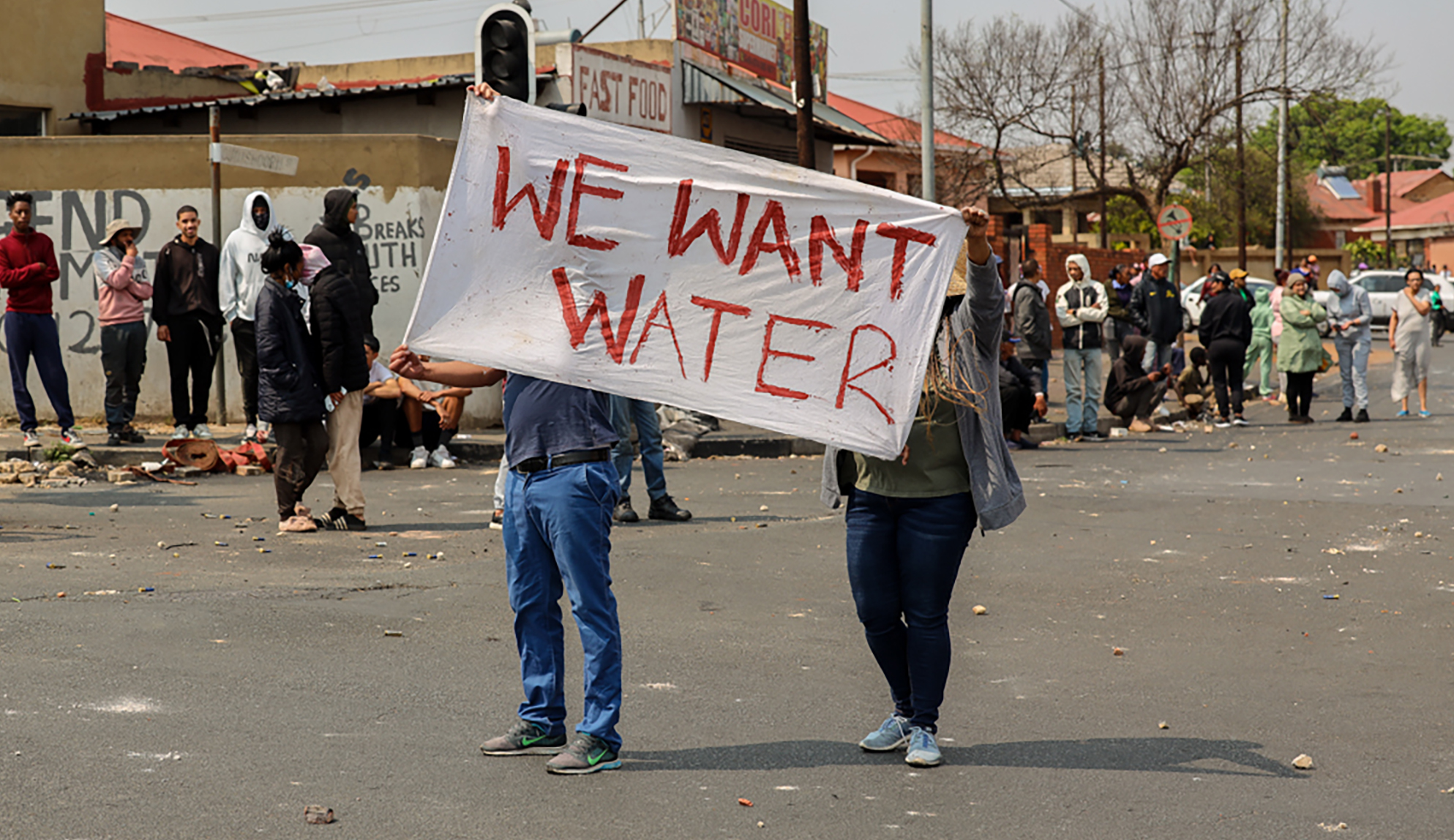
 Residents protest over water shortages in Coronationville, Johannesburg, on 10 September. (Photo: Fani Mahuntsi / Gallo Images)
 From Alexandra to Sandton, Soweto to Hyde Park, Diepsloot to Waterfall, millions across Johannesburg wake to the same grim reality: dry taps, broken infrastructure and empty promises.
What began as occasional interruptions has morphed into a full-blown humanitarian crisis affecting every corner of South Africa’s economic heartland. This isn’t just about inconvenience — it is about the violation of constitutional rights.
Decades of mismanagement, political games and systemic neglect have robbed residents of their right to lawful, reasonable and procedurally fair administration. Instead, Johannesburg faces a fundamental breakdown in governance.
The people are fed up with broken pipes, throttling, sewage leaks and endless excuses. Every dry tap strips families of dignity and health in a city that once promised a better life.
/file/dailymaverick/wp-content/uploads/2025/09/13333160.jpg "Residents of Westbury, Johannesburg, walk through a police checkpoint with a shopping trolley carrying water containers during a protest on 10 September, demanding that their water supply be restored. (Photo: Kim Ludbrooke / EPA)")
/file/dailymaverick/wp-content/uploads/2025/09/13333159.jpg "Westbury residents and members of the SAPS during the 10 September water protest. (Photo: Kim Ludbrooke / EPA)")
Read more: Police fire rubber bullets at residents and journalists in Joburg water protests
The Johannesburg water crisis: A chronicle of collapse
Water outages have plagued Johannesburg for nearly a decade. Since 2023, they have grown in frequency and duration, leaving almost half the city facing regular shortages by mid-2024. Families spend heavily on coping measures — boreholes, tanks, pumps — while the failing system worsens water quality.
The collapse threatens multiple constitutional rights: access to water (section 27), public health, and an environment not harmful to wellbeing (section 24). It is no longer just a service failure — it is a health, education and economic emergency.
Desperate communities fetch water from contaminated streams, risking cholera and other diseases. Schools close for lack of water and safe sanitation, disproportionately harming disadvantaged learners. Businesses bleed revenue as emergency water costs soar, rippling through supply chains and deepening unemployment and poverty.
/file/dailymaverick/wp-content/uploads/2025/01/DSC_0899.jpg "Residents of the Phumla Mqashi informal settlement in Lenasia South return home with buckets of water filled from JoJo tanks, following the disconnection of illegal water connections. (Photo: Julia Evans)")
Obligations of the City of Johannesburg
The post-apartheid government promised equity and universal access. Policies like Free Basic Water — 6,000 litres per month at no cost — were meant to ensure no one went without. Wealthier households would cross-subsidise poorer families.
The city also undertook to guarantee at least a minimum daily supply of safe water near people’s homes, with outages rare and brief. But Johannesburg has failed to keep that promise.
Instead of fairness and dignity, residents face dry taps, dirty water and unaffordable bills. What was meant to be the foundation of justice is crumbling, hitting the poorest hardest.
A city united in crisis
For the first time, the water crisis has united Johannesburg across class and geography. Affluent suburbs and informal settlements alike endure shortages and rising tariffs.
Among the hardest hit are Albertskroon, Bergbron, Brixton, Bryanston, Claremont, Coronationville, Crosby, Cyrildene, Emmarentia, Ferndale, Florida, Forest Town, Greenside, Illovo, Jan Hofmeyer, Kelvin, Kensington, Langlaagte North, Lawley Station, Lenasia, Malvern, Mayfair, Melville, Nana’s Farm, Newlands, Northcliff, Parkview, Phumla Mqashi, Randburg, Sandown, Soweto, Strathavon, Vrededorp and Wilgeheuwel.
Even those with running water are not spared — they pay rising tariffs while the infrastructure beneath their streets collapses. The businesses they depend on face shutdowns.
/file/dailymaverick/wp-content/uploads/2024/11/DSC_0403.jpg "Joburg Water’s planned disconnection operation in Phumla Mqashi informal settlement in Lenasia led to a stand-off between metro police officers and residents on 12 November 2024. (Photo: Julia Evans)")
Read more: How a burst pipe in Randburg exposes Joburg’s deepening water crisis
The reality on the ground
Residents report low pressure, frequent outages, poor water quality and inexplicably high bills. They pay diligently, yet face dry taps, sewage spills and “inhumane, unconstitutional” conditions. One community leader captured the frustration: “There is no freedom without dignity. Please give us water.”
/file/dailymaverick/wp-content/uploads/2024/12/DSC_0594.jpg "Residents of Phumla Mqashi informal settlement in Lenasia South marched from the Golden Highway to Lenasia South Civic Centre on 2 December 2024 to demand access to clean, running water from communal taps. (Photo: Julia Evans)")
How did we get here?
1. Financial mismanagement and corruption
- Johannesburg loses nearly half its treated water to leaks, theft, and illegal connections;
- Instead of fixing the system, inflated bills, faulty meters and punitive pre-payments are pushed on to households;
- Some residents face bills of R50,000 or more; others are disconnected despite paying faithfully; and
- Chronic underfunding and emergency procurement corruption ensure pipes burst, reservoirs crack, and sewage flows unchecked.
/file/dailymaverick/wp-content/uploads/2025/02/DSC_1255.jpg "Treated drinking water flows down Dorset Road, opposite Zoo Lake, following an underground pipe burst on 27 January. (Photo: Julia Evans)")
2. Infrastructure collapse
- Only 14km of pipes are replaced annually out of 1,200km;
- Reservoirs like Alexandra Park, Berea, Yeoville (1 & 2) and Hursthill (1 & 2) are failing;
- Instead of upgrades, the city relies on water trucks and JoJo tanks — unsafe and inadequate stopgaps; and
- Across the city: Florida Park water flows only after 11pm; Emmarentia meters spin with trapped air; Wilgeheuwel homes flood from surges; Brixton taps run brown.
/file/dailymaverick/wp-content/uploads/2024/12/DSC_0847.jpg "Civil society groups, water researchers and affected communities during a site visit to Johannesburg Water's Hursthill Reservoir, part of the Kommando System, in Brixton on 9 December 2024. (Photo: Julia Evans)")
3. Political instability and neglect
- Since 2019, Johannesburg has cycled through nine mayors. Coalition chaos, patronage and corruption trump expertise, leaving infrastructure in the hands of the unqualified.
4. The lived experiences of Joburgers
- Township residents face unaffordable bills alongside daily cut-offs;
- Langlaagte North residents are billed even during weekslong outages — deadly during fires;
- Claremont has endured outages for more than a decade, surviving on the “bucket system”;
- Informal settlements like Nana’s Farm and Lawley Station rely on unsafe streams, exposing children to illness and women to danger; and
- Even Sandton homes with tanks “still run dry”.
/file/dailymaverick/wp-content/uploads/2024/10/DSC_8926.jpg "A water tanker stops outside a senior citizens’ home in Coronationville on 16 October 2024. (Photo: Julia Evans)")
5. The cost to residents
- Families spend tens of thousands on boreholes, tanks and pumps;
- Pensioners borrow to pay unfair bills or fund storage;
- Parents send children to school unwashed; old age homes rely on buckets; businesses collapse; and
- One resident summed it up: “We are paying more but receiving less.”
6. Unresponsive authorities
- Complaints are logged and ignored. Repairs drag on for months;
- Leaks run for years. Residents raising concerns on social media are blocked; and
- Councillors escalate, but nothing changes.
/file/dailymaverick/wp-content/uploads/2025/08/6I1A4551.jpg "A water leak in Judith's Paarl, Johannesburg, on 18 August 2025. (Photo: Felix Dlangamandla)")
Citizens’ demands for water justice: Immediate actions required
- Ring-fence water funds — ensure grants and tariffs go to infrastructure, not politics;
- Appoint qualified engineers — end political patronage;
- Emergency leak repair teams — stop the 48% water loss;
- Transparent auditing — publish spending oversight; and
- Cross-party crisis committee — prioritise water over politics.
Immediate demands
- Basic service guarantee — universal potable water, no interruptions exceeding seven days a year;
- End water tankers — except in emergencies; disclose all tanker contracts, costs and water sources; and
- Just administration — timely, accurate outage info; end extended maintenance outages; respond to citizen queries.
What has failed
- Political appointments without expertise;
- Reactive, not preventive, maintenance;
- Siloed planning with Rand Water and other departments;
- Empty promises without budgets;
- Endless blame-shifting; and
- Short-term quick fixes over system renewal.
A unified demand: Water justice now
Johannesburg’s water crisis has revealed both the rot in governance and the resilience of its citizens. From Sandton to Soweto, Kensington to Vorna Valley, residents are united in demanding water justice.
This is no longer about party politics. It is about the constitutional right to water, human dignity and accountability for the rates and taxes people pay. The era of polite requests is over.
The water that flows — or doesn’t — through Johannesburg’s pipes is more than a utility. It is the lifeblood of our communities, our economy and our dignity. We will no longer accept excuses, delays or political theatre while our taps run dry. DM
Next week, Daily Maverick will publish the Water Forum’s Water Diaries, accounts of residents about the city’s water crisis. Dr Ferrial Adam is the executive director of WaterCAN. The Water Forum is a coalition of civil society activists for water justice in Johannesburg.