




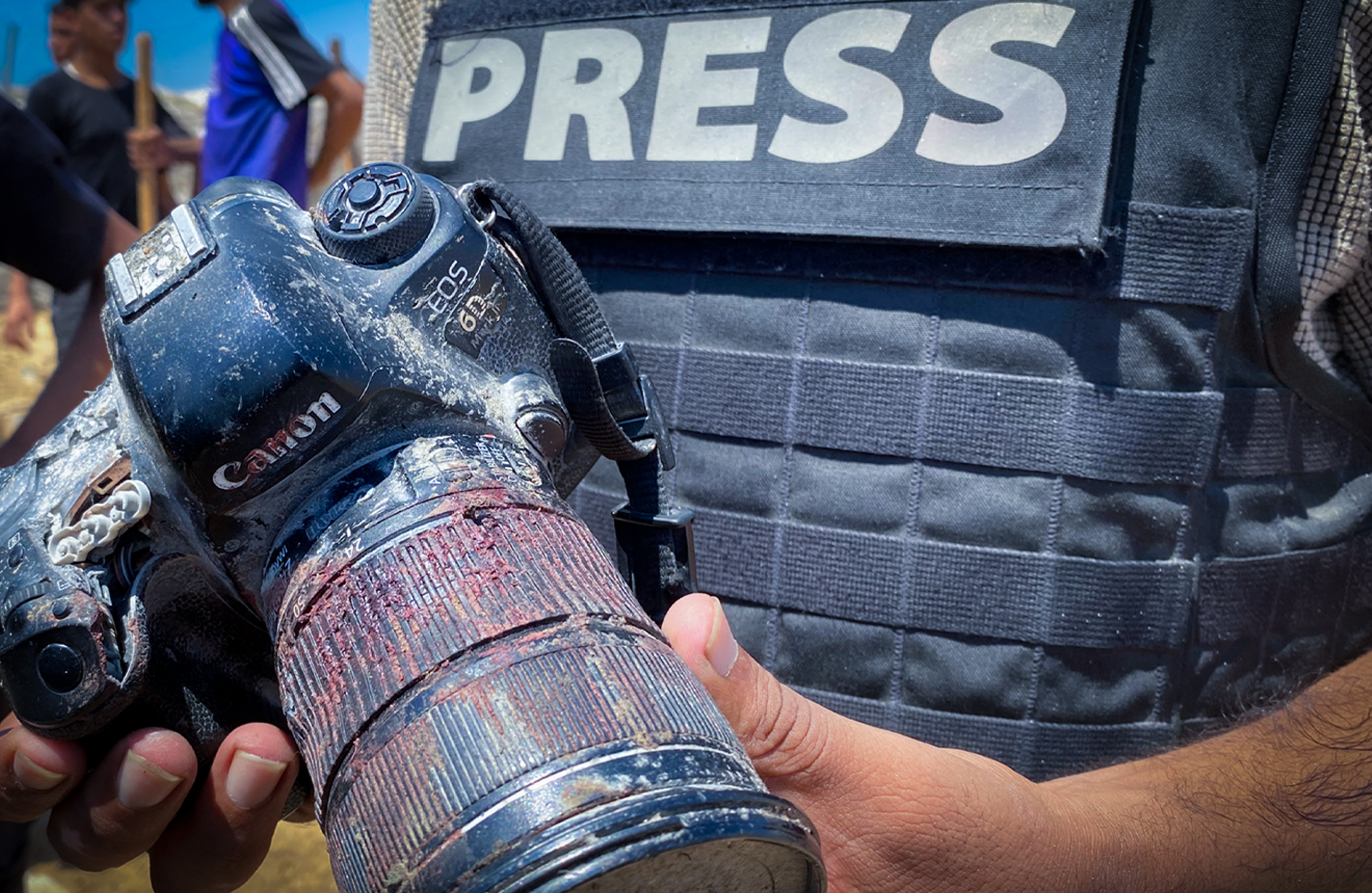
 A journalist holds the blood-covered camera belonging to Palestinian photojournalist Mariam Dagga, a journalist who freelanced for AP since the start of the war and who was killed in an Israeli strike on Nasser hospital in Khan Yunis in the southern Gaza Strip, during her funeral on 25 August 2025. Gaza's civil defence agency said five journalists, including Mariam Dagga, were among at least 20 people killed on 25 August when Israeli strikes hit Nasser hospital in the south, with Reuters, the Associated Press and Al Jazeera mourning their slain contributors. (Photo: AFP)
 In Gaza, a now-razed city in Palestine, we witness a rising genocide, and last week the United Nations declared a famine in its wake.
The war in Palestine has escalated into one of the gravest human rights issues of our time, where even those who bear witness to its atrocities, hundreds of journalists, have been killed in targeted attacks.
History shows us, from the Nazi Holocaust to the Rwandan genocide, and now in Palestine, famine often shadows genocide.
Daily Maverick will neither step away from our duty of truth in covering this war, the genocide, the famine and its tragic consequences. Nor will we baulk from covering other wars.
In Gaza, Israel’s offensive that followed the devastating 7 October 2023 Hamas attacks – killing 1,195 Israelis, mostly civilians, and the capturing of 251 hostages, some who remain captive and their families profoundly traumatised – has claimed over 62,000 lives, displaced entire communities and maimed innocent people.
And it has undoubtedly reshaped global politics and the conversation about justice, security and humanity.
There is a well-known saying that “In war, truth is the first casualty”. With a ban on independent reporting by Israel and the targeting of journalists on the ground, truth is a certain casualty.
Propaganda campaigns, disinformation and weaponised narratives run wild and leave our readers snared by rage, grief and confusion. In the maelstrom, Daily Maverick has been subjected to the most appalling abuse from some quarters, some aimed at our families.
As an editor leading a newsroom committed to truth, fairness and accountability, I am acutely aware of the responsibility we hold that comes with reporting and providing a platform for public debate, especially in such difficult and violent times.
South Africa’s Bill of Rights enshrines not only freedom of expression and freedom of the press, but also the rights to dignity, equality and life. These principles bind us as much as they guide us. Our journalism must honour these principles in both spirit and practice.
Daily Maverick’s primary responsibility is to inform, as tough as that is in Gaza with Israel’s ban on foreign journalists, and with the social media and AI age making it so easy to spread misinformation and disinformation.
We commit to our coverage of facts: documenting events as they unfold, unpacking the political and humanitarian stakes and providing reliable information to our readers. This is reporting that will build on our reputation of original, fearless journalism that asks tough questions and holds truth to power.
We will, in more muscular ways, also reflect the experiences of people living and working in Gaza – voices often silenced or reduced to numbed numbers in international reporting. Their perspectives remain central to our journalism and are essential in helping the world understand the true cost of this war.
The war in Gaza, while taking place thousands of kilometres away, is intricately linked to developments in South Africa playing out on university campuses, in courtrooms and in how the country is viewed on the international stage.
It is because of South Africa’s clear and deep solidarity with the people of Palestine and the case against Israel led by our country at the International Court of Justice that divisions have sharpened and fractures have developed in and among communities, families and friendship circles.
We have not been immune to this. Some readers and supporters have chosen implacable ideological stances at odds with our reporting.
In this climate, not all commentary adds to public understanding, and it is our duty to separate rhetoric from ideas. And we must distinguish between opinion as rhetoric and opinion that adds meaningful value to the public discourse.
Daily Maverick’s position on opinion pieces about Gaza is clear: We will run opinions that advance deeper insight, not pieces that recycle rage or inflame division.
We will neither run many pieces on the same topic, nor will we countenance a war on our pages, while ensuring we give writers a right to reply – a core element of the Press Council code of conduct that we are signatories to.
Our opinion pages, like all our journalism, must challenge thinking, sharpen debate and expand on what is possible in the pursuit of peace.
We have a triple responsibility: not shying away from covering the human rights issues of the day; hosting a thoughtful, critical and constructive exchange of ideas; and maintaining our uncompromising commitment to fact-based journalism.
In a time of heightened polarisation, propaganda and disinformation, Daily Maverick’s role is not to inflame division, but to illuminate paths towards understanding and, ultimately, peace while never compromising on the search for truth. DM
Jillian Green is Editor-in-Chief of Daily Maverick.
Read our editorial policy here