




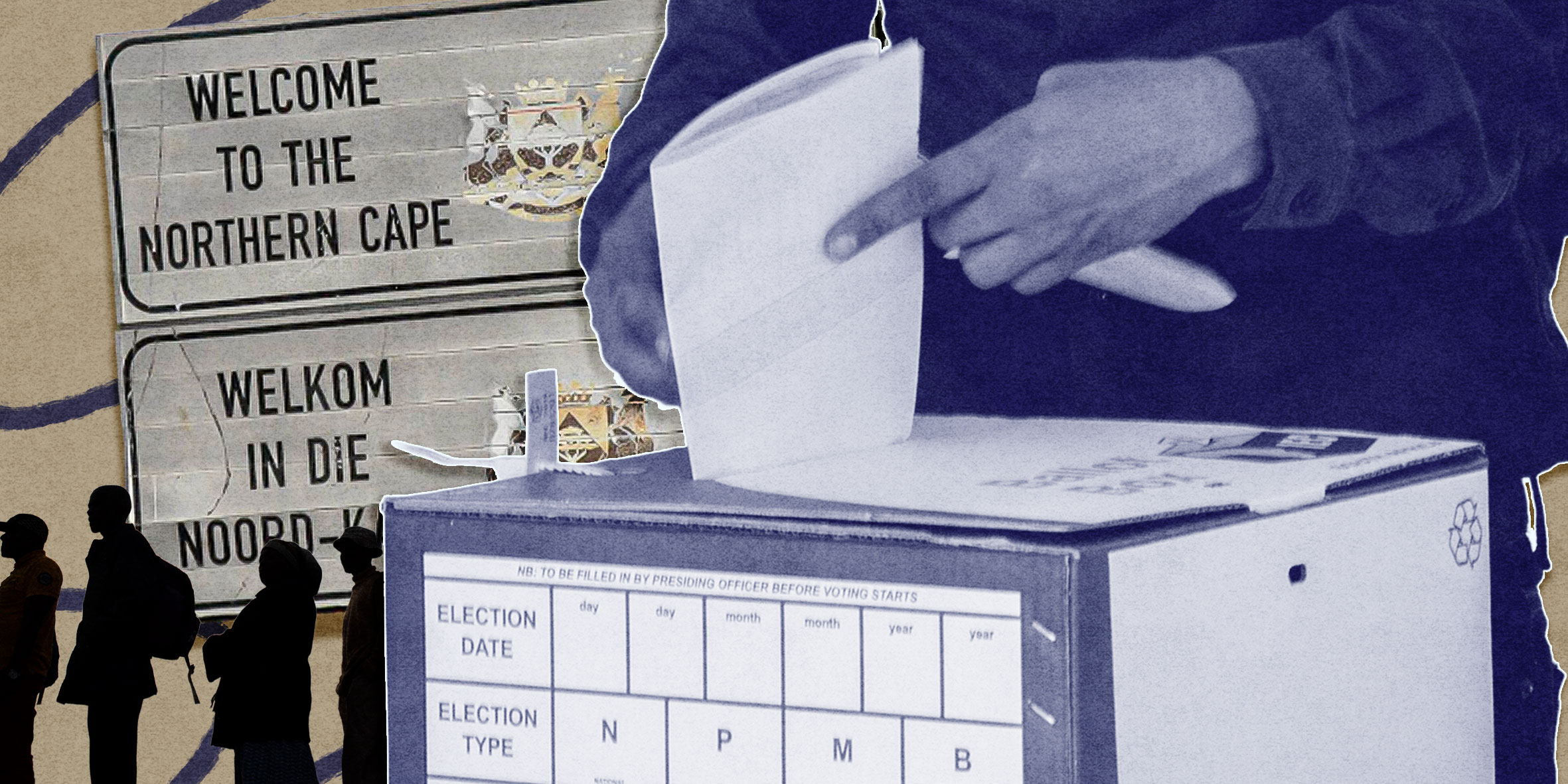
 Northern Cape road sign (Sourced: Wikimedia) | Voters wait to cast their ballots. (Photo: Gallo Images / Alet Pretorius) | Voters at the Duff’s Road voting station in KwaMashu, KwaZulu-Natal, on 8 May 2019. (Photo: Aisha Abdool Karim) | (Photo: Daily Maverick)
 Quid pro quo deals. Motions of no confidence. Governance failures. Frequent political realignments.
The political instability that has roiled Thembelihle Local Municipality, in the Northern Cape, since the formation of a coalition government in the 2021 municipal elections, resembles the dysfunction that has stagnated many coalition-run municipalities across South Africa.
Read more: How hyperlocal strategies could revitalise South Africa’s broken local municipalities
In the 11-seat council, the balance of power has not rested with the largest parties. Instead, it has resided with the Siyathemba Community Movement (SCM), a one-seat microparty that has managed to occupy the mayorship after a series of twists and turns in coalition politics.
Small political parties emerged as key players in the 2016 local government elections (LGEs), where they were confirmed as king-making local actors, Daily Maverick reported. In the 2021 elections, a confluence of voter dissatisfaction with South Africa’s main political parties, matched with the reality of no big, viable alternative, resulted in several microparties gaining representation in local councils, reinforcing their kingmaker status.
Many of these municipalities have experienced frequent turnovers and change in the four years since the local government elections. Residents are often the biggest losers, with the political instability in these coalitions making it difficult for service delivery to proceed. Johannesburg is perhaps the most clear-cut example of a council that has experienced ongoing political realignment, and where its residents pay the highest price. (Other examples are here, here and here.)
Research from the Mapungubwe Institute for Strategic Reflection (Mistra) in Johannesburg has found that the frequent political realignments in local coalitions have obfuscated accountability and responsibility.
When residents face water shortages, power cuts or collapsing infrastructure, it’s become increasingly difficult to know which party is responsible for the failures in governance.
This begs the question: How will this affect voters’ decisions in the 2026 polls? Will this pattern of microparties’ influence in local government continue, or will voters decide to punish smaller parties and return to bigger parties?
Read more: The GNU, alliances and alignments — the 2026 municipal elections will soon test them all
The rise of microparties
Mistra’s latest report, titled Mistra Coalitions Barometer II, launched earlier this month, monitors national, provincial and local government coalitions in South Africa from 2023-2025.
The report covers the Government of National Unity (GNU) and the provincial coalition governments of Gauteng, KwaZulu-Natal and the Northern Cape from mid-2024 to April-May 2025. It also provides case studies of about 70 metropolitan and local coalition governments from the second half of 2023 to February-March 2025.
Barometer II highlights that minor, micro and community parties have often become kingmakers in all three spheres of government. According to the report, small parties often used their leverage to secure major positions in local councils – aligning with the party, often either the ANC or DA – that made the best offer.
“One of the persistent coalition change factors in the period of Barometer II was the coalition motivations of the minor and community parties. Minor and micro parties often played kingmaking roles across the national, provincial and local domains. An array of these parties contested both in the LGE2021 and in the NPE2024; only a minuscule proportion gained (mostly minor) representation.
“However, the GNU formula in which five of the 10 parties represented in the GNU had won less than one percent of the national vote each in descending order, the UDM (0.5 percent), to Rise Mzansi (0.4 percent), Al Jama-ah, the PAC and GOOD (at 0.2 percent each), had further consolidated the recognition of microparty diversity and recognition of minor political voices in South Africa.
“The pattern of microparty elevation was replicated in coalition configurations locally across provinces – minor parties had no problem in asking and getting major positions as either office bearers or custodians of municipal committees and portfolios,” read the report.
“They [small parties] really have a consistent presence and influence across many – not all – but many of the coalitions that we see. They come in very useful, especially when one of the bigger parties (it is more likely the ANC than the DA, although the DA definitely is not above it) are short of just a few seats in tiny councils. It’s so often just one or two seats,” Professor Susan Booysen, head of research at Mistra, told Daily Maverick in an interview.
According to Booysen, these microparties make themselves readily available, knowing that they are being “elevated to positions of power” that they would not ordinarily assume without the coalition arrangement.
“They guarantee a majority to the bigger party leading the coalition. It’s about power,” she said.
Read more: The Kingmakers (Part One): The key parties in power plays
Read more: The Kingmakers (Part Two): The key parties in power plays
The “prime” executive positions, very often sought by microparties in coalitions include a mayorship, deputy mayorship or speaker, according to Booysen.
“The more significant of the minor parties easily get those,” she said.
“We’ve also seen some cases, even in metros recently, the ANC and EFF agreed to be powers behind the throne and push the microparties in Johannesburg or wherever, into the mayorship positions. That is another manifestation of it. We also know that control of municipal portfolios is a big reward in these negotiations.”
‘Nobody takes responsibility’
Interestingly, the Barometer II report found that there was greater stability in local councils as the “frenetic” coalition environment of 2021-2023 slowed in some parts. The report found that more than half of SA’s local coalition governments had been stable since 2023.
However, it found that this rise in stability did not translate into effective governance. Earlier this year, South Africa’s Auditor-General (AG) revealed the shocking state of our local councils in the lead-up to the 2026 polls, with only 41 out of 257 municipalities receiving a clean bill of health.
“Though coalition volatility declined, Barometer II found little improvement in service delivery or accountability, with frequent realignments further blurring responsibility,” the Barometer II report read.
Booysen said that the frequent turnovers and change in local coalitions further “obfuscate accountability”.
“There have been so many changes – sometimes not complete turnovers of coalitions, but one party leaves the coalition and others join – and it becomes very unclear as to which party is responsible for what part of poor governance or governance failures,” she said.
“It’s going to be very interesting to see how that impacts on local government elections next year.”
Read more: Five critical steps to reform local government and save our collapsing municipalities
In Thembelihle Local Municipality, the ANC won five seats, the EFF three, and the DA, FF+, and Siyathemba Community Movement (SCM) won one seat each in the 2021 local government elections. What looked at first to be a predictable ANC-led coalition quickly went pear-shaped.
Against party instruction, SCM’s lone councillor sided with the EFF to elect an EFF mayor and SCM speaker. Days later, the arrangement collapsed – only to be reinstated in 2022, and then overturned again in 2024, when the ANC and SCM cooperated in removing the EFF mayor from power.
Thembelihle is now run by an ANC-SCM coalition, with the SCM in the mayoral seat and the ANC in the position of speaker.
The Barometer II report noted that Thembelihle Local Municipality is one of the Northern Cape’s “troubled [and] poorly serviced” coalition-run municipalities. In the past, Thembelihle has failed to adequately provide basic services, including refuse collection, and water and sanitation. It received a qualified audit opinion with findings from the AG.
In May this year, the DA in Thembelihle said it would increase pressure on the municipality to repair its broken sewage truck, “to stop residential areas in Strydenburg and Hopetown from being flooded by sewage”. DA councillor in the municipality, Derick Jansen, told Daily Maverick this week that the truck was again broken and is standing idle.
“It keeps on breaking… Its licence disk is also not up to date… And that has a negative impact on service delivery when it comes to [sewage management],” said Jansen.
Eralda Viljoen, a resident of Strydenburg, told Daily Maverick that with the “poeptrok” being broken for extended periods, there is constantly raw sewage running through her backyard.
/file/dailymaverick/wp-content/uploads/2025/08/58b2e461-1366-4083-873e-be41c581dc14.jpg "Sewage flows through Strydenburg resident Eralda Viljoen’s backyard. (Photo: Supplied / Eralda Viljoen)")
/file/dailymaverick/wp-content/uploads/2025/08/8b9c901e-ccd1-494e-9150-073f3ab10508.jpg "Raw sewage runs through Auret Street in Strydenburg, Northern Cape. (Photo: Supplied / Eralda Viljoen)")
“Nobody takes responsibility,” she said, adding that she did not exactly know which party to blame for the governance failures. “We need to pay and pay and pay, but we get broken service delivery [because] there’s permanently something wrong.”
She said that the political instability in the municipality had affected her trust in the council leadership. “The [mayor] is null and void. He’s never anywhere,” said Viljoen.
Jansen and FF+ councillor in Thembelihle, Paul van Niekerk, echoed Viljoen’s remarks, with Van Niekerk saying that “the majority of the council is fighting [with] each other and they do not do… what they’ve been elected to in council”.
Read more: Thirty years after democracy, fed-up Northern Cape residents thirst for more
The mayor of Thembelihle Municipality, Marnus Visser, didn’t respond directly to Daily Maverick’s questions and claimed they were part of a smear campaign. He said that “the allegations being pushed are entirely false and misleading”.
Thembelihle Municipality did not respond to Daily Maverick’s queries.
Looking ahead to 2026
“When voters have to make a choice to decide which party to vote for, where does accountability start, [and] where does it end?” asked Booysen, in a conversation with Daily Maverick.
“In Johannesburg, when did the decay start? Was it in a DA term, was it before that, was it after that? Voters are going to find it very difficult to draw that line.”
Read more: Joburg is too big to fail. It’s time to give it back to its people
Making things even more complicated is the mudslinging which happens among parties, and which is likely only to get worse as the polls draw near, according to Booysen.
Earlier this year, the DA’s George Michalakis introduced the Local Government: Municipal Structures Second Amendment Bill in Parliament. The Bill is only at the first stages in the executive law-making process, but aims to introduce a minimum vote threshold (seat quota +1) that parties must reach before they are entitled to be considered for a council seat.
“This will ensure that smaller parties, who do not enjoy the confidence of the voters, are not let into council through ‘the back door’ by way of the second-round highest surplus calculations,” read the Bill.
According to the Bill, coalitions at local level often require many parties – sometimes 10 or more, most of whom hold just a single seat – to form a majority. Often, some of these parties obtain a seat without the requisite votes needed for such a seat, but through surplus vote calculations.
“The effect of this is that opposition parties continuously lobby these smaller parties to retract from coalitions in exchange for positions or favour. These ‘one-person’ parties who obtain a fraction of the votes required for a seat, now become ‘king makers’, which can destabilise entire governments, which, in turn, affects service delivery to the very people who voted these parties in,” the Bill continued.
Parliamentary processes for dealing with Bills can be quite lengthy, which will make timelines for passing the Bill ahead of the local government elections tight, according to a Business Day report. This Bill is also likely to be contested quite a bit, said Booysen.
“It will be fascinating to see whether the local parties continue to have this huge presence in local elections, or whether it is rubbing off that small parties can obfuscate your voting choices,” said Booysen.
“We’ve seen a few of the small parties – microparties – disappear in the course of this four-year term to date. But given that the big political parties are still shedding votes and that, in many cases, there isn’t an obvious alternative party to vote for, in that political context, small parties do retain a lot of currency.” DM